AI-Generated Video Summary by NoteTube
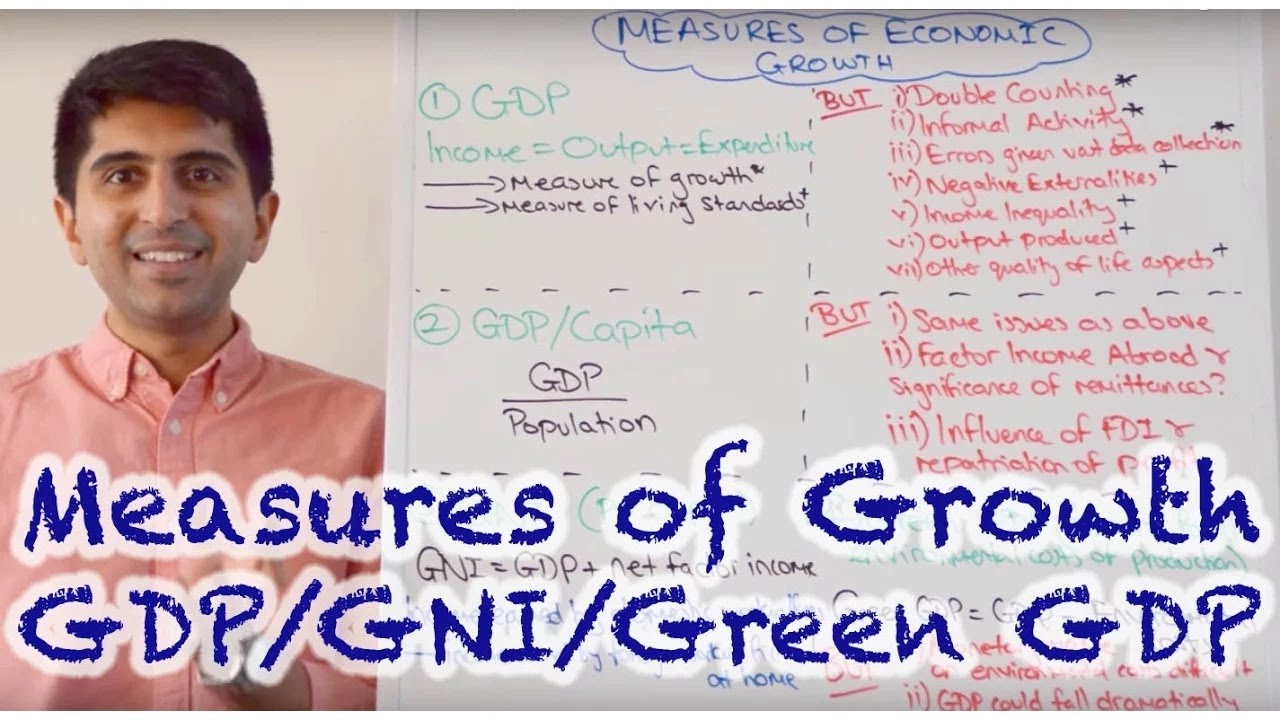
Y1 16) Measures of Economic Growth & Living Standards - GDP, GDP/Capita, GNI, Green GDP
EconplusDal
Overview
This video explores various measures of national income and economic growth, highlighting their importance for governments, economists, and businesses. It begins by defining GDP (Gross Domestic Product) as the primary measure of economic output and a proxy for living standards. However, the video critically examines the limitations of GDP, including the risk of double-counting, exclusion of informal economic activity, potential for errors in data collection, and its failure to account for negative externalities like pollution, income inequality, and non-monetary quality of life factors. It then introduces GDP per capita as an average measure of individual income but notes it shares many of GDP's flaws. The discussion moves to GNI (Gross National Income) and GNI per capita, which address issues related to remittances and foreign direct investment (FDI) more effectively than GDP. Finally, the concept of Green GDP is introduced as an attempt to incorporate environmental costs into economic measurement, though its practical implementation faces significant challenges due to valuation difficulties and political sensitivity.
Want AI Chat, Flashcards & Quizzes from this video?
Sign Up FreeChapters
- •National income statistics serve as a 'report card' for governments to assess economic performance.
- •They help evaluate the success of past policies and inform future economic strategies.
- •These statistics aid in forecasting demand and economic growth for businesses and economists.
- •They are crucial for measuring and tracking improvements in living standards over time.
- •National income data allows for international comparisons of economic performance.
- •GDP is the most commonly used measure of national income and economic growth.
- •Definition: The value of all final goods and services produced in an economy within a year.
- •Can be calculated using the income, output, or expenditure methods.
- •Benefits include measuring growth and providing an indication of living standards.
- •Real GDP adjusts for inflation, providing a more accurate measure of growth.
- •Risk of double-counting, especially when using the output method without careful consideration of final goods.
- •Exclusion of informal and illegal economic activities (black market, unregistered businesses, DIY work).
- •Potential for significant errors in data collection due to the complexity and volume of information required.
- •Ignores the quality of output and negative externalities (pollution, resource depletion, biodiversity loss).
- •Does not account for income inequality, the type of goods produced (e.g., capital vs. consumer goods), or non-monetary quality of life factors (health, education, freedom).
- •Calculated as Real GDP divided by the total population.
- •Provides an average measure of individual incomes in an economy.
- •Addresses the issue of population growth potentially outpacing GDP growth, making individuals worse off.
- •Suffers from the same fundamental limitations as GDP regarding externalities, inequality, and quality of life.
- •GNI is defined as the total income generated by a country's factors of production, regardless of location.
- •Calculated as GDP plus net factor income (income earned by domestic factors abroad minus income earned by foreign factors domestically).
- •Effectively includes remittances (income sent back by citizens working abroad).
- •Does not include income generated by Foreign Direct Investment (FDI) that is repatriated.
- •Considered a better measure of living standards than GDP, especially in developing countries reliant on remittances.
- •An attempt to measure economic growth that accounts for the environmental costs of production.
- •Calculated as GDP minus the environmental costs (e.g., pollution, resource depletion).
- •Aims to provide a truer reflection of living standards by including negative externalities.
- •Major challenges include the difficulty and subjectivity of placing monetary values on environmental costs.
- •Can be politically sensitive, as seen with China's attempt to use it, leading to significant reductions in reported GDP and potentially lower perceived living standards.
Key Takeaways
- 1GDP is a widely used but imperfect measure of economic growth and living standards.
- 2Key limitations of GDP include ignoring informal economies, externalities, and income distribution.
- 3GDP per capita offers an average income perspective but shares GDP's core flaws.
- 4GNI is a superior measure for economies significantly influenced by remittances and foreign investment repatriation.
- 5Green GDP attempts to incorporate environmental costs, offering a more holistic view of sustainability.
- 6Valuing environmental costs and political sensitivity pose significant hurdles for Green GDP implementation.
- 7No single measure perfectly captures economic well-being; a combination of indicators (like HDI alongside GDP/GNI) provides a more comprehensive understanding.