1:10:37
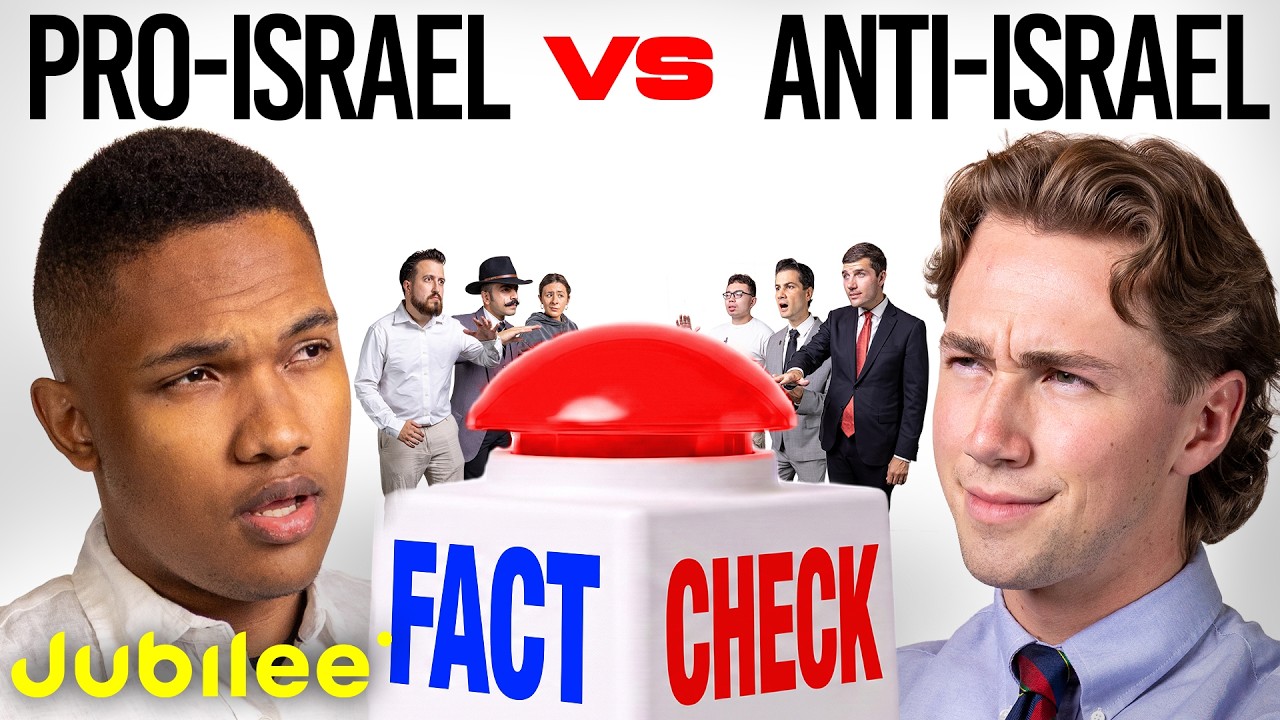
Pro-Israel vs Anti-Israel Republicans Fact-Checked Live | Checkmate
Jubilee
Overview
This video presents a debate between pro-Israel and anti-Israel conservatives, framed as a fact-checking game called 'Checkmate.' Two teams, one supporting Israel and the other opposing it, engage in a series of prompts where they make claims that the opposing team can fact-check. The discussion covers whether supporting Israel aligns with 'America First' principles, the nature of the US-Israel relationship, and the controversial question of whether Israel has committed genocide in Gaza. The debate highlights differing interpretations of historical events, international law, and political rhetoric, with fact-checking serving as the mechanism to adjudicate the claims made.
How was this?
Save this permanently with flashcards, quizzes, and AI chat
Chapters
- The show 'Checkmate' uses a fact-checking game format to resolve debates.
- Two teams, pro-Israel and anti-Israel conservatives, compete.
- The first prompt asks if supporting Israel puts America first.
- The game involves pressing a button to fact-check opponent's claims, with points awarded for correct checks.
This chapter sets the stage for the debate by explaining the game's rules and introducing the central conflict: the alignment of support for Israel with American interests.
The prompt 'Does supporting Israel put America first?' is presented as the first challenge.
- One argument is that Israel's actions, like escalating tensions with Hezbollah, undermine US diplomatic objectives with Iran, thus not being 'America First'.
- Counterarguments suggest Israel's actions are responses to aggression and that its R&D contributions are beneficial to the US.
- The financial aid (MOU/FMF) to Israel is discussed, specifically how funds are used for domestic production vs. US arms purchases.
- A fact-check confirms that approximately $500 million annually from US aid goes to Israel's missile defense systems.
This section explores the complex economic and foreign policy dimensions of the US-Israel relationship, questioning whether the alliance serves American interests or creates conflicts.
The fact-check regarding $500 million of US aid going to Israel's missile defense systems under the MOU.
- A claim that the US began financial aid to Israel in 1948 is fact-checked and found false; aid began in 1949.
- Arguments are made that Israel is a liability due to international unpopularity, particularly concerning actions in Gaza and Lebanon.
- The claim that Mossad provided intelligence on WMDs for the Iraq War is fact-checked as true, though the intelligence was later found to be inaccurate or incomplete.
- The idea that Germany's significant arms exports to Israel are due to a domestic aid program is fact-checked as false; it's driven by foreign policy and historical ties.
This chapter delves into the historical narrative of US-Israel relations and the perceived benefits and detriments of the alliance, using specific historical events and intelligence claims as points of contention.
The fact-check that US economic aid to Israel began in 1949, not 1948.
- The debate shifts to whether Israel has committed genocide in Gaza.
- One perspective argues that intent is crucial and that Israel's actions, like issuing warnings, negate genocidal intent.
- Counterarguments focus on statements by Israeli officials that are perceived as genocidal and the high civilian death toll.
- A fact-check disputes the claim that the current Hamas charter explicitly calls for the elimination of all Jewish people worldwide.
This section tackles the highly contentious issue of genocide, exploring the legal definition, the role of intent versus actions, and the interpretation of specific statements and casualty figures.
The fact-check that the current Hamas charter does not explicitly call for the elimination of all Jewish people worldwide.
- The legal definition of genocide is clarified: 'systematic destruction' rather than 'systematic elimination' of a people.
- The discussion highlights that there is no fixed percentage of a group that must be killed for an act to be considered genocide.
- Arguments are made that actions like destroying an IVF clinic could be seen as preventing reproduction, a potential element of genocide.
- The invocation of biblical narratives, like the story of Amalek, by Israeli officials is debated as evidence of genocidal intent.
This chapter scrutinizes the precise legal and ethical definitions surrounding genocide, emphasizing the importance of intent and the specific acts that constitute the crime, moving beyond broad accusations.
The fact-check confirming that there is no fixed percentage of a group that must be killed to legally qualify as genocide.
- The high death toll of children in Gaza is presented as evidence, though sources and exact numbers are disputed.
- The argument is made that Hamas uses civilian areas and infrastructure for military purposes, complicating civilian casualty figures.
- The destruction of buildings in Gaza is discussed, with a fact-check disputing the claim that 90% of structures are damaged or destroyed.
- The distinction between war, ethnic cleansing, and genocide is explored, with displacement being categorized more closely with ethnic cleansing.
This section examines the practical realities of warfare in Gaza, including casualty data, the use of civilian infrastructure, and the physical destruction, to assess whether these actions meet the threshold for genocide.
The fact-check stating that approximately 69-70% of structures in Gaza have been damaged or destroyed, not 90% as claimed.
- The prompt questions whether conservatives are becoming more anti-semitic, with a distinction made between mainstream and extremist conservatives.
- The role of non-interventionist stances, such as those attributed to Megan Kelly, is debated in relation to conservative identity.
- A fact-check confirms Megan Kelly has stated she is anti-interventionist.
- The rise of anti-Jewish posts on social media, particularly after October 7th, is discussed, with debate over whether criticism of Israel equates to anti-semitism.
This final chapter addresses the evolving landscape of conservatism, particularly concerning anti-semitism and the influence of media figures and social media on political discourse.
The fact-check confirming that Megan Kelly has explicitly stated she is anti-interventionist.
Key takeaways
- Distinguishing between criticism of Israeli policy and anti-semitism is crucial for productive political discourse.
- The definition of genocide is a specific legal term requiring proof of intent to destroy a protected group, not just mass casualties or displacement.
- The 'America First' principle is interpreted differently, with some arguing that supporting Israel conflicts with US interests, while others see it as a strategic alliance.
- Historical context and accurate data are essential for evaluating claims about foreign aid, military actions, and international relations.
- Social media plays a significant role in amplifying both political discourse and potentially harmful rhetoric, making fact-checking vital.
- The nature of modern warfare, particularly in densely populated areas, raises complex ethical and legal questions regarding civilian casualties and intent.
- Defining conservative identity involves ongoing debate about core values, such as foreign policy stances and social issues.
Key terms
America FirstGenocideIntent (in genocide)MOU (Memorandum of Understanding)FMF (Foreign Military Financing)MossadHezbollahAmalekAnti-semitismInterventionismGeopolitical RealismEthnic Cleansing
Test your understanding
- How do the participants in the debate define 'America First,' and how do their definitions lead to different conclusions about supporting Israel?
- What are the key legal elements required to prove genocide, and how do the participants apply these elements to the situation in Gaza?
- Explain the difference between criticism of Israeli policy and anti-semitism as discussed in the video.
- What role does historical context, such as the start date of US aid to Israel or past intelligence sharing, play in the arguments presented?
- How does the debate address the potential for media platforms and social media to influence perceptions of anti-semitism and foreign policy?