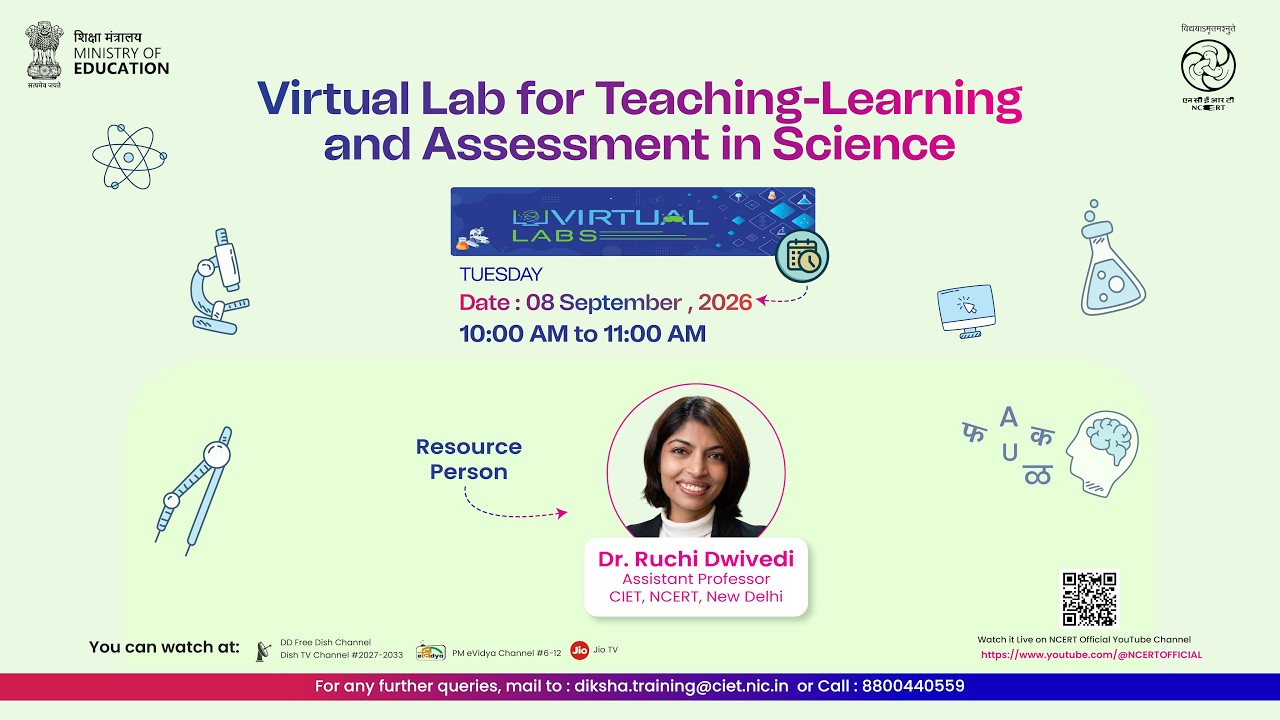
Virtual Lab for Teaching-Learning and Assessment in Science
NCERT OFFICIAL
Overview
This video introduces the concept and benefits of virtual labs for science education, emphasizing their role in teaching, learning, and assessment. It highlights how virtual labs align with the National Education Policy (NEP) 2020 and the National Curriculum Framework for School Education (NCFSE) 2023 by promoting experiential and active learning. The session explains the accessibility of virtual labs through platforms like Diksha, addresses the importance of the teacher's role in guiding students through these digital tools, and contrasts their advantages with the continued relevance of physical labs, especially in the context of Indian schools. Ultimately, virtual labs are presented as a complementary tool to enhance scientific temper and practical understanding.
Save this permanently with flashcards, quizzes, and AI chat
Chapters
- Virtual labs offer a revolutionary approach to science education, complementing traditional physical labs.
- They facilitate understanding of experimentation for learners of all ages.
- Virtual labs are crucial for addressing the limitations of physical lab access in many Indian schools.
- The session will cover the significance of virtual labs in the Indian school system, demonstration, and the teacher's role.
- Virtual labs can be accessed through the Diksha platform, available as a mobile app and a desktop website.
- The Diksha platform provides a centralized repository for e-resources, including virtual labs.
- Accessibility is designed for various devices and operating systems (Android, iOS).
- Virtual labs move beyond passive observation (videos, auditory) to active, hands-on learning, fostering a scientific temper.
- They support experiential learning and learning by doing, key tenets of NEP 2020.
- Technology in education should complement and supplement, not substitute, teachers and existing resources.
- Virtual labs are integrated into the curriculum process to directly impact learning, not just for enrichment.
- Teachers are crucial for guided learning and instructional design within virtual labs, preventing misconceptions.
- Teachers help students navigate different learning stages (prep, middle, formal science) and address complex questions beyond just the final answer.
- The teacher's role is to facilitate methodological analysis, understand procedural nuances, and interpret unexpected results.
- Virtual labs do not replace teachers; they enhance the teacher's ability to guide and assess.
- Statistical data shows a significant lack of designated laboratories in many Indian government schools, making virtual labs essential.
- Virtual labs offer a cost-effective solution where physical resources like chemicals and apparatus are scarce or expensive.
- They overcome limitations of physical labs, such as consumable reagents, fragile or costly equipment, and managing large class sizes for practicals.
- Safety concerns in physical labs, especially with hazardous materials or environments, are mitigated by virtual simulations.
- Virtual labs provide interactive simulations accessible on any device, allowing equal opportunity for all students.
- They promote active learning and develop scientific temper through experimentation.
- Key benefits include enhanced safety, unlimited repetition for practice, and the ability to explore 'what if' scenarios with reagents and samples.
- Immediate feedback, including explanations for correct and incorrect answers, supports self-evaluation and deeper understanding.
- Teachers can use virtual labs for pre-briefing students before physical experiments, providing theoretical understanding and procedural guidance.
- During classroom sessions, virtual labs can be used for hands-on practice, allowing students to learn at their own pace and clear doubts without fear of failure.
- Virtual labs are valuable tools for formative assessment, providing instant feedback and explanations.
- They align with NEP 2020's goal of moving away from rote memorization towards experiential learning and understanding.
Key takeaways
- Virtual labs are a revolutionary tool that enhances science education by providing accessible, hands-on experimental learning opportunities.
- They are crucial for bridging the gap in physical lab infrastructure, especially in diverse educational settings like India.
- The Diksha platform serves as a primary gateway for accessing a wide range of virtual lab resources.
- Teachers remain central to the learning process, guiding students, facilitating understanding, and addressing complex scientific inquiries through virtual tools.
- Virtual labs promote active learning, scientific temper, and a deeper understanding of concepts by allowing safe, repeatable experimentation and immediate feedback.
- These digital tools are designed to complement, not replace, physical labs, offering unique advantages in safety, cost-effectiveness, and accessibility.
- Effective integration of virtual labs can transform teaching methodologies, moving from rote learning to experiential and inquiry-based science education.
Key terms
Test your understanding
- How do virtual labs contribute to developing a scientific temper in students compared to passive learning methods?
- What are the primary ways students and teachers can access virtual lab resources, and what platform is highlighted for this purpose?
- Explain the role of a teacher when students are using virtual labs for experimentation.
- What are the key advantages of virtual labs over physical labs, particularly in the context of Indian schools?
- How can virtual labs be utilized for formative assessment, and what kind of feedback do they provide?