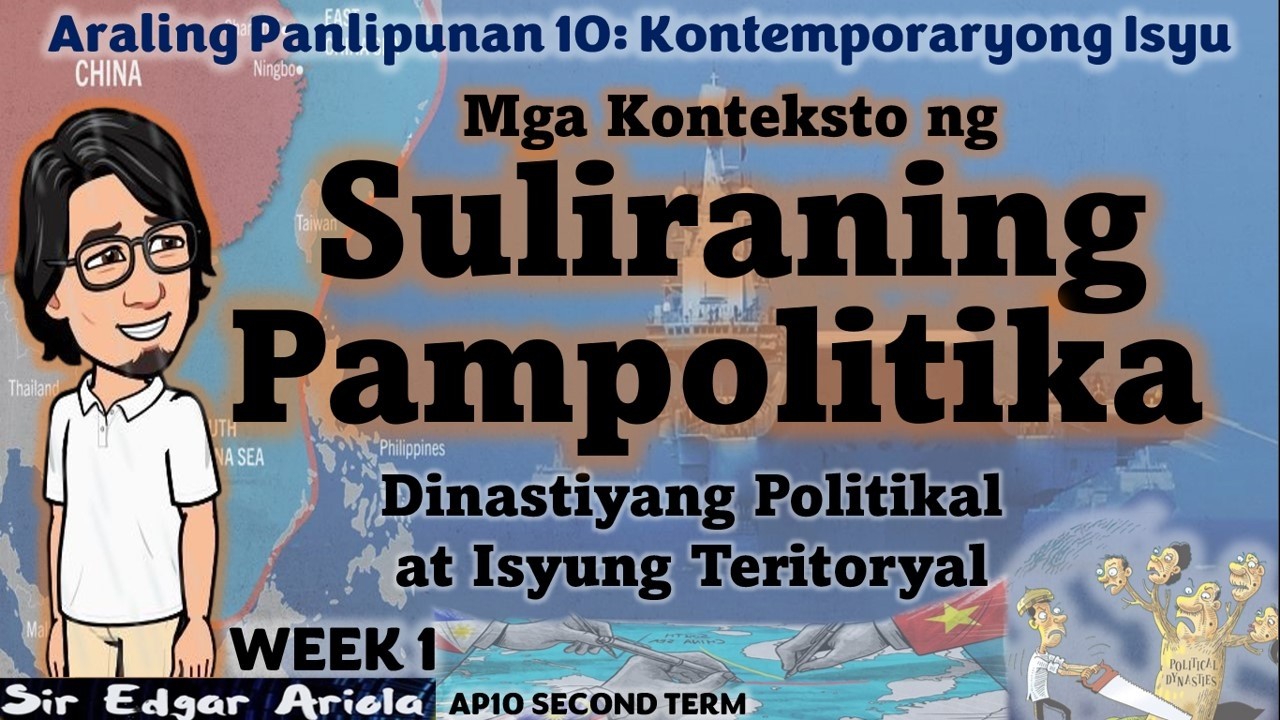
Mga Konteksto ng Suliraning Pampolitika Week 1 AP 10 SECOND TERM Revised K-10 #AP10 #trimester
Sir Edgar Ariola
Overview
This video explores two major political issues in the Philippines: political dynasties and territorial disputes. It defines political dynasties as a system where power is concentrated within a few families, detailing their characteristics, the reasons for their persistence, and their impact on competition. The video also addresses territorial issues, specifically focusing on the West Philippine Sea and the Spratly Islands. It explains the nature of territorial disputes, the claims of various countries, the significance of these areas due to natural resources and trade routes, and the effects of these conflicts on the Philippines' economy, environment, and international relations. Finally, it outlines the Philippines' strategies for asserting its territorial integrity.
Save this permanently with flashcards, quizzes, and AI chat
Chapters
- Political issues are problems related to governance, policies, and public affairs, including corruption, poverty, political dynasties, and territorial disputes.
- Political dynasties are systems where governmental power is held by a few families over extended periods, with members succeeding each other in elected positions.
- Key characteristics of political dynasties include monopolization of power, hereditary succession, the use of wealth and influence to maintain control, and reduced opportunities for other aspiring leaders.
- The persistence of political dynasties is attributed to historical ties, existing power and influence networks, strategic alliances, public perception management (myth-making), public dependency on these families for economic support, historical legacy, and the current legal framework that allows their continuation.
- Territorial disputes involve conflicts between nations over the claim of a specific area or territory, while border conflicts specifically concern disagreements over national boundaries.
- The West Philippine Sea (WPS) and Spratly Islands are key areas of dispute, with multiple Asian countries, including China, Vietnam, Malaysia, and Brunei, claiming parts of these territories.
- The Spratly Islands are significant due to potential oil reserves and their role in global shipping lanes, while the WPS is within the Philippines' Exclusive Economic Zone (EEZ) as defined by UNCLOS, rich in resources like fish and oil, and vital for trade routes.
- Specific areas within the Philippine EEZ, such as Pag-asa Island, Scarborough Shoal (Baho de Masinlok), Kalayaan Group of Islands, and Ayungin Shoal, are subject to claims and incursions, with China having built structures in these areas.
- The primary causes of territorial conflicts include competing historical claims, the rich natural resources (fish, oil, gas) in disputed areas, and the geopolitical importance of these regions for global trade and security.
- The effects of these conflicts include strained international relations, diplomatic protests, potential economic sanctions, negative impacts on local fishing and tourism industries, and environmental damage to marine ecosystems like coral reefs.
- The Philippines is strengthening alliances with countries like the United States, Japan, and Australia through security agreements, military aid, and joint exercises to bolster its position.
- The Philippines has pursued legal avenues, such as presenting its case to the Permanent Court of Arbitration (PCA) based on UNCLOS, to assert its rights and has reinforced its national security by establishing facilities and increasing patrols in its controlled areas.
Key takeaways
- Political power can become concentrated within families, limiting broader participation and potentially leading to governance issues.
- The persistence of political dynasties is a complex issue influenced by historical factors, socio-economic conditions, and legal frameworks.
- Territorial disputes are driven by overlapping claims, valuable natural resources, and strategic geopolitical importance.
- Conflicts over territory can have significant negative consequences on international relations, local economies, and the environment.
- Nations employ a combination of diplomacy, legal action, and strategic alliances to assert and protect their territorial claims.
- International law, such as UNCLOS, provides a framework for resolving maritime disputes, though enforcement and recognition can be challenging.
- The West Philippine Sea is a critical area for the Philippines due to its economic resources and strategic location, making its protection a national priority.
Key terms
Test your understanding
- What are the defining characteristics of a political dynasty, and how do they differ from a merit-based political system?
- Why are the West Philippine Sea and Spratly Islands considered areas of significant territorial dispute?
- How do historical factors and public dependency contribute to the perpetuation of political dynasties in the Philippines?
- What are the primary economic and environmental consequences of territorial conflicts in maritime regions like the West Philippine Sea?
- How has the Philippines utilized international law and diplomacy to assert its claims in the West Philippine Sea?