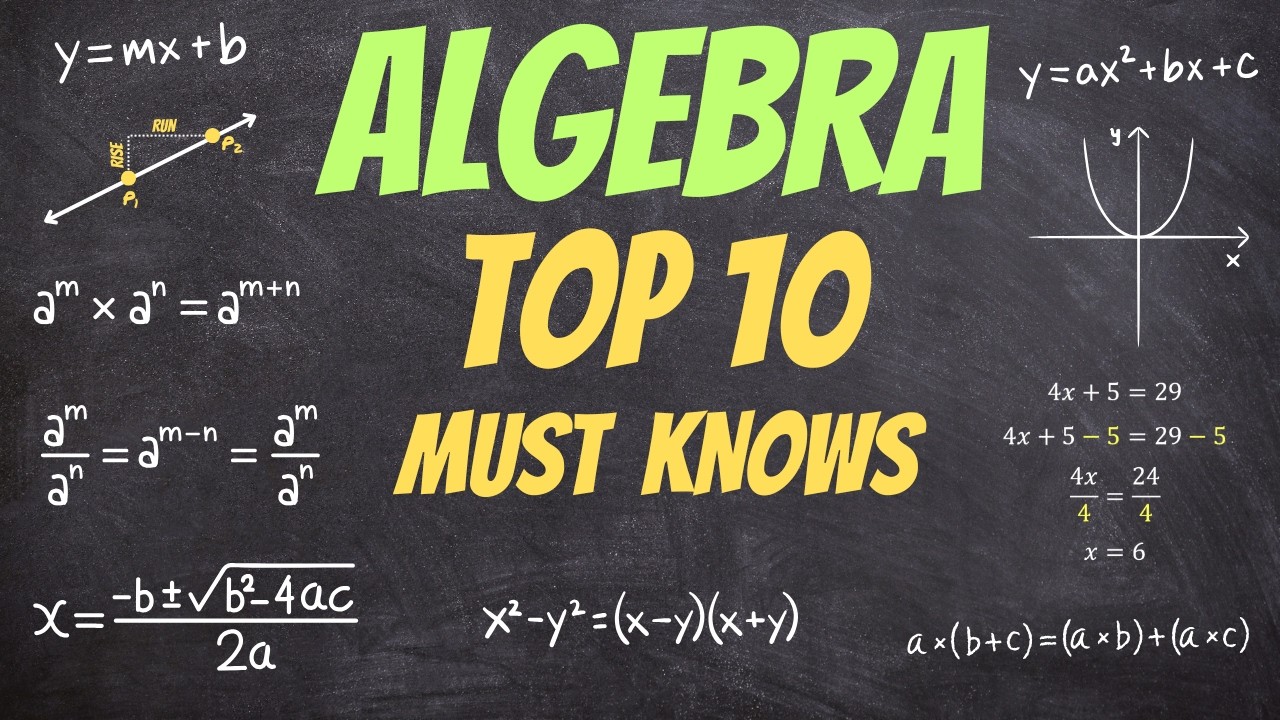
All of ALGEBRA in under 1 hour (ultimate study guide)
JensenMath
Overview
This video provides a comprehensive study guide to essential algebra concepts, covering ten key topics in under an hour. It begins with simplifying expressions using like terms and the distributive property, then moves to solving linear equations and inequalities. The guide further explains functions, graphing linear functions using slope-intercept form, and solving systems of equations through graphing, substitution, and elimination. It also delves into the rules of exponents, multiplying and factoring polynomials, and finally, understanding and solving quadratic functions and equations using factoring and the quadratic formula. The aim is to equip learners with a solid foundation in fundamental algebra.
Save this permanently with flashcards, quizzes, and AI chat
Chapters
- Terms are numbers, variables, or products of numbers and variables.
- An algebraic expression is a combination of terms connected by operations.
- Like terms have the exact same variables with the exact same exponents.
- To simplify, collect like terms by adding or subtracting their coefficients; the variable part remains unchanged.
- The distributive property states that a(x + y) = ax + ay, meaning the term outside the parentheses multiplies each term inside.
- Solving an equation means finding the variable's value that makes the equation true.
- The balance method is used to isolate the variable by applying the same inverse operations to both sides of the equation.
- Follow the reverse order of operations (addition/subtraction before multiplication/division) when using inverse operations.
- To solve equations with variables on both sides, gather variable terms on one side and constant terms on the other.
- Inequalities compare two quantities using symbols like >, <, ≥, or ≤.
- Solving inequalities involves isolating the variable, similar to equations.
- A key rule: if you multiply or divide both sides by a negative number, you must reverse the inequality sign.
- Solutions to inequalities are ranges of values, often represented on a number line or in interval notation.
- A function is a relationship where each input has exactly one output.
- Function notation, like f(x), replaces 'y' and represents the output of a function for a given input 'x'.
- f(2) = 9 means that when the input is 2, the output of function 'f' is 9.
- The vertical line test can determine if a graph represents a function; any vertical line should intersect the graph at most once.
- Linear functions graph as straight lines.
- The slope-intercept form is y = mx + b.
- 'm' represents the slope (rise over run), indicating the line's steepness and direction.
- 'b' represents the y-intercept, the point where the line crosses the y-axis.
- A system of equations involves two or more equations with the same variables.
- The solution is the set of variable values that satisfy all equations simultaneously.
- Methods to solve include graphing (finding the intersection point), substitution (replacing a variable with an equivalent expression), and elimination (adding/subtracting equations to cancel a variable).
- A power (like a^m) represents repeated multiplication of a base ('a') by itself 'm' times (the exponent).
- Product Rule: a^m * a^n = a^(m+n) (when multiplying powers with the same base, add exponents).
- Quotient Rule: a^m / a^n = a^(m-n) (when dividing powers with the same base, subtract exponents).
- Power of a Power Rule: (a^m)^n = a^(m*n) (when raising a power to another exponent, multiply exponents).
- Multiplying polynomials requires distributing every term in one polynomial to every term in the other.
- For binomials (two-term polynomials), the FOIL method (First, Outer, Inner, Last) can be used.
- Factoring is the reverse process of multiplication, breaking down a polynomial into simpler factors.
- Common factoring involves dividing out the greatest common factor (GCF) from all terms.
- Quadratic trinomials (ax² + bx + c) can be factored by finding two numbers that multiply to 'ac' and add to 'b' (if a=1) or by grouping (if a≠1).
- Quadratic functions have a highest exponent of two (x²) and graph as parabolas (U-shaped curves).
- The vertex is the minimum or maximum point of the parabola.
- The x-intercepts are the points where the parabola crosses the x-axis (where y=0).
- Quadratic equations can be solved by factoring or using the quadratic formula: x = [-b ± sqrt(b² - 4ac)] / 2a.
Key takeaways
- Algebraic expressions can be simplified by combining like terms and applying the distributive property.
- Solving linear equations and inequalities relies on isolating the variable using inverse operations, with a special rule for inequalities involving negative multipliers/divisors.
- Functions establish a precise relationship between inputs and outputs, crucial for modeling dependencies.
- Graphing linear functions involves understanding slope (rate of change) and y-intercept (starting point).
- Systems of equations allow us to find solutions that satisfy multiple conditions simultaneously.
- Exponent rules provide efficient ways to manipulate expressions with repeated multiplication.
- Factoring polynomials is the inverse of multiplication and is key to solving quadratic equations.
- Quadratic equations, characterized by an x² term, can be solved using factoring or the quadratic formula to find their roots (x-intercepts).
Key terms
Test your understanding
- How do you identify and combine like terms in an algebraic expression?
- What is the process for solving a linear equation, and why is it called the 'balance method'?
- Explain the difference between solving a linear equation and solving a linear inequality, particularly when dealing with negative numbers.
- What defines a function, and how does function notation f(x) communicate input and output values?
- How can you use the slope and y-intercept to graph a linear function?
- Describe the substitution and elimination methods for solving systems of linear equations.
- What are the three main rules for manipulating exponents, and how do they simplify calculations?
- How does factoring a polynomial differ from multiplying polynomials, and what is the goal of each process?
- What are the key components of a quadratic function's graph (parabola, vertex, x-intercepts), and how can you find the x-intercepts?