AI-Generated Video Summary by NoteTube
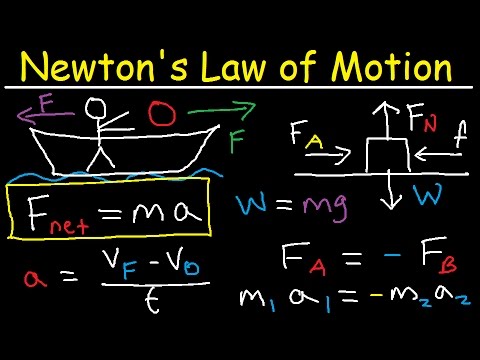
Newton's Law of Motion - First, Second & Third - Physics
The Organic Chemistry Tutor
Overview
This video explains Newton's three laws of motion. Newton's First Law, also known as the law of inertia, states that an object at rest stays at rest, and an object in motion stays in motion with the same speed and in the same direction unless acted upon by an unbalanced force. The video illustrates this with examples of a stationary box and objects moving on surfaces with varying friction, like a carpet versus ice, and in outer space. Newton's Second Law is presented as F=ma, explaining the relationship between net force, mass, and acceleration. It also introduces momentum (p=mv) and the impulse-momentum theorem. Finally, Newton's Third Law, the action-reaction law, is detailed, stating that for every action, there is an equal and opposite reaction, demonstrated through scenarios like throwing a ball, a person jumping, and celestial bodies interacting.
Want AI Chat, Flashcards & Quizzes from this video?
Sign Up FreeChapters
- •An object at rest remains at rest unless acted upon by an unbalanced force.
- •An object in motion continues in motion with constant velocity unless acted upon by an unbalanced force.
- •Balanced forces result in no change in motion (net force is zero).
- •Friction and air resistance are examples of forces that can cause an object in motion to slow down or stop.
- •The net force acting on an object is equal to its mass times its acceleration (F=ma).
- •Net force is directly proportional to acceleration and mass.
- •Acceleration is inversely proportional to mass when force is constant.
- •Momentum (p) is the product of mass and velocity (p=mv).
- •Net force equals the rate of change of momentum (F = Δp/Δt).
- •For every action, there is an equal and opposite reaction.
- •Forces always occur in pairs.
- •The action and reaction forces are equal in magnitude but opposite in direction.
- •The effect of these forces on objects depends on their respective masses (less mass = greater acceleration).
- •If an object moves with constant velocity, the net force acting on it is zero.
- •Zero net force implies zero acceleration.
- •In the absence of acceleration, applied force must equal opposing forces (like friction).
- •Calculate acceleration using F=ma when net force and mass are known.
- •Use kinematic equations (e.g., v_f = v_i + at, d = v_i*t + 0.5*a*t^2) to find final speed, time, or distance.
- •Determine net force by subtracting opposing forces (applied force minus friction).
- •Calculate the force exerted on one object using F=ma.
- •The reaction force on the other object is equal in magnitude and opposite in direction.
- •Calculate the acceleration of the second object using F=ma, noting the force is the same but the mass differs.
- •The object with less mass experiences a greater acceleration.
Key Takeaways
- 1Newton's First Law explains inertia: objects resist changes in their state of motion.
- 2An unbalanced net force is required to change an object's velocity (accelerate it).
- 3Newton's Second Law (F=ma) quantifies the relationship between force, mass, and acceleration.
- 4Momentum is a measure of an object's mass in motion.
- 5Newton's Third Law highlights that forces are interactions between two objects, always occurring in equal and opposite pairs.
- 6Understanding these laws is crucial for analyzing motion and forces in various physical scenarios.
- 7In the absence of net force, velocity remains constant (which includes being at rest).
- 8The direction of forces and accelerations is critical and must be considered in calculations.