51:05
Direction Sense Test - Tricks & Shortcuts for 2026 - 2027 Placement tests, Job Interviews & Exams
CareerRide
Overview
This video explains the direction sense test, a common topic in logical reasoning for various exams and job interviews. It covers the fundamental concepts of directions (North, South, East, West, and intermediate directions), angles between them, and how turns (clockwise, anticlockwise, left, right) affect orientation. The video also delves into practical applications like calculating distances using the Pythagorean theorem and understanding shadow direction based on the sun's position. Several example problems are solved to illustrate these concepts, focusing on finding the final direction or distance from the starting point.
How was this?
Save this permanently with flashcards, quizzes, and AI chat
Chapters
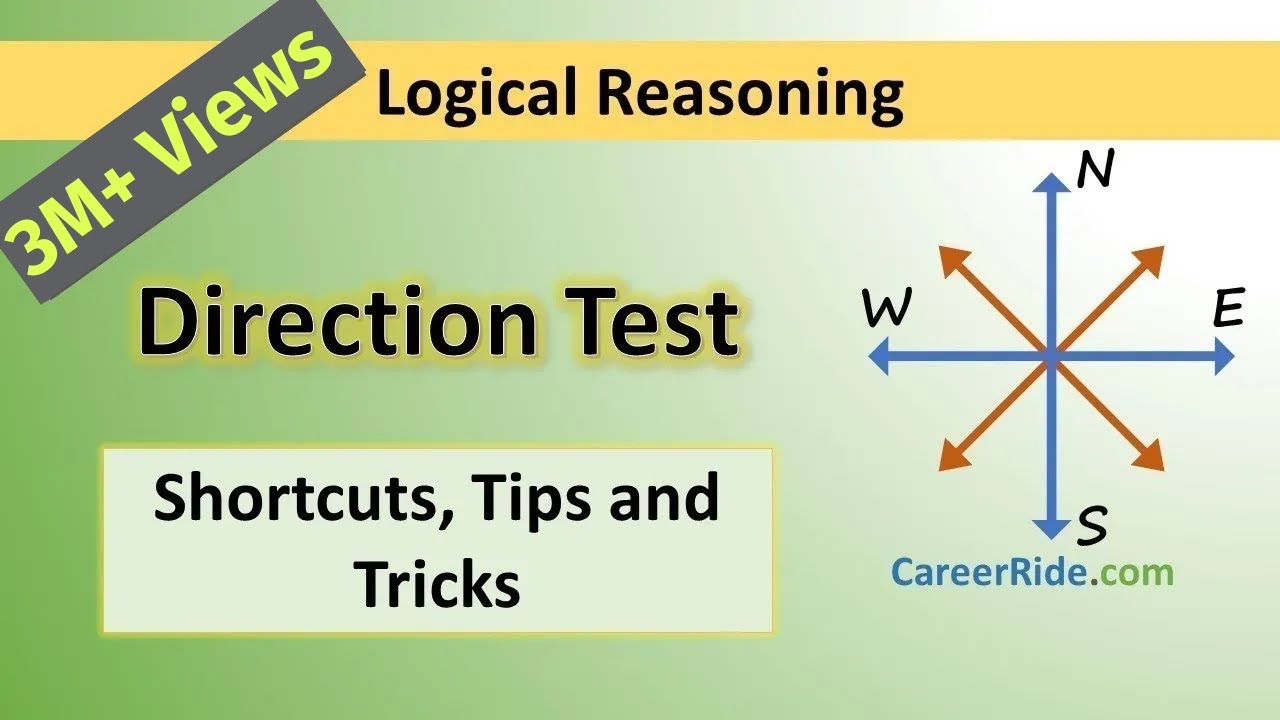
- The four cardinal directions are North (up), South (down), East (right), and West (left).
- Intermediate directions (Northeast, Southeast, Southwest, Northwest) lie at 45° angles between cardinal directions.
- The angle between any two adjacent cardinal directions is 90°, and between a cardinal and an intermediate direction is 45°.
- The total degrees in a circle are 360°.
Understanding these basic directions and angles is crucial for accurately interpreting movement and orientation in direction-based problems.
North is always at the top, South at the bottom, East to the right, and West to the left on a standard diagram.
- A default left or right turn, if no angle is specified, is always 90°.
- A 180° turn (left or right) always results in facing the exact opposite direction.
- Clockwise movement follows the direction of a clock's hands, while anticlockwise movement is the reverse.
- Clockwise and anticlockwise directions are relative to the observer's current facing direction.
Correctly interpreting turns is essential for tracking a person's or object's path and determining their final orientation.
If facing North and turning 180°, you will end up facing South.
- Direction problems often involve familiar geometric shapes like squares, rectangles, and right-angled triangles.
- The Pythagorean theorem (a² + b² = c²) is used to calculate the distance (hypotenuse) in right-angled triangles when two sides are known.
- Complex paths can be broken down into segments that form these geometric shapes.
- When calculating distance, it's important to identify the starting and ending points accurately.
This allows for precise calculation of the straight-line distance between two points, even after a series of turns and movements.
If a person walks 30m North and then 40m East, the direct distance from the start is the hypotenuse of a right triangle: sqrt(30² + 40²) = 50m.
- The sun rises in the East and sets in the West.
- In the morning (after sunrise), the sun is in the East, and shadows fall towards the West.
- In the evening (before sunset), the sun is in the West, and shadows fall towards the East.
- At noon (around 12 PM), the sun is directly overhead, and shadows fall directly downwards, making them difficult to see.
- The direction of a shadow relative to a person (left, right, front, back) depends on the sun's position and the person's facing direction.
Shadow problems test your ability to combine knowledge of sun position, time of day, and relative directions.
If the sun is in the East (morning) and a person is facing North, their shadow will fall to their left (West).
- Problems can ask for the final direction faced, the distance from the start, or both.
- Draw a diagram step-by-step, representing each movement and turn accurately.
- For distance problems, identify the resulting geometric shapes (rectangles, triangles) and apply relevant formulas.
- For shadow problems, determine the sun's position based on the time and then deduce the shadow's direction and the person's orientation.
Practice with varied examples reinforces the application of all learned concepts and builds problem-solving speed and accuracy.
Solving a problem where a person walks 10km North, turns 270° clockwise, walks 20km, then turns 270° anticlockwise and walks 37km, finally turning right and walking 20km, to find the final distance and direction from the start.
Key takeaways
- Always establish a reference point and direction (usually North) when solving direction sense problems.
- Default turns (left/right) are 90° unless an angle is specified.
- A 180° turn always reverses your direction.
- Clockwise and anticlockwise turns are consistent regardless of the direction you are facing.
- The Pythagorean theorem is essential for calculating straight-line distances in direction problems.
- Shadow direction is determined by the sun's position (East in the morning, West in the evening, overhead at noon).
- Practice drawing diagrams quickly and accurately to visualize the movements.
Key terms
Cardinal DirectionsIntermediate DirectionsClockwiseAnticlockwise90° Turn180° TurnPythagorean TheoremSunriseSunsetShadow
Test your understanding
- How do you determine the direction of a shadow in the morning versus the evening?
- What is the significance of a 180° turn in direction sense tests?
- How can the Pythagorean theorem be applied to solve distance problems in direction sense tests?
- What is the default angle for a left or right turn if no specific angle is mentioned?
- Explain the difference between clockwise and anticlockwise movement in relation to facing direction.