Session 1.1 Self Awareness
Office of the Counselling and Career Services
Overview
This session introduces self-awareness as a foundational skill for personal growth, emotional intelligence, and academic success. It defines self-awareness, explores its various dimensions (cognitive, emotional, behavioral, social, developmental, moral/spiritual), and highlights its importance in managing emotions, building relationships, and achieving academic goals. The session also presents categories of self-awareness (internal and external) and offers practical activities like journaling, seeking feedback, and using tools like the Johari Window to enhance this crucial skill. The ultimate aim is to empower learners to make intentional choices and live more authentic lives.
Save this permanently with flashcards, quizzes, and AI chat
Chapters
- Welcome to the self-enhancement program focusing on self-awareness.
- Active participation and completion of requirements are essential for graduation.
- The course will explore the meaning, dimensions, and importance of self-awareness.
- Learning objectives include recognizing thoughts, emotions, behaviors, and values, and understanding self-awareness's role in emotional intelligence and academic success.
- The activity aims to explore the contrast between one's public persona and private self.
- Participants visually represent their public self (how they present to others) and private self (inner thoughts and feelings) by drawing a mask.
- The exercise encourages reflection on chosen symbols, colors, and expressions to represent these different aspects of identity.
- Processing questions prompt discussion on the choices made and the insights gained from visualizing both selves.
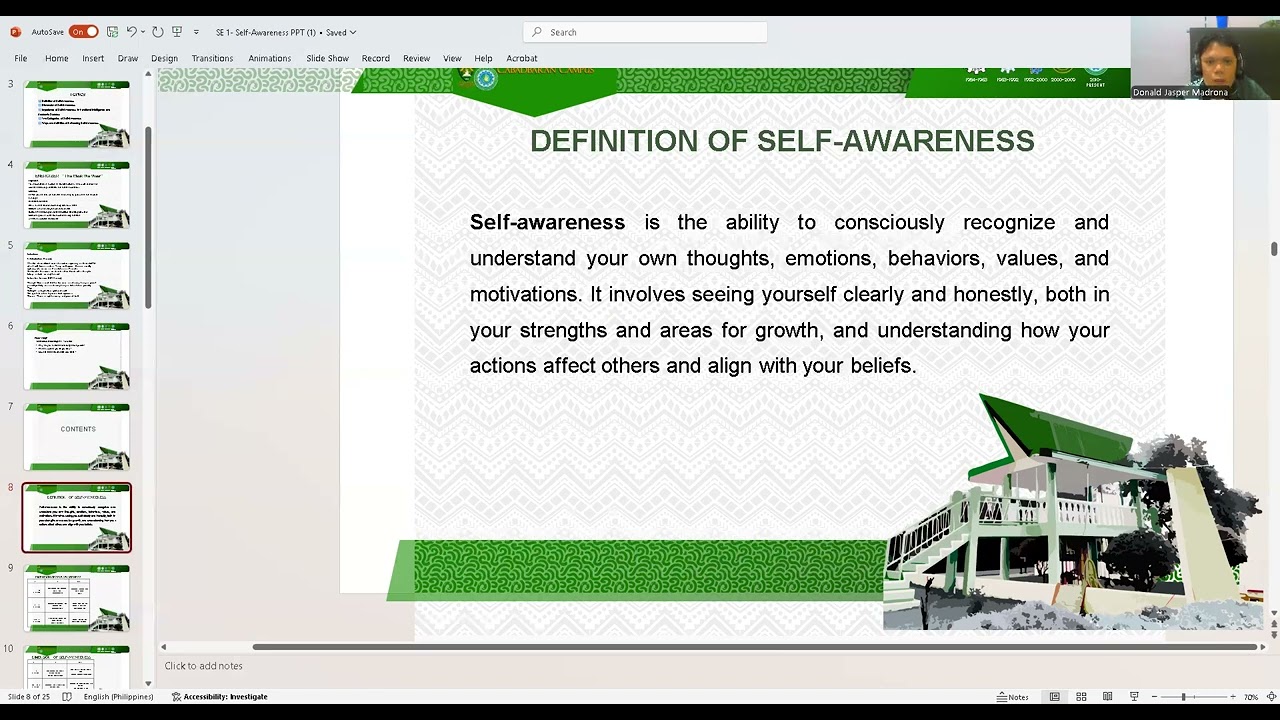
- Self-awareness is the conscious ability to recognize and understand one's own thoughts, emotions, behaviors, values, and motivations.
- It involves seeing oneself clearly, acknowledging both strengths and areas for growth.
- Understanding how actions affect others and align with personal beliefs is a key component.
- Self-awareness empowers deliberate choices, fosters emotional maturity, and promotes personal growth by clarifying how one's internal world influences interactions.
- Cognitive awareness: Understanding your thoughts, beliefs, and inner dialogue, and challenging limiting beliefs.
- Emotional awareness: Identifying and managing emotions and their triggers, understanding why you feel a certain way.
- Behavioral awareness: Observing your actions and habits and their impact on others, fostering accountability.
- Social awareness: Understanding how others perceive you and how you relate to them, guiding empathetic communication.
- Developmental awareness: Recognizing growth areas and being open to feedback for improvement.
- Moral/Spiritual awareness: Knowing your values and convictions and aligning them with your beliefs.
- Self-awareness is the bedrock of emotional intelligence, enabling accurate perception of one's own emotions and patterns.
- It allows for better regulation of reactions, leading to intentional choices over impulsive ones.
- Internal clarity enhances empathy and social awareness, fostering healthier relationships and communication.
- In academics, it helps manage stress, identify learning styles, overcome procrastination, and support overall performance and discipline.
- Internal self-awareness focuses on understanding one's own values, emotions, and patterns.
- External self-awareness involves understanding how others perceive you.
- Enhancing self-awareness can be done through observing oneself, journaling, trying new experiences, and taking psychological tests.
- Seeking feedback from others, undergoing counseling, and reflecting on spiritual texts are also effective methods.
- The 'Let It Pass' assignment involves gathering descriptive words from friends and family to gain external feedback.
- The Johari Window model helps interpret this feedback by categorizing self-knowledge into open, blind, hidden, and unknown areas.
- Self-awareness empowers intentional choices, authentic relationships, and resilience.
- Reflection, feedback, and aligning actions with purpose are key to personal growth and transformation.
Key takeaways
- Self-awareness is the essential first step towards emotional intelligence, personal growth, and academic success.
- Understanding your internal world (thoughts, emotions, values) and how it's perceived externally is crucial for effective interaction.
- Actively seeking and being open to feedback from others can reveal blind spots and accelerate personal development.
- Developing self-awareness is an ongoing process that requires consistent reflection, practice, and a willingness to learn.
- By understanding your strengths and weaknesses, you can make more intentional choices that align with your goals and values.
- Emotional regulation, improved relationships, and better academic performance are direct benefits of cultivating self-awareness.
- Tools like journaling, psychological tests, and the Johari Window can provide valuable insights into your own psyche.
Key terms
Test your understanding
- What is the core definition of self-awareness and why is it considered foundational for personal development?
- How do the different dimensions of self-awareness (cognitive, emotional, behavioral, etc.) contribute to a holistic understanding of oneself?
- Explain the relationship between self-awareness, emotional intelligence, and academic success, providing examples of how one influences the others.
- How can understanding both internal and external aspects of self-awareness help an individual navigate social interactions and personal challenges more effectively?
- What are at least three practical strategies or activities discussed in the video that learners can use to actively enhance their self-awareness?