ALL-E Workshop: MATH1081, 1131, 1231, 1241 & 1251(Term 2, 2026)
Academic Success & Faculty Engagement Team UNSW
Overview
This workshop focuses on the principles of effective mathematical writing, emphasizing clarity, precision, and logical flow. It covers how to structure mathematical arguments using complete sentences, proper punctuation, and appropriate use of symbols and terminology. The session also provides guidance on formatting equations, distinguishing between inline and displayed formulas, and using tools like LaTeX and Microsoft Word's equation editor. Finally, it touches upon the importance of self-contained arguments and how to provide constructive peer feedback, aiming to improve the overall understanding and communication of mathematical concepts.
Save this permanently with flashcards, quizzes, and AI chat
Chapters
- Mathematical writing is crucial for communicating complex ideas that cannot be expressed solely through equations.
- Clear mathematical explanations are essential for students in mathematics, science, engineering, and other fields.
- Writing mathematics clearly helps identify logical gaps and errors in one's own understanding.
- Well-written mathematics is more likely to be correct and improves the writer's comprehension of the subject matter.
- Mathematical writing prioritizes correctness, precision, clarity, and logic.
- Avoid emulating informal whiteboard or homework solutions, which are often not examples of good mathematical writing.
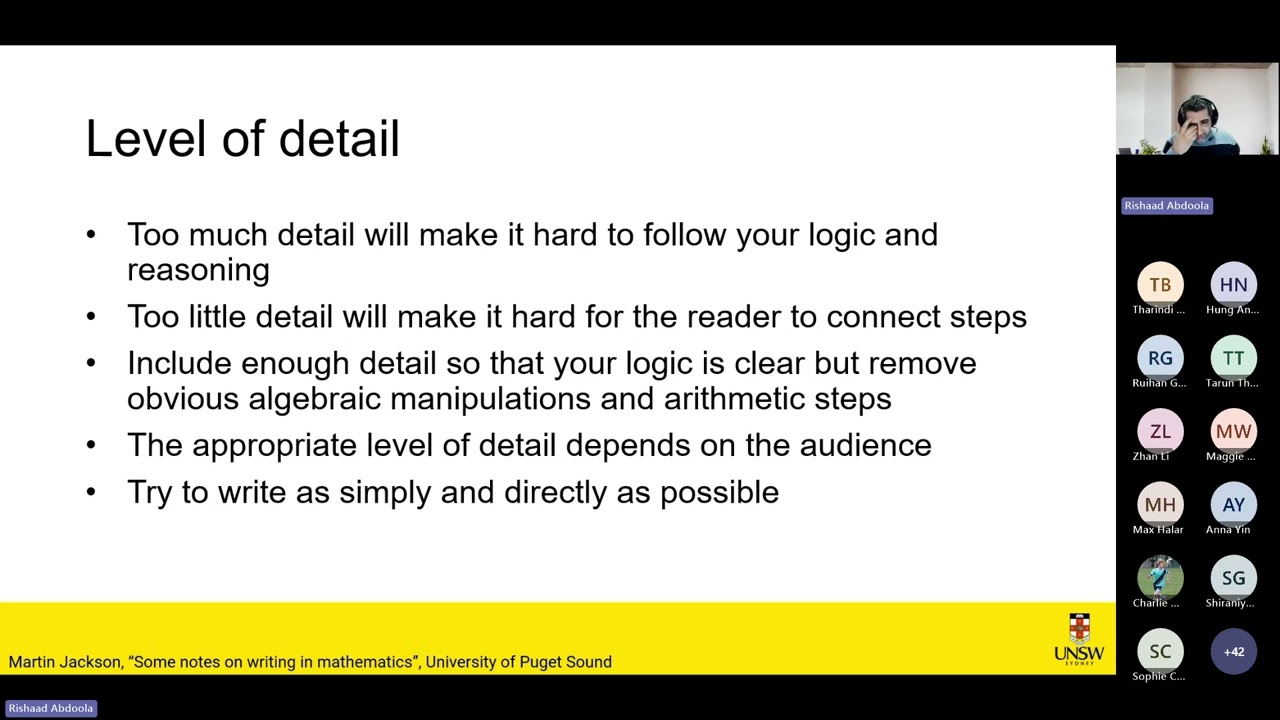
- Strive for an appropriate level of detail: enough to be clear, but not so much that it obscures the main points.
- The target audience for most assignments is a peer who has taken the same course but doesn't know how to solve the specific problem.
- Always use complete sentences, even when including equations or symbols.
- Never begin a sentence with a symbol or number; symbols should supplement, not replace, sentences.
- Use commas to separate variables in a list (e.g., 'let a, b, and c be integers').
- Distinguish between mathematical notation and regular text, ensuring correct typesetting for symbols and variables.
- Use the active voice for directness and clarity.
- Write in the first person plural ('we', 'us', 'our') and present tense to create an inclusive and immediate feel.
- Ensure correct punctuation, especially when separating mathematical expressions or equations within sentences.
- Displayed equations should be integrated into sentences and correctly punctuated, not left as standalone elements.
- Inline equations fit within a paragraph on the same line and are suitable for short expressions.
- Displayed equations are centered on their own line for important or longer formulas, often used for numbering or emphasis.
- Both inline and displayed equations must be integrated into the surrounding text and correctly punctuated.
- Use appropriate software (like LaTeX or Word's equation editor) for correct typesetting, avoiding italics for standard mathematical symbols.
- Microsoft Word's equation editor (accessed via Alt + Equals) offers shortcuts for inline and displayed equations.
- Learn shortcuts for common symbols and structures to improve typing speed and accuracy in Word.
- LaTeX is a powerful typesetting system particularly suited for complex mathematical documents.
- Overleaf is a web-based LaTeX editor that simplifies collaboration and access, especially for university students using SSO.
- Symbols are powerful but should not replace sentences; use them to enhance, not obscure, meaning.
- Write out logical symbols (e.g., 'for all', 'there exists') in words unless in a formal logic statement.
- Avoid informal abbreviations (like 'iff' or 'wrt') in formal mathematical writing.
- Proofs should be self-contained, clearly stating what is to be proven, the method of proof, and ending with a concluding statement.
- Feedback should be positive, unique, specific, and constructive.
- Acknowledge what the peer did well and provide concrete examples of areas for improvement.
- Focus on actionable behaviors rather than vague criticisms.
- Ensure feedback is self-contained and understandable without referring back to the original assignment prompt.
Key takeaways
- Mathematical writing is as important as mathematical correctness for clear communication.
- Always write in complete sentences, integrating equations and symbols naturally.
- Choose an appropriate level of detail for your audience, avoiding both excessive jargon and missing steps.
- Use active voice, first-person plural, and present tense for a more engaging and direct writing style.
- Properly format equations using inline or displayed styles and correct typesetting tools.
- Symbols should complement, not replace, clear prose; write out logical operators in words.
- Proofs must be self-contained, clearly stating the objective and method, and concluding definitively.
- Effective peer feedback is specific, constructive, and actionable, helping to identify areas for improvement.
Key terms
Test your understanding
- Why is clear mathematical writing essential for students in fields beyond pure mathematics?
- What is the difference between good mathematical writing and typical whiteboard solutions, and why does this distinction matter?
- How can you ensure your mathematical arguments are both sufficiently detailed and concise?
- What are the key elements of effective peer feedback in a mathematical context?
- Explain the difference between inline and displayed equations and when to use each.