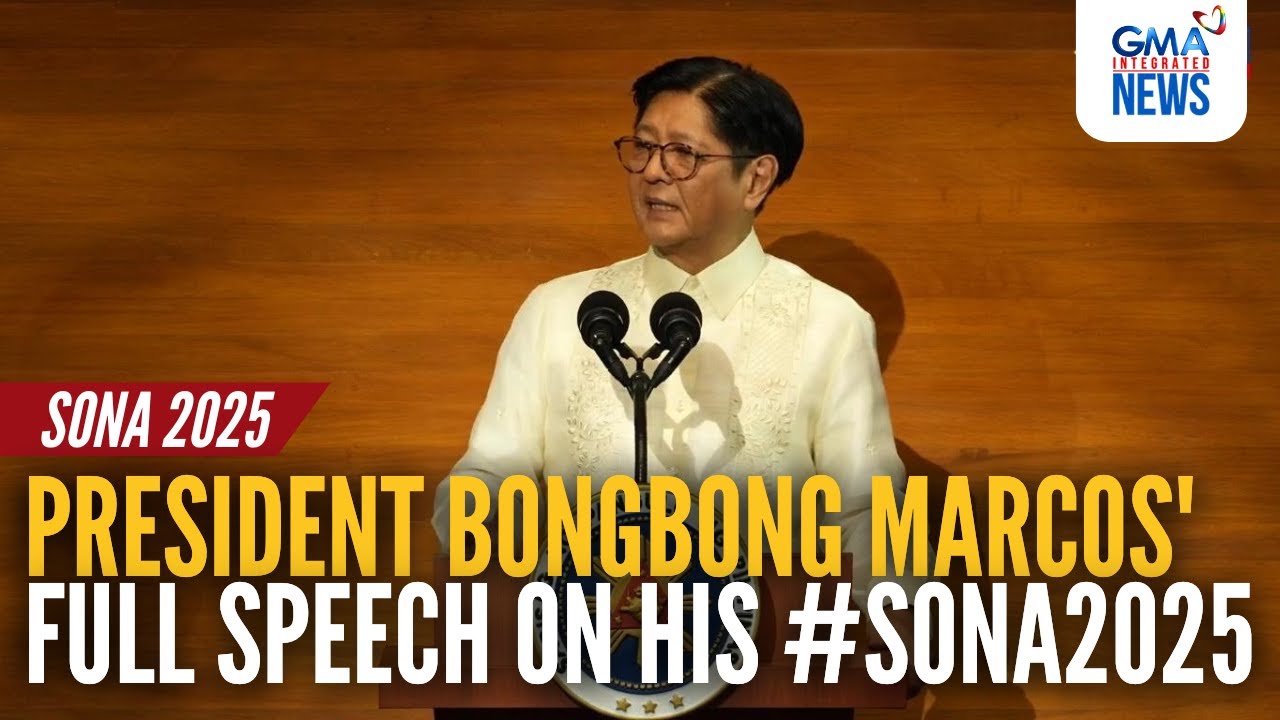
FULL SPEECH - President Bongbong Marcos' full speech on his #SONA2025 | GMA Integrated News
GMA News
Overview
President Bongbong Marcos delivers his State of the Nation Address (SONA) for 2025, outlining the administration's achievements and future plans across various sectors. The speech emphasizes economic progress, job creation, agricultural development, energy security, improved public services in water and education, and enhanced healthcare. It also highlights infrastructure projects, digital transformation, peace and order initiatives, disaster preparedness, and foreign policy. The President stresses the importance of good governance, accountability, and the collective effort of Filipinos in achieving national development and prosperity, urging continued dedication to building a better future for the country.
Save this permanently with flashcards, quizzes, and AI chat
Chapters
- Acknowledged elected officials and distinguished guests, emphasizing unity despite political differences.
- Recognized the recent election results as a clear message from the people, indicating dissatisfaction with government services.
- Stated that despite positive economic indicators like increased business confidence and decreased inflation, the focus must be on alleviating the hardships faced by citizens.
- Pledged to intensify efforts in the remaining three years to improve the lives of Filipinos.
- Identified decent employment as the most effective strategy against poverty and hunger.
- Outlined plans to support the remaining unemployed workforce through various agencies like DOLE and DTI.
- Promised continued investment in microenterprises with low interest and no collateral, including protection for intellectual property.
- Aimed to help millions of impoverished families start their own small businesses.
- Called for investment in key industries such as automotive, electronics, biotechnology, and renewable energy.
- Addressed the availability and affordability of rice, aiming for a P20 per kilo price point without harming farmers.
- Announced the expansion of the Kadiwa store program nationwide to support farmers and ensure accessible prices.
- Warned traders against price manipulation, labeling it as economic sabotage.
- Strengthened local production of pork through initiatives like providing piglets and establishing biosecure facilities, alongside ASF vaccination.
- Detailed investments in infrastructure for farmers and fisherfolk, including farm-to-market roads, irrigation, and modern machinery.
- Acknowledged the ongoing challenges in the energy sector, including the need to provide electricity to underserved households and address high prices.
- Highlighted progress in electrifying millions of homes and plans to complete new power generation facilities.
- Promoted net metering programs to allow consumers to sell excess electricity back to the grid.
- Addressed the water crisis, acknowledging widespread complaints about service interruptions and inadequate supply.
- Vowed to hold water districts and their partners accountable for poor service and ensure affordable, reliable water supply.
- Recognized deficiencies in foundational skills (math, science, reading) and the issue of school dropouts.
- Emphasized education as a top priority, launching the 'ARAL' program for academic recovery and strengthening early childhood care.
- Addressed student mental health by increasing the number of school counselors and establishing child development centers.
- Accelerated the construction of classrooms to alleviate student congestion and improve learning conditions.
- Enhanced teacher support through increased plantilla positions, reduced documentation, and compensation for overload and overtime.
- Expanded public hospitals and specialty centers, ensuring every municipality has a doctor.
- Enhanced PhilHealth benefits, covering critical illnesses like heart conditions and various cancers, as well as dialysis and kidney transplants.
- Continued and expanded the '4Ps' (Pantawid Pamilyang Pilipino Program) for conditional cash grants, with many families graduating from the program.
- Increased support for nutrition programs, including feeding initiatives for children and addressing rising obesity rates in adults.
- Promoted active lifestyles and community sports to improve public health and well-being.
- Outlined ambitious infrastructure projects including roads, bridges, railways, airports, and ports, emphasizing long-term development.
- Improved public transportation services, increasing discounts for PWDs, seniors, and students on LRT/MRT and piloting free 'Love Bus' services.
- Accelerated the deployment of unused train coaches and initiated major bridge projects like the Bataan-Cavite Interlink Bridge.
- Expanded free Wi-Fi access nationwide and distributed free SIM cards with data for students.
- Promoted the e-Gov app to consolidate government services, making them more accessible and efficient for citizens.
- Strengthened the police and military with modern equipment and enhanced capabilities.
- Facilitated the reintegration of former rebels into society through community development and livelihood programs.
- Reported a decrease in crime rates and emphasized rapid police response times.
- Highlighted significant successes in anti-illegal drug operations, including large-scale confiscations and arrests of high-value targets.
- Affirmed the Philippines' commitment to international law and its role as a reliable global partner.
- Acknowledged the increasing frequency and intensity of natural disasters due to climate change.
- Stressed the importance of continuous improvement in disaster preparedness and response.
- Announced the construction of modern evacuation centers to replace schools currently used for shelter.
- Utilized advanced technologies for early warning systems and effective rescue operations.
- Called for public cooperation, discipline, and bayanihan spirit in facing calamities.
- Expressed commitment to transparency and accountability, vowing to prosecute those involved in corruption and failed infrastructure projects.
- Stated that the 2026 national budget will only be approved if fully aligned with the national expenditure program.
- Reiterated the administration's dedication to serving the Filipino people, drawing strength from lessons learned.
- Emphasized the inherent strengths of Filipinos: resilience, skill, hard work, and kindness.
- Called for unity and collective effort to achieve national progress and fulfill the nation's potential.
Key takeaways
- Economic progress must translate into tangible improvements in the lives of ordinary citizens, with a focus on job creation and poverty reduction.
- Modernizing the agricultural sector is crucial for food security and supporting the livelihoods of farmers and fisherfolk.
- Reliable access to energy and clean water are fundamental public services that require continuous improvement and accountability from providers.
- Investing in education and healthcare is paramount for building a skilled, healthy, and resilient population.
- Infrastructure development and digital transformation are key drivers of economic growth and improved public services.
- Maintaining peace, order, and national security, alongside robust disaster preparedness, are essential for a stable and prosperous nation.
- Good governance, transparency, and accountability are non-negotiable principles for national development.
- The Filipino spirit of resilience, hard work, and unity is the nation's greatest asset in overcoming challenges and achieving progress.
Key terms
Test your understanding
- How does the administration plan to address the people's dissatisfaction with government services, as indicated by the election results?
- What specific strategies will be employed to create decent employment and combat poverty, according to the President's address?
- How will the government ensure food security and support the agricultural sector while making essential goods like rice more affordable?
- What are the key initiatives outlined to improve the country's energy and water supply, and what accountability measures are in place?
- How does the administration plan to enhance the education system to better equip the youth for the future, and what support will be provided to teachers?
- What measures are being taken to strengthen the healthcare system and expand social protection programs for vulnerable Filipinos?
- How will the government leverage infrastructure development and digital connectivity to drive economic growth and improve public services?
- What steps are being taken to ensure peace, order, and national security, and how is the country preparing for natural disasters and climate change?