17:12
Common Dance Terms in Folk Dance
John Michael D. Pastor
Overview
This video provides a glossary of common terms used in Philippine folk dances. It defines and demonstrates various steps, arm movements, and partner interactions, explaining their origins and significance. The terms cover fundamental actions like 'brush,' 'hop,' and 'step,' as well as more complex formations and gestures such as 'crossed arms,' 'saludo,' and 'star with the right hand.' Understanding these terms is crucial for learning and performing folk dances accurately.
How was this?
Save this permanently with flashcards, quizzes, and AI chat
Chapters
- Brush: Hitting the floor with the ball or heel of the free foot after shifting weight, then lifting the free foot.
- Cut: Quickly displacing one foot with the other, transferring body weight.
- Draw: Pulling one foot along the floor close to the other, with optional weight transfer.
- Slide: Gliding a foot smoothly along the floor, with or without weight transfer.
- Step: Moving one foot to a new resting place, involving a complete transfer of weight.
These fundamental foot movements form the building blocks of most folk dance steps, requiring precise execution for clarity and rhythm.
The 'brush' involves hitting the floor with the free foot before lifting it, similar to sweeping.
- Clockwise: Moving in the direction of clock hands, with the right shoulder towards the center.
- Counterclockwise: Moving in the reverse direction of clock hands, with the left shoulder towards the center.
- Pivot: Turning on the ball, heel, or whole foot.
- Whirl: Making fast turns using small steps in place.
Understanding directional terms is essential for executing formations and partner movements correctly, ensuring dancers move in unison.
A 'clockwise' movement means turning to your left when facing the center of a circle.
- Crossed Arms: Partners facing each other or side-by-side, joining hands in front.
- Hands on Waist: Placing hands at the waistline with knuckles in and fingers pointing inward.
- Hyon: Placing one forearm in front and the other at the back of the waist (Visayan term).
- Kuma: Moving the hand from the wrist in a circular motion (Ilocano term).
- Salok: Swinging the arm downward and upward, bending the trunk forward (Tagalog term).
Specific arm and hand gestures add expressive detail and cultural nuance to folk dances, conveying meaning and aesthetic appeal.
'Salok' involves a sweeping arm motion accompanied by a forward bend of the body, mimicking scooping.
- Dugso: A Visayan term for advancing forward, passing each other by the side, and returning to place.
- Saludo: A bow to partners, audience, or neighbors, often with feet together (Spanish origin).
- Star with the Right Hand: Four or more people joining right hands and circling clockwise.
- Star with the Left Hand: Similar to the right hand star, but joining left hands and circling counterclockwise.
These terms describe how dancers interact with each other, creating dynamic patterns and fostering a sense of community within the dance.
'Star with the right hand' involves a group forming a circle by holding hands in the center and moving together.
- Hop: A spring from one foot, landing on the same foot, with the other foot raised.
- Jump: Springing from one or both feet, landing on both feet.
- Place: Positioning a foot in a desired spot without bearing weight.
- Point: Lightly touching the floor with the toes of one foot while the other foot bears weight.
- Tap: Tapping the ball or toe of the free foot slightly, without transferring weight.
These actions involve variations in jumping, landing, and foot placement, requiring balance and control.
A 'hop' is a single-footed jump where you land on the same foot you took off from.
- Inside Foot/Hand: The foot or hand nearest to one's partner when standing side-by-side.
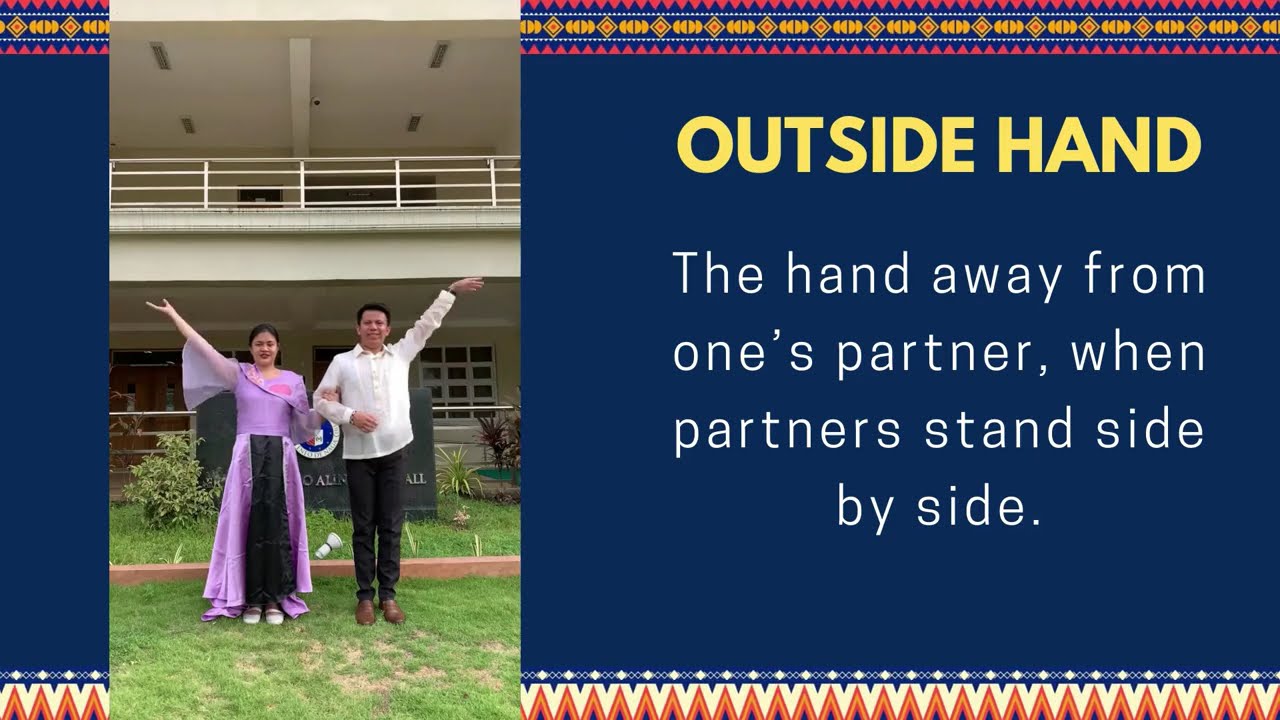
- Outside Foot/Hand: The foot or hand farthest from one's partner when standing side-by-side.
- Supporting Foot: The foot bearing the main weight of the body.
- Free Foot: The foot not bearing weight, used for various movements.
These terms clarify spatial relationships between partners, which is crucial for executing synchronized movements and formations.
When dancing side-by-side, the 'inside foot' is the one closest to your partner.
Key takeaways
- Folk dances utilize a specific vocabulary of movements, including footwork, arm gestures, and body postures.
- Directional terms like clockwise and counterclockwise are fundamental for group coordination.
- Understanding partner-specific terms (inside/outside foot/hand) is vital for executing paired movements correctly.
- Many folk dance terms have origins in specific Philippine regions or foreign languages, reflecting cultural influences.
- Mastering basic steps like 'brush,' 'hop,' and 'step' is essential before progressing to more complex choreography.
- Gestures like 'salok' and 'kuma' add expressive and cultural layers to the dance.
- Formations like 'star' patterns require synchronized movement and clear communication among dancers.
Key terms
BrushClockwiseCounterclockwiseCutDrawHopHyopInside FootJumpKumaPlacePivotPointSalokSaludoSlideStompStepSupporting FootTapWhirl
Test your understanding
- What is the difference between a 'hop' and a 'jump' in folk dance?
- How does the term 'clockwise' differ from 'counterclockwise' in terms of dancer orientation?
- Why is it important to distinguish between the 'inside' and 'outside' foot when dancing with a partner?
- Explain the action described by the term 'brush' and how it differs from a simple 'step'.
- What does the term 'saludo' signify in the context of folk dance performance?