AI-Generated Video Summary by NoteTube
ACTIVITY 4 IMMUNOASSAYS
peter samonte
Overview
This video provides a comprehensive introduction to immunoassays, focusing on labeled immunoassays. It explains the fundamental principles of antigen-antibody reactions and how labels are used to detect and quantify analytes. The discussion covers various types of labels, including enzymes, radioactive isotopes, fluorescent compounds, and chemiluminescent substances, detailing their properties and applications. The video also delves into essential terminology like analyte, affinity, avidity, specificity, standards, and quality control. It further elaborates on different assay formats such as homogeneous and heterogeneous, competitive and non-competitive, and specific techniques like ELISA, FIA, CLIA, and RIA, outlining their methodologies, instrumentation, advantages, and disadvantages. The content is structured to provide a clear understanding of these diagnostic tools used in laboratory medicine.
This summary expires in 30 days. Save it permanently with flashcards, quizzes & AI chat.
Chapters
- •Immunoassays use antigen-antibody reactions to detect or quantify molecules.
- •Reagents used are either antigens or antibodies.
- •Samples can be serum (for antibodies) or other suspensions (for antigens).
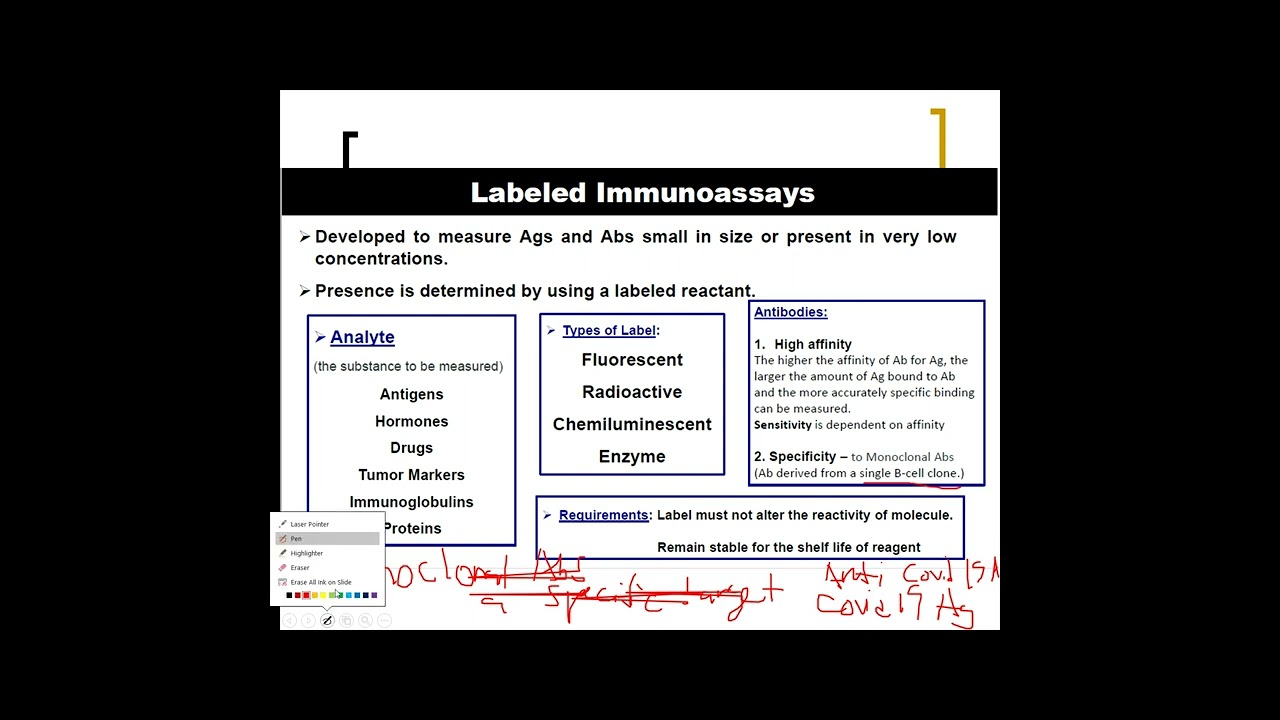
- •Labeled immunoassays use labels like enzymes, radioactive isotopes, fluorescent, or chemiluminescent substances.
- •Labels are attached to antigens or antibodies to aid detection.
- •Common labels include enzymes, radioactive isotopes, fluorescent, and chemiluminescent substances.
- •Labels must not alter the reactivity of the molecule they are attached to.
- •Labels must remain stable for the shelf life of the reagent.
- •Analyte is the substance being measured (antigen, hormone, drug, antibody, etc.).
- •Affinity refers to the strength of binding between an antibody and an antigen.
- •Avidity is the overall binding strength of multiple interactions.
- •Specificity, particularly for monoclonal antibodies, refers to targeting a single antigen.
- •Standards or calibrators are unlabeled analytes of known concentration used for accuracy assessment.
- •Quality control involves using blank tubes and positive/negative controls.
- •Label selection considers substrate conversion, ease of detection, and stability.
- •Detection methods vary based on the label (e.g., radioactivity counters, spectrometers, fluorometers).
- •Separation methods are used to remove unreacted analytes (free antigens/antibodies).
- •Solid phases (like microtiter plates) and washing steps are common separation techniques.
- •Basic components include labeled reagents, analyte of interest, and ligands.
- •A solid phase is a support for immobilization.
- •Incubation allows antigen-antibody reactions to occur.
- •Label is a molecule or atom attached as a tag or marker.
- •Radioactive labels use isotopes (e.g., 125I) detected by gamma counters (RIA).
- •Enzyme labels (e.g., HRP, ALP) react with substrates, detected by spectrometers (EIA/ELISA).
- •Fluorescent labels absorb and emit light, detected by fluorometers (FIA/IFA).
- •Chemiluminescent labels produce light during oxidation, detected by luminometers (CLIA).
- •Labels are coupled using tyrosine residues (radioisotopes), glutaraldehyde (fluorochromes), or biotin-avidin systems (enzymes).
- •Antibodies bind to solid phases via Protein A, G, or L, which target different parts of the antibody.
- •Homogeneous assays do not require separation of bound/unbound analytes.
- •Heterogeneous assays require separation steps.
- •Competitive assays involve competition for binding sites; signal is inversely proportional to analyte.
- •Non-competitive assays capture analyte; signal is directly proportional to analyte.
- •EIA uses enzymes as labels, detected by color change.
- •ELISA (Enzyme-Linked Immunosorbent Assay) is a common EIA format.
- •Types include Direct, Indirect, and Sandwich ELISA.
- •Sandwich ELISA is highly sensitive for antigen detection.
- •FIA uses fluorescent compounds (fluorophores) as labels.
- •Direct IFA detects antigens directly with labeled antibodies.
- •Indirect IFA uses unlabeled antibodies followed by labeled anti-human immunoglobulin.
- •Fluorescence Polarization Immunoassays (FPIA) are competitive assays for small molecules.
- •CLIA uses chemicals that emit light upon oxidation.
- •Common labels include luminol and acridinium esters.
- •Offers high sensitivity and stable reagents.
- •Quenching can be a disadvantage.
- •RIA uses radioactive isotopes (e.g., 125I) as labels.
- •Primarily competitive assays, with signal inversely proportional to analyte.
- •Requires specialized equipment like gamma counters.
- •Highly sensitive but involves radioactive hazards.
Key Takeaways
- 1Immunoassays leverage the specific binding of antibodies to antigens for detection and quantification.
- 2Labeled immunoassays enhance sensitivity by using detectable labels like enzymes, fluorescent dyes, or radioactive isotopes.
- 3The choice of label and assay format (homogeneous/heterogeneous, competitive/non-competitive) depends on the analyte, required sensitivity, and available resources.
- 4ELISA, FIA, CLIA, and RIA are major types of labeled immunoassays, each with distinct principles, advantages, and limitations.
- 5Understanding terms like analyte, affinity, avidity, and specificity is crucial for interpreting immunoassay results.
- 6Standards and quality controls are essential for ensuring the accuracy and reliability of immunoassay testing.
- 7Separation techniques are critical in heterogeneous assays to remove interfering unbound reagents.
- 8Assay formats like sandwich ELISA offer high specificity and sensitivity by capturing the analyte between two antibodies.