Kasper MLB Slate Breakdown | June 27th
Kasper
Overview
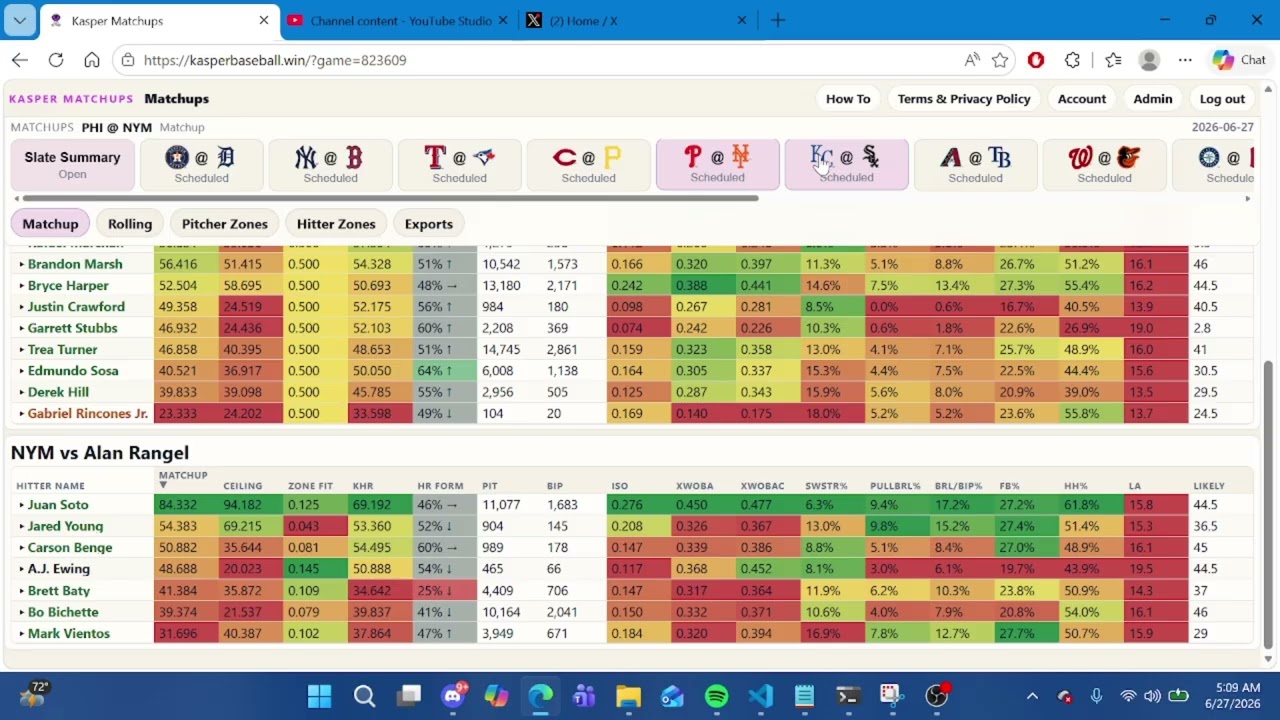
This video provides a breakdown of the Major League Baseball slate for June 27th, focusing on player recommendations for daily fantasy sports. The presenter introduces a new user interface (UI) for the slate summary, currently live on desktop but still in development for mobile. The core of the video involves a game-by-game analysis, highlighting top players based on various metrics like KHR (presumably a proprietary stat like 'Key Hitter Rating') and matchup data. The presenter discusses individual player performance, form, and potential value, offering specific recommendations for hitters and sometimes pitchers across multiple games. The video concludes with a reminder about the UI's status and a call for user feedback.
Save this permanently with flashcards, quizzes, and AI chat
Chapters
- The video covers the MLB slate for June 27th.
- A new user interface (UI) is being rolled out, with the desktop version now live.
- The mobile version of the UI is still under development and will use Streamlit temporarily.
- The presenter is seeking feedback on the new UI.
- Top players for the Houston vs. Arizona game are identified.
- Key metrics like KHR and matchup data are used for player selection.
- Specific hitter recommendations include Parades, Alvarez, Smith, Altuve, and Bryce Matthews.
- The presenter leans towards Cam Smith due to his current form and KHR.
- Analysis of the Detroit vs. New York game.
- Top players mentioned include McGonogal and Green for Detroit.
- For New York, Goldie, Rice, and Bellinger are highlighted as top options.
- The presenter identifies Goldie, Rice, and Bellinger as strong matchup plays.
- Breakdown of the Boston vs. Toronto game.
- Key hitters for Boston include Duran, Ambro, and Yoshida.
- For Toronto, Seager, Peterson, and Langford are identified as top picks.
- The presenter favors Seager and Langford, with Nimo also noted for KHR.
- Analysis of multiple games including Reds vs. Pirates, Mets vs. Phillies, and Royals vs. White Sox.
- Player recommendations are made based on KHR, matchups, and recent form.
- Specific players like Sal Stewart, Sodto, Vientos, Kaggs, and Bobby Witt Jr. are discussed.
- The presenter notes UI issues like missing names due to display length, indicating areas for improvement.
- Coverage of later games, including Diamondbacks vs. Rays, Dodgers vs. Padres, and Athletics vs. Angels.
- Player recommendations are based on KHR, matchups, and hitter tendencies.
- Notable players discussed include Carol, Marte, Ohtani, Freeman, Machado, and Neto.
- The presenter expresses confidence in certain players like Demurs (Athletics) and Neto (Angels).
- Reiteration that the new UI is live on desktop only.
- Mobile users will continue to use Streamlit, with a risk of downtime.
- The presenter hopes the mobile UI will be completed soon.
- Users are encouraged to report any bugs found on the desktop UI.
Key takeaways
- Player selection in daily fantasy sports involves analyzing hitter metrics (like KHR) in conjunction with pitcher matchups and recent player form.
- Even with new UI development, temporary solutions like Streamlit may be used, carrying a risk of instability.
- Identifying players with strong KHR and favorable matchups is a core strategy for finding value.
- Understanding hitter tendencies against specific pitcher types (e.g., lefty vs. righty) can inform player choices.
- The presenter's analysis prioritizes players showing good form and strong underlying metrics, even if they aren't the most well-known names.
- User feedback is crucial for refining and improving data visualization tools.
- The split between desktop and mobile UI development highlights the challenges of cross-platform application deployment.
Key terms
Test your understanding
- How does the presenter use KHR and matchup data to recommend hitters for a specific game?
- What are the current limitations of the new UI, and how do they affect mobile users?
- Why might a player with good underlying metrics but less consistent recent form still be considered a valuable pick?
- What is the presenter's process for identifying top player selections when multiple metrics are available?
- How does the presenter's approach to player analysis differ between games with clear pitching advantages and those with more balanced matchups?