1:07:54
Art and Culture 2026 Current Affairs | UNESCO Sites, Festivals, Folk Dance, | ssc cgl railway groupd
Ravi Aditi Classes
Overview
This video covers a comprehensive list of art and culture-related current affairs for 2026, focusing on topics relevant for competitive exams. It details new UNESCO World Heritage Site declarations, significant festivals, traditional art forms, awards, and archaeological discoveries. The content aims to provide learners with essential facts and context to understand India's rich cultural heritage and its international recognition.
How was this?
Save this permanently with flashcards, quizzes, and AI chat
Chapters
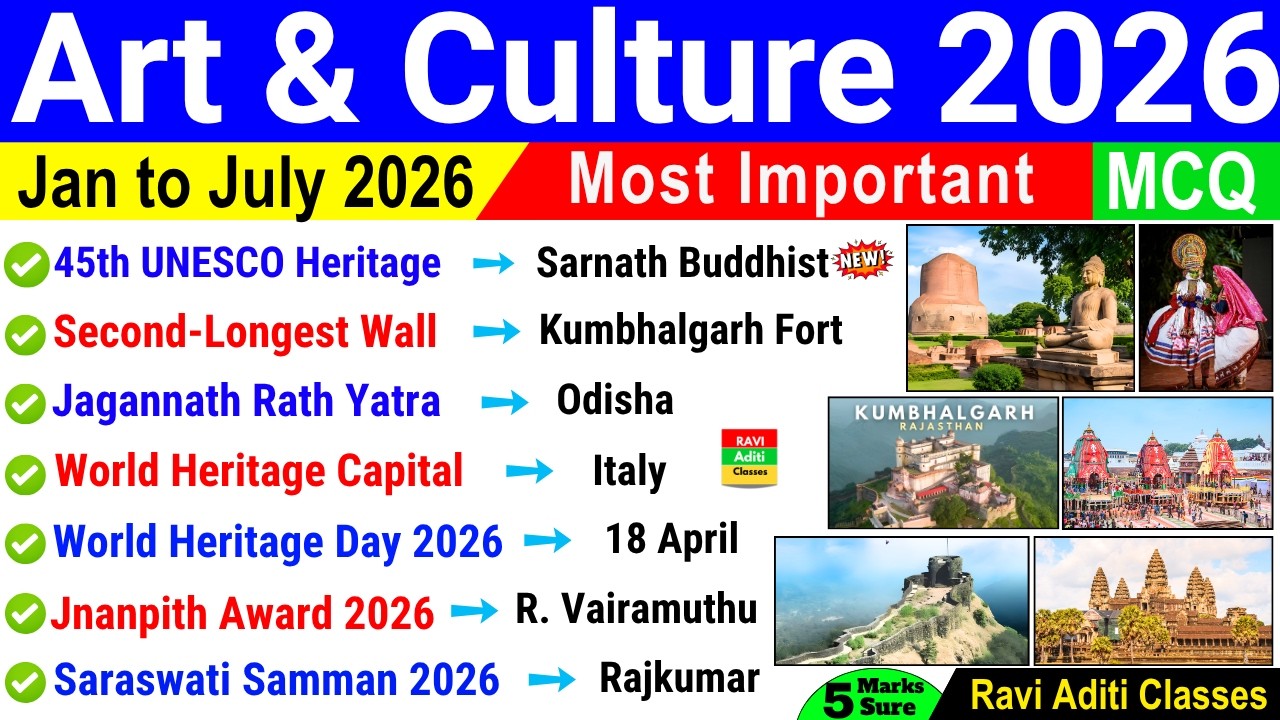
- Sarnath, an ancient Buddhist site in Uttar Pradesh, was declared India's 45th UNESCO World Heritage Site.
- Sarnath is significant as the location where Lord Buddha delivered his first sermon, the Dharmachakra Pravartan.
- This declaration makes Sarnath the fourth UNESCO World Heritage Site in Uttar Pradesh, joining the Taj Mahal, Agra Fort, and Fatehpur Sikri.
- The Kumbhalgarh Fort in Rajasthan was recognized as the world's second-longest continuous wall, after the Great Wall of China.
Understanding UNESCO World Heritage Sites is crucial as they represent globally significant cultural and natural landmarks, often tested in exams and important for appreciating national heritage.
The ancient Buddhist site of Sarnath in Uttar Pradesh being designated as India's 45th UNESCO World Heritage Site.
- World Art Day is celebrated on April 15th, with the 2026 theme being 'A Garden of Expression: Cultivating Community Through Art'.
- Prime Minister Narendra Modi gifted an artistic brass turtle, a famous craft from Moradabad, Uttar Pradesh, to the President of Seychelles.
- The first NBT Bhushan Samman for contributions in art, literature, and culture was awarded to Prasoon Joshi, Chairman of Prasar Bharati.
- The Ustad Bismillah Khan Yuva Puraskar 2025 was awarded to Acharya Ranchhod Lal Ji Goswami for his contributions to the arts.
Recognizing artistic contributions and awards highlights individuals and art forms that shape cultural landscapes and are often subjects of current affairs questions.
Prasoon Joshi receiving the first NBT Bhushan Samman for his work in art, literature, and culture.
- Folk singer Dr. Teejan Bai, a recipient of the Padma Vibhushan, passed away; she was associated with the Pandwani folk art form.
- The 'Dree Festival', an agricultural and cultural event, was celebrated in Arunachal Pradesh by the Apatani tribe.
- The 'Ambubachi Mela' festival was held at the Kamakhya Temple in Guwahati, Assam.
- The 'Garia Puja' festival, primarily an agricultural celebration, was observed in Tripura.
Folk arts and festivals are integral to India's cultural diversity, offering insights into regional traditions, beliefs, and community practices.
Dr. Teejan Bai, a renowned exponent of the Pandwani folk art form, being honored posthumously.
- Two 2000-year-old gold rings bearing the ancient Indian Brahmi script were discovered at the Don Yat Thong archaeological site in Thailand.
- The Archaeological Survey of India declared the Yana Caves in Karnataka as a Geo-Heritage Site of national importance.
- Three significant 16th-century inscriptions of the Vijayanagar king Sadashiva Shivraya were discovered in the Sheshachalam Forest of Andhra Pradesh.
- Australia announced the return of three ancient artifacts, dating back to the 11th and 12th centuries, stolen from temples in Tamil Nadu.
Archaeological finds and heritage preservation efforts shed light on ancient civilizations, trade routes, and historical connections, often revealing new aspects of India's past.
The discovery of 2000-year-old gold rings with Brahmi script in Thailand, indicating ancient Indian cultural influence.
- The word 'Alpana', a traditional folk art form from West Bengal, was added to the Oxford English Dictionary.
- Other Indian-related words like 'Nihari' (a meat dish) and 'Nazm' (a historical term) were also included in the dictionary.
- The Mizoram assembly passed a resolution to include the Mizo language in the Eighth Schedule of the Constitution.
- The first immersive language museum, 'Shabdlok' (Museum of Words), was inaugurated in Kolkata.
The recognition of Indian languages and art forms in global platforms like dictionaries and museums signifies their cultural significance and reach.
The inclusion of 'Alpana', a traditional West Bengal folk art, in the Oxford English Dictionary.
- India established an International Civilization Center in Kyrgyzstan for the study of the Manas and Mahabharata civilizations.
- Prime Minister Narendra Modi visited the UNESCO World Heritage Site Prambanan Temple complex in Indonesia.
- Australia returned ancient artifacts to India that were stolen from temples in Tamil Nadu.
- The 11th-century Anaimangalam Chola copper plates were formally handed over to India by the Netherlands.
Cultural exchanges and the return of artifacts strengthen international ties and highlight the global interconnectedness of heritage and history.
India establishing an International Civilization Center in Kyrgyzstan to study Manas and Mahabharata civilizations.
- The 'Bhairav Yatra' of Rajouri, Jammu & Kashmir, was officially included in India's National List of Intangible Cultural Heritage.
- The Jagannath Rath Yatra festival in Puri, Odisha, is an annual chariot procession dedicated to Lord Jagannath.
- The 'Divya Kala Mela', organized for differently-abled artisans, was inaugurated in Kolkata.
- The Shri Jagannath Temple in Puri, Odisha, became the first temple to secure a trademark for its Nilachakra logo and sacred words.
Listing intangible cultural heritage and celebrating national festivals are vital for preserving and promoting unique traditions and community practices.
The inclusion of the Bhairav Yatra of Rajouri, Jammu & Kashmir, in India's National List of Intangible Cultural Heritage.
Key takeaways
- India's cultural heritage is increasingly being recognized globally, with new UNESCO World Heritage Site designations and inclusions in international dictionaries.
- Traditional folk arts, festivals, and crafts remain vibrant and are being promoted through various government initiatives and international exchanges.
- Archaeological discoveries continue to reveal new insights into India's ancient past and its connections with other civilizations.
- The return of stolen artifacts signifies a growing global commitment to cultural heritage preservation.
- Language and literature play a crucial role in cultural identity, with ongoing efforts to preserve and promote indigenous languages.
- Festivals across India, from agricultural celebrations to religious processions, showcase the country's diverse cultural tapestry.
- The recognition of intangible cultural heritage, like festivals and art forms, is essential for safeguarding unique traditions for future generations.
Key terms
UNESCO World Heritage SiteSarnathKumbhalgarh FortWorld Art DayPandwaniBrahmi ScriptAlpanaIntangible Cultural HeritageJagannath Rath YatraDivya Kala MelaArchaeological Survey of IndiaFolk Art
Test your understanding
- What is the significance of Sarnath being declared India's 45th UNESCO World Heritage Site?
- How does the recognition of traditional art forms like 'Alpana' in international dictionaries contribute to cultural preservation?
- Why are archaeological discoveries of ancient scripts and artifacts important for understanding India's history?
- What is the role of festivals like the Dree Festival and Garia Puja in preserving cultural diversity?
- How do international cultural exchanges and the return of artifacts impact India's global heritage standing?