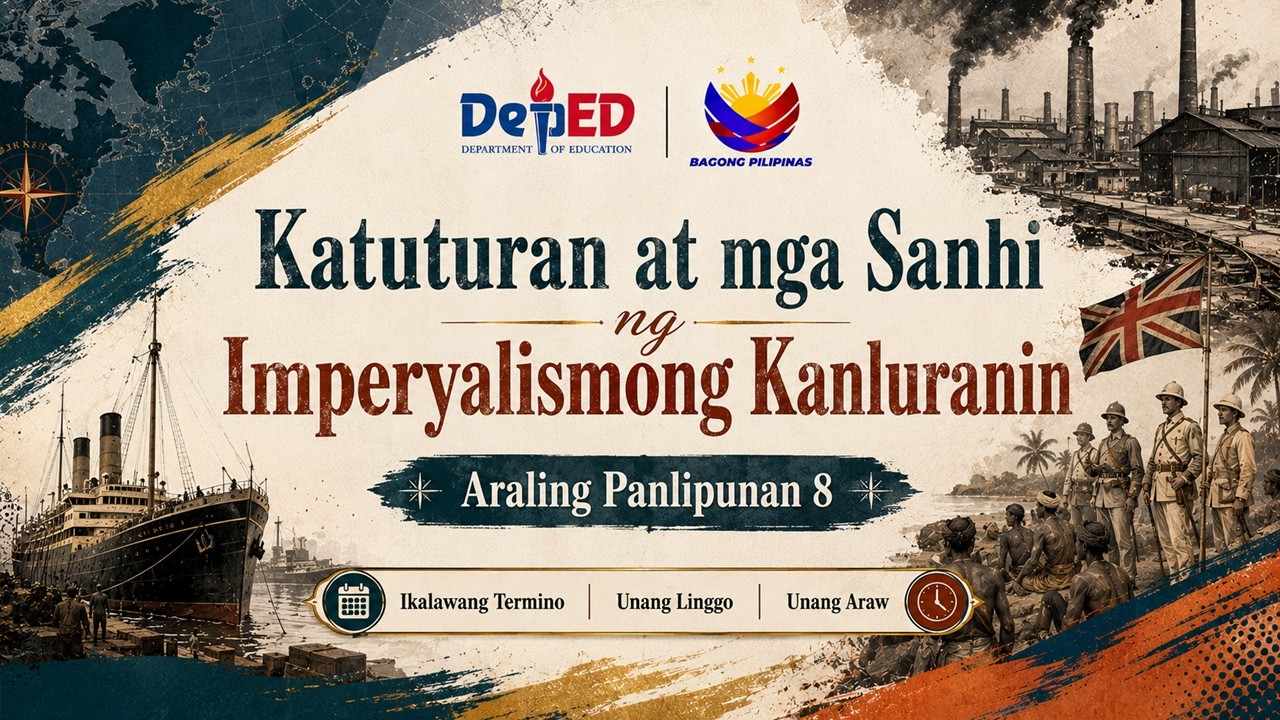
AP 8 Term 2, Week 1-1 Katuturan at mga Sanhi ng Imperyalismong Kanluranin with PPT & DLL
Ma'am Eve
Overview
This video explores the definition and causes of Western imperialism. It begins by contrasting Japan's isolationist policy under the Tokugawa Shogunate with the expansionist actions of other global powers. The core of the lesson defines imperialism as the extension of a nation's power and influence over other territories, detailing how this control can manifest in economic, political, and social spheres. It then delves into the primary motivations behind Western imperialism, categorizing them into economic (raw materials, markets, cheap labor), cultural (spreading Western way of life and beliefs), and religious (spreading Christianity) drivers. The video emphasizes that these motives often intertwined and were fueled by the Industrial Revolution.
Save this permanently with flashcards, quizzes, and AI chat
Chapters
- Some nations maintain order through strict control over borders and foreign interaction, as exemplified by Japan's Sakoku policy under the Tokugawa Shogunate.
- Japan's Sakoku policy aimed to limit foreign influence and maintain internal stability by restricting the entry of foreigners and contact with other countries.
- Despite isolation, Japan maintained limited, controlled trade with the Dutch and Chinese in Nagasaki, showing it wasn't a complete shutdown.
- In contrast, other powerful nations actively sought to expand their power, control, and influence over other lands.
- Imperialism is defined as the expansion of a powerful nation's power, control, or influence over other countries or territories.
- This expansion can involve conquest and interference in the lives of the people in the subjugated territories.
- Imperial control can extend into three main areas: economic (controlling resources and trade), political (influencing governance and laws), and social (altering way of life, culture, and beliefs).
- The Industrial Revolution led to increased factory production in industrialized nations, creating a demand for more resources and markets.
- Imperialism was driven by the need for raw materials (like rubber and cotton) to fuel factories.
- Industrialized nations sought new markets to sell their surplus goods.
- The availability of cheap labor in colonies helped reduce production costs and increase profits for colonizers.
- Some Europeans believed their race and culture were superior and felt a duty to spread their way of life, laws, and education to non-Western societies.
- This belief in cultural superiority was used to justify expansion and interference in other lands.
- Imperial expansion was also linked to the desire to spread Christianity through missionaries.
- Missionaries aimed to convert people and sometimes sought to change traditional practices they deemed contrary to their religion, while also believing they were helping by ending practices like the slave trade.
- Imperial motives were often intertwined; nations might seek economic gain while simultaneously pursuing cultural and religious expansion.
- The period from 1870 to 1914 saw a rapid expansion of European colonies and influence across the globe.
- Imperialism led to direct interference in the politics, economies, and societies of many territories.
- True strength lies not in dominance, but in using power with respect, justice, responsibility, and care for others.
Key takeaways
- Imperialism is the expansion of a nation's power and control over other territories, affecting their economy, politics, and society.
- The Industrial Revolution created a strong economic demand for raw materials, new markets, and cheap labor, fueling Western imperialism.
- Beliefs in cultural and religious superiority were used as justifications for imperial expansion, alongside economic interests.
- Imperialism involved not just political and economic control, but also the imposition of foreign cultures, languages, and religions.
- The motives behind imperialism were often complex and interconnected, rarely stemming from a single cause.
- The period between 1870 and 1914 marked a significant acceleration of European colonial expansion.
- True strength is demonstrated not by dominance, but by the responsible and respectful use of power for the benefit of others.
Key terms
Test your understanding
- What is the definition of imperialism and how can its control manifest in different aspects of a society?
- How did the Industrial Revolution directly contribute to the economic motivations behind Western imperialism?
- Explain the cultural and religious justifications that European powers used to support their imperial ambitions.
- Why is it important to understand that the motives for imperialism were often interconnected rather than singular?
- What ethical considerations are raised by the concept of imperialism regarding the use of power and influence?