1:33:27
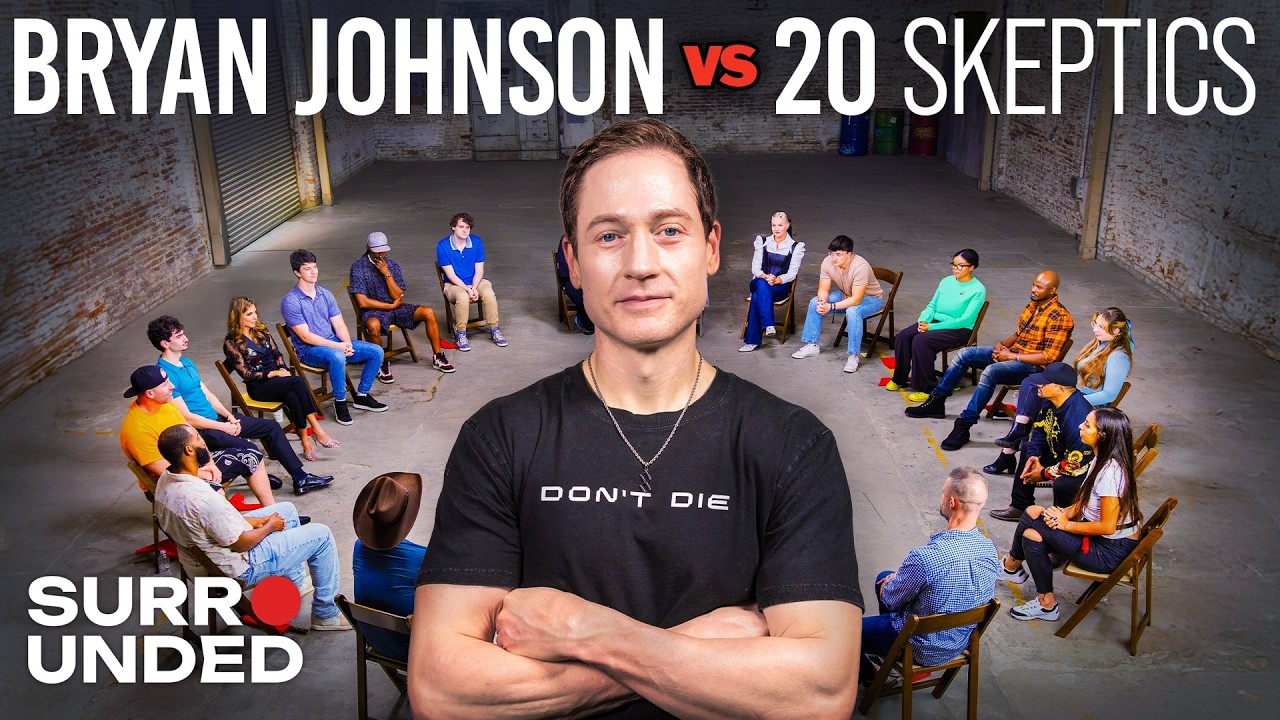
Bryan Johnson vs 20 Skeptics | Surrounded
Jubilee
Overview
This video features Bryan Johnson, known for his extreme anti-aging regimen, engaging in a debate with 20 skeptics about his core claims: that ending death should be humanity's top priority and that no one should ever eat fast food. The discussion delves into the role of AI in achieving longevity, the societal implications of valuing existence over death, the accessibility of health practices for different socioeconomic groups, and the nature of addiction versus personal choice. Skeptics challenge Johnson's views, questioning the scientific basis, the potential for overpopulation, the classist nature of his advice, and the very definition of a life well-lived.
How was this?
Save this permanently with flashcards, quizzes, and AI chat
Chapters
- Humanity's primary objective should be to end death, especially as we approach the era of superintelligent AI.
- This shift in focus from valuing death to valuing existence is a necessary step for intelligent life.
- While current evidence for ending human death is lacking, biological examples like jellyfish and hydra show that immortality is achievable.
- Societies have historically created religions and philosophies to cope with death, but this is the first time we might have the scientific means to overcome it.
Understanding this argument is crucial for grasping Johnson's overarching philosophy and his motivation for pursuing radical life extension.
Johnson draws a parallel between the historical justifications for death (reincarnation, afterlife, legacy) and the potential for a future where death is scientifically overcome.
- Modern society is built on the profit of death, with industries actively promoting behaviors that lead to illness and early demise.
- Behaviors like staying up late, consuming unhealthy foods, and engaging with addictive algorithms are forms of 'seeking death' that companies exploit.
- Introducing superintelligence into a death-valuing society sends the wrong signal; we should instead signal a value for existence.
- The pursuit of profit and status often leads individuals and corporations to disregard the negative consequences, including death.
This chapter highlights the critique of current societal norms and economic systems, framing them as actively detrimental to human well-being and longevity.
Companies creating addictive foods and algorithms are presented as profiting from behaviors that hasten death, creating a 'world built on the profit of death'.
- Johnson argues that 'existence' is the highest virtue because defining 'positive existence' is subjective and can lead to conflict.
- The universal agreement on 'not dying' makes it a more stable foundation for humanity than subjective definitions of a good life.
- The urgency to live tomorrow stems from the finite nature of life; removing death might diminish this urgency.
- Historical shifts in societal values, like the abolition of slavery, show that currently accepted norms, including the inevitability of death, can be challenged.
This section explores the philosophical underpinnings of Johnson's value system and addresses counterarguments about prioritizing well-being over mere existence.
The example of universal human rights and the end of slavery illustrates how deeply ingrained societal beliefs can change over time, suggesting the concept of death's inevitability can also be challenged.
- Skeptics argue that a world without death would lead to ecological collapse due to overpopulation and resource depletion.
- Natural cycles of turnover and transformation are essential for planetary health, as seen in the changing seasons.
- Johnson counters that humanity is already intervening in biology through medicine and technology, suggesting further intervention to extend life is a natural progression.
- He suggests that current concerns about overpopulation might be misplaced, as fertility rates are declining, and future challenges could be different.
This chapter addresses a significant practical concern about the consequences of eliminating death, forcing a consideration of ecological balance and natural cycles.
The analogy of seasons changing (summer to winter) is used to illustrate the natural process of turnover and renewal that is fundamental to ecosystems.
- Skeptics argue that Johnson's focus on longevity is a luxury accessible only to the wealthy, while the poor struggle daily for survival.
- For those living paycheck to paycheck, 'surviving' is the priority, not 'not dying' in the abstract sense Johnson promotes.
- Johnson claims he also experienced poverty and depression, and his current work is not about criticizing others but highlighting how industries create addiction and illness.
- His 'five core power laws' are presented as accessible principles, though critics question if his extreme regimen is truly egalitarian.
This is a critical point of contention, questioning the universality and ethical implications of Johnson's anti-aging pursuits in a world with significant economic inequality.
The example of people eating fast food not out of desire but out of necessity due to lack of time and money is used to illustrate the socioeconomic constraints on health choices.
- Skeptics question if Johnson's own intense focus on health and longevity is a form of addiction, merely rebranded as a 'pursuit'.
- Johnson asserts his actions are a pursuit of understanding and improving life, not an addiction, and that he shares his findings freely.
- The debate touches on personal sovereignty and the right to choose one's path, including the choice not to live.
- Johnson's past struggles with depression and suicidal ideation are shared to establish common ground on the value of life and hope.
This chapter delves into the psychological aspects of life extension and personal habits, examining whether the pursuit of health can become as detrimental as the behaviors it seeks to replace.
The question is posed: 'Do you not think that you're addicted to trying to stay alive?' highlighting the potential for obsession even in positive pursuits.
- Johnson believes superintelligent AI will be the key to overcoming death and unlocking new possibilities for human existence.
- Skeptics question the rapid progression of science, suggesting that only a fraction of knowledge has been discovered, making current anti-aging regimens potentially detrimental in the future.
- The brain's aging and deterioration are identified as a major hurdle, with current science unable to reverse it.
- Johnson acknowledges current limitations but emphasizes that history is filled with 'impossible' things becoming possible through scientific advancement.
This section addresses the technological and scientific underpinnings of Johnson's claims, exploring both the potential of AI and the uncertainties of scientific progress.
The example of Rapamycin, a drug Johnson took, which he later stopped due to side effects and new evidence, illustrates the evolving and sometimes contradictory nature of scientific findings in health.
- Johnson claims fast food companies use sophisticated science to create addictive products, leading to societal illness.
- Critics argue this claim is classist, as fast food is often a necessity for those with limited time and budget, not a choice driven by addiction.
- The value of enjoyment and moderation in life is contrasted with Johnson's strict dietary philosophy.
- Johnson proposes a societal shift where consumers stop demanding 'poison' and companies are incentivized to produce healthier options.
This chapter focuses on a specific, tangible aspect of Johnson's philosophy, revealing deep divisions on personal responsibility, societal structures, and the definition of a fulfilling life.
The argument that fast food companies 'hit a peak dopamine moment in the brain' by using the 'right amount of fats, proteins, and sugars' to make people addicted.
- Some argue that death is a 'promotion' or a natural, earned end to a life well-lived, rather than something to be avoided at all costs.
- Historical texts from various religions suggest ancient cultures believed in long lifespans or immortality, which eventually ended, possibly due to negative consequences like overpopulation.
- The importance of social connection and community is highlighted as a key factor in a fulfilling life, potentially more so than strict adherence to health regimens.
- Johnson's personal journey from depression and suicidal ideation to finding meaning in existence is presented as a source of hope and purpose.
This chapter presents alternative philosophical and cultural viewpoints on death and longevity, offering a broader context for Johnson's radical ideas.
The mention of ancient texts like the Sumerian King List, which describe rulers living for tens of thousands of years, is used to suggest that the concept of extreme longevity is not entirely new.
Key takeaways
- The pursuit of ending death is presented as a potential new primary objective for humanity, especially in the context of advancing AI.
- Societal structures and industries can actively promote behaviors that lead to poor health and early death, driven by profit motives.
- There is a significant debate about whether prioritizing mere existence is more valuable than pursuing a subjectively defined 'positive existence' or happiness.
- The accessibility and class implications of extreme health and longevity practices are a major point of contention, with critics arguing they are often luxuries for the wealthy.
- The role of personal choice, addiction, and the potential for even positive pursuits to become obsessive is a complex ethical consideration.
- While AI is seen by some as a key to overcoming death, others question the current pace of scientific progress and the potential long-term risks of radical life extension.
- The debate highlights a fundamental tension between individual responsibility for health choices and the influence of societal systems and economic pressures.
- Alternative perspectives suggest that death can be viewed as a natural transition or 'promotion' and that social connection is vital for a fulfilling life.
Key terms
Biological agingChronological ageSuperintelligenceExistential momentValue of existenceProfit of deathClassistEgalitarianAddictionPersonal sovereigntyHealthspanLongevitySocietal norms
Test your understanding
- What is Bryan Johnson's primary argument for why ending death should be humanity's number one objective?
- How do skeptics argue that current societal structures and industries contribute to 'the profit of death'?
- Explain the core of the argument that Johnson's pursuit of longevity might be classist.
- What is the difference between Johnson's view of 'existence' as the highest virtue and the idea of prioritizing 'positive existence' or happiness?
- How does the debate address the potential ecological consequences of humans not dying?