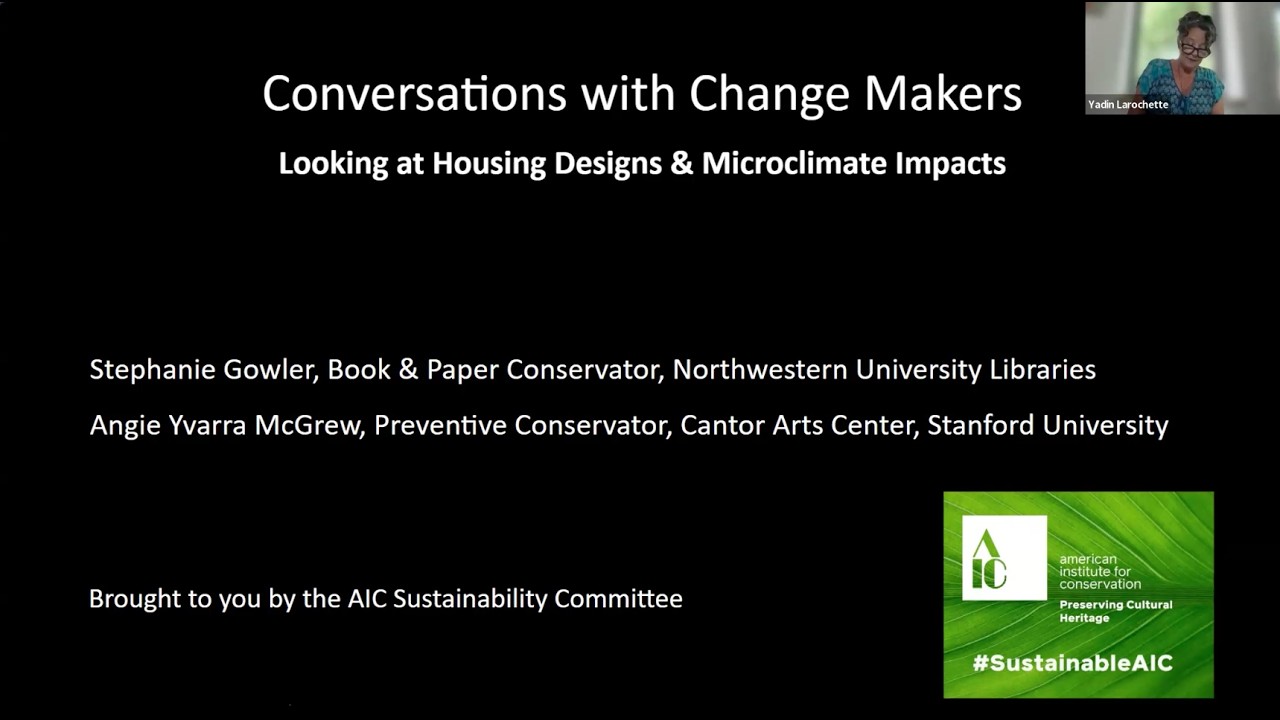
Conversations with Change Makers: Looking at Housing Design & Microclimate Impacts
AIC & FAIC
Overview
This video features conservators Stephanie Gowler and Angie Ivara McGru discussing innovative housing solutions for cultural heritage collections. They emphasize how custom-designed enclosures not only protect artifacts from environmental fluctuations and physical damage but also enhance accessibility for researchers and the public. The discussion highlights sustainable practices, such as reusing materials and minimizing waste, and touches upon the impact of microclimates within storage environments. Both speakers share practical examples and techniques, showcasing how thoughtful housing design contributes to the long-term preservation and usability of diverse collections, from rare books to three-dimensional objects.
Save this permanently with flashcards, quizzes, and AI chat
Chapters
- The video introduces the AIC Sustainability Committee's series on energy use and environmental impact in cultural heritage storage.
- Stephanie Gowler and Angie Ivara McGru present their work on housing designs for collections.
- Housing serves multiple purposes: protecting objects, buffering environmental changes, improving accessibility, protecting people from hazardous materials, preventing loss, keeping associated items together, and signaling care for collections.
- The importance of considering the entire lifecycle of a collection, from acquisition to storage and use, is implicitly highlighted.
- For circulating collections, housings like polyethylene dust covers and four-flap wrappers increase visibility on shelves and provide environmental buffering for items leaving controlled environments.
- A minimum housing size standard (5.5 x 7.5 inches) is used, with smaller items retrofitted into larger housings using scrap materials.
- Special collections utilize similar methods, including custom-fit case boxes with internal supports (e.g., cellofoam sockets) for multi-piece items like Fluxus art or objects like Vuvuzelas, allowing them to be shelved like books.
- Wedge-shaped books or vellum-covered books may require specialized restraint boxes to counteract environmental warping.
- Manuscript and archival collections with interspersed 3D items are housed together in padded folders or document cases to maintain sequence.
- Polyester film encapsulation, sewn with mattboard stubs, creates binders for fragile items like old album pages or fair tickets, allowing safe viewing.
- Commercially available three-ring binder boxes are adapted with sleeves (e.g., for baseball cards) to house collections of small objects like political memorabilia (buttons).
- Corrugated board trays stacked within banker's boxes are used for large collections of objects, enabling easy access to the entire collection with minimal individual handling.
- Housings can protect conservators from hazardous materials; for example, beaded bags containing arsenic and lead are placed in muslin sleeves within padded folders to contain debris and minimize direct contact.
- Standardized hazard labels are used on housings for clear identification.
- Viewing windows made of materials like Mylar or Tyvek can be incorporated into housings (e.g., padded folders) to allow object inspection without removal, reducing handling.
- Examples include a movie clapboard with a Tyvek window and paintings on mica housed on transparent polyester film.
- A mini-experiment showed that buffered housings (using corrugated board and paper, or ethofoam) significantly stabilized temperature and relative humidity compared to the ambient storage environment.
- This buffering effect is crucial in less controlled storage spaces, mitigating fluctuations from external conditions like proximity to Lake Michigan.
- Northwestern's conservation lab is a designated Green Lab, emphasizing sustainability through practices like using scrap materials for housing construction.
- Recycling programs are in place for Tyvek scraps (through DuPont) and plastic films (through Terracycle).
- Key tools include the Fletcher wall-mounted board cutter for accuracy and speed, gridded cutting mats, and sturdy worktables.
- Various punches (e.g., CS Osborne, multi-size sets from McMaster-Carr) are used for creating clean holes and shapes, with advice to invest in quality tools.
- Custom punches can be made from materials like electrical conduit for specific foam shapes.
- Templates and worksheets are developed to ensure consistency and aid decision-making in box construction, with detailed instructions and markings on the board.
- Incorporating viewing windows (Mylar or Tyvek) into boxes enhances accessibility, often using double-sided tape for attachment.
- Shallow boxes with deep lids are designed for easy access to objects, with careful alignment of box and lid dimensions.
- Drop-front boxes, sometimes using slot-and-tab construction without glue, offer further accessibility, especially for fragile items.
- Angled trays within boxes can create self-placing compartments for multiple items, optimizing space and access.
- Standardizing box sizes can lead to space gains by utilizing shelf footprints efficiently, though initial rearrangement may be necessary.
- The decision to rehouse is often driven by new acquisitions, items coming off display, or curatorial requests.
- While standardization can optimize space, the primary goal is often improved accessibility and safe handling, even if it means sacrificing some storage density.
- Future HVAC system replacements necessitate considering housings as 'boxes within boxes' to manage environmental control more effectively.
Key takeaways
- Effective housing is a critical preservation strategy that goes beyond simple containment, actively buffering environmental changes and protecting objects from physical stress.
- Resourcefulness, such as the extensive reuse of scrap materials, is a cornerstone of sustainable conservation practices.
- Custom housing design can significantly improve the accessibility of collections for researchers, educators, and the public, facilitating engagement and study.
- The choice of housing materials and construction methods must consider the specific needs and potential hazards of the object being stored.
- Even simple housings can create a more stable microclimate, reducing the impact of fluctuations in temperature and relative humidity.
- Investing in quality tools and developing standardized procedures, like templates and worksheets, leads to more efficient and consistent housing production.
- The integration of viewing windows and accessible designs allows for object examination with minimal handling, reducing risk and increasing usability.
- Balancing space optimization with accessibility and preservation needs is a key challenge in collection management, often requiring strategic compromises.
Key terms
Test your understanding
- What are the primary functions of housing for cultural heritage collections beyond simple storage?
- How can the reuse of scrap materials contribute to both sustainability and cost-effectiveness in conservation housing projects?
- Describe how custom housing designs can enhance the accessibility of diverse collection items for researchers.
- Explain the concept of microclimate buffering and why it is important for collections stored in less controlled environments.
- What are some key tools and techniques mentioned that aid in the precise and efficient construction of archival housings?