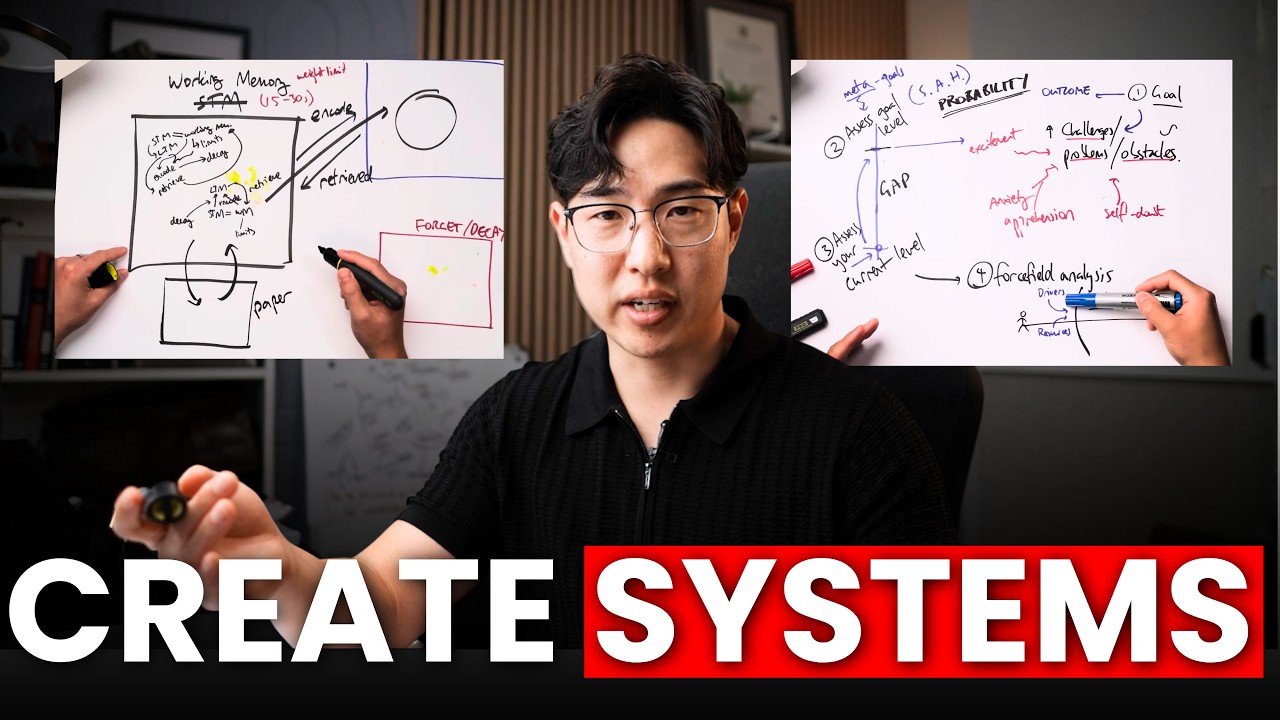
Productivity is Hard Until You Build Systems Like This
Justin Sung
Overview
This video presents a four-part productivity system designed to make consistent productivity more achievable by focusing on intentionality, energy management, pre-decision making, and environmental cues, rather than relying on motivation. It redefines productivity as progress towards personal goals, not just busyness. The system involves defining personal goals, matching tasks to natural energy levels (flow matching), creating pre-determined decisions for potential obstacles (scripted actions), and optimizing environmental triggers (action architecture). The underlying principle is to reduce the cognitive load on the prefrontal cortex, which fatigues easily, by making as many decisions as possible in advance and leveraging environmental cues to guide behavior.
Save this permanently with flashcards, quizzes, and AI chat
Chapters
- Productivity is not about being busy or disciplined like a robot, but about taking actions that move you towards your own defined goals.
- Toxic productivity arises from the pressure to constantly be at peak performance and optimize for optimization's sake.
- Personal goals determine what is productive; activities like socializing, hobbies, and rest can be highly productive if they support your overarching goals and well-being.
- Focus on 2-3 most meaningful outcomes rather than a long list of tasks to clarify what truly matters.
- Humans naturally experience fluctuations in cognitive energy throughout the day, with peaks and troughs.
- Flow matching involves scheduling complex, cognitively demanding tasks during periods of high energy (cognitive peaks) and simpler, administrative tasks during lower energy periods.
- This strategy reduces wasted time and energy, leading to higher quality output and avoiding the need for compensatory overtime.
- Research suggests productivity significantly diminishes after approximately 50 hours per week, with diminishing returns on extra hours.
- Identify high-risk tasks in your schedule – those you intend to do but are likely to be derailed by common obstacles.
- Create 'scripted actions' by making predetermined decisions for these predictable risks ('if X happens, then I will do Y').
- This reduces the gap between intention and behavior by removing the need for complex decision-making when fatigued.
- Scripted actions leverage the understanding of prefrontal cortex (PFC) fatigue, conserving mental energy for when it's most needed.
- Motivation accounts for only a small portion of action; environmental cues are more powerful triggers for behavior.
- Action architecture involves intentionally designing your environment with cues that prompt desired behaviors and removing cues that lead to distractions.
- This shifts focus from motivation-dependent productivity to cue-dependent productivity, making actions more automatic.
- Clear, specific cue-response pairings are essential for building habits, as complex behaviors are not typically habits but sequences of decisions.
- Chronic prefrontal cortex fatigue can occur if recovery is inadequate, leading to persistent tiredness and laziness.
- While sleep is important, it may not fully address PFC fatigue; specific recovery strategies are necessary.
- Recognizing and addressing the signs of PFC fatigue is crucial for long-term productivity and well-being.
- The video suggests a separate resource for detailed recovery strategies.
Key takeaways
- True productivity is defined by progress towards your personal goals, not by busyness or external validation.
- Aligning cognitively demanding tasks with your natural energy peaks (flow matching) significantly enhances efficiency and output quality.
- Proactively making decisions for predictable obstacles (scripted actions) conserves mental energy and increases the likelihood of follow-through.
- Designing your environment with specific cues that trigger desired actions (action architecture) is more effective than relying on motivation.
- Habits are built on clear cue-response pairings, not just the repetition of complex behaviors.
- Sustained productivity depends on effective recovery strategies to combat prefrontal cortex fatigue.
- The most impactful productivity gains often come from planning and preparation done in advance, not from last-minute effort.
Key terms
Test your understanding
- How does the video's definition of productivity differ from the common perception of being busy?
- What is flow matching, and why is it important for managing your daily tasks?
- Explain the concept of scripted actions and how they help overcome decision fatigue.
- How does action architecture leverage environmental cues to improve productivity?
- What is prefrontal cortex fatigue, and what are its implications for productivity and decision-making?