3:04
Cell diversity, shape and size
Teacher's Pet
Overview
This video explores the diversity of cell size, shape, and function, emphasizing how a cell's form is intrinsically linked to its purpose. It explains the critical importance of a high surface area to volume ratio for efficient material transport, using cube analogies. The video also outlines the fundamental components common to all cells (membrane, cytoplasm, DNA) and differentiates between prokaryotic and eukaryotic cells based on their internal structures and complexity. Finally, it touches upon the organization of cells into tissues, organs, and organ systems in multicellular organisms, highlighting the concept of division of labor.
How was this?
Save this permanently with flashcards, quizzes, and AI chat
Chapters
- Cell shape is directly related to its specific function within an organism.
- Cells must be small to maintain an efficient surface area to volume ratio.
- A high surface area to volume ratio facilitates the transport of necessary materials into the cell and waste products out.
Understanding the relationship between cell shape and function helps predict a cell's role, while the size constraint explains why cells are microscopic and crucial for organismal efficiency.
Smooth muscle cells are elongated to facilitate contraction and movement of substances like food.
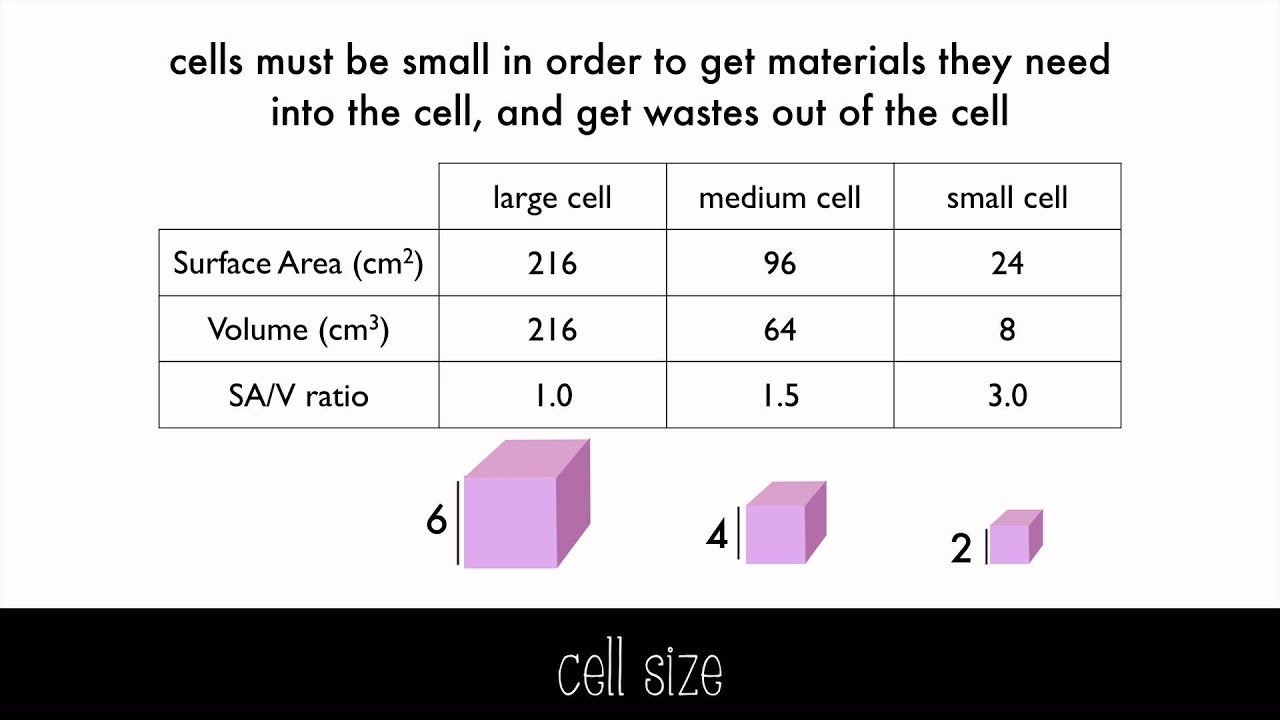
- As a cell increases in size, its volume grows faster than its surface area.
- Smaller cubes have a significantly higher surface area to volume ratio compared to larger cubes.
- This ratio is critical for cells to exchange substances with their environment effectively.
This principle explains why cells cannot grow indefinitely large; maintaining a favorable ratio is essential for survival and metabolic processes.
A small cube (2cm edge) has a surface area to volume ratio of 3:1, while a large cube (6cm edge) has a ratio of 1:1, meaning the smaller cube has proportionally more surface for exchange.
- All cells, regardless of type, share three fundamental components: a cell membrane, cytoplasm, and a control center containing DNA.
- The cell membrane regulates the passage of substances into and out of the cell.
- Cytoplasm is the jelly-like substance filling the cell, containing the cytoskeleton and, in eukaryotes, organelles.
- The DNA-containing control center directs cell functions and reproduction.
Recognizing these common elements provides a foundational understanding of cellular biology and allows for comparison across different cell types.
Both animal cells and bacterial cells possess a cell membrane, cytoplasm, and DNA.
- Eukaryotic cells possess a true nucleus that houses their DNA and are generally larger and more complex.
- Prokaryotic cells lack a nucleus; their DNA is loosely coiled in the cytoplasm.
- Eukaryotes also have membrane-bound organelles, which prokaryotes lack.
- Organisms like plants and animals are composed of eukaryotic cells, while bacteria are prokaryotic.
Distinguishing between prokaryotes and eukaryotes is fundamental to understanding the vast diversity of life and the evolutionary history of cells.
Plant cells (eukaryotic) have a nucleus and chloroplasts, while bacterial cells (prokaryotic) do not.
- Multicellular organisms exhibit levels of organization that enable a division of labor among cells.
- Cells group together to form tissues, which combine to create organs.
- Organs work together as organ systems to perform complex functions for the organism.
- This specialization allows different parts of the body to focus on specific tasks, increasing overall efficiency.
This hierarchical organization explains how complex life forms function, with specialized cells contributing to the survival and operation of the entire organism.
Smooth muscle cells form muscle tissue, which is part of the stomach organ, which is part of the digestive system, enabling nutrient absorption for the entire organism.
Key takeaways
- A cell's physical shape is a direct indicator of its specialized function.
- The efficiency of a cell's internal processes is dictated by its surface area to volume ratio, favoring smaller sizes.
- All cells share essential components: a boundary (membrane), internal environment (cytoplasm), and genetic material (DNA).
- The presence or absence of a nucleus and membrane-bound organelles is the primary distinction between prokaryotic and eukaryotic cells.
- Multicellularity allows for complex organisms through the division of labor, organized from cells to tissues, organs, and systems.
- Understanding cell structure and function is foundational to comprehending all of biology.
Key terms
Cell shapeCell sizeSurface area to volume ratioCell membraneCytoplasmDNAProkaryoteEukaryoteNucleusOrganellesMulticellular organismDivision of labor
Test your understanding
- How does a cell's shape relate to its specific job within an organism?
- Why is a high surface area to volume ratio crucial for cell survival and function?
- What are the three essential components found in all cells, and what is the primary role of each?
- What key structural differences distinguish prokaryotic cells from eukaryotic cells?
- How does the concept of 'division of labor' apply to the organization of cells in multicellular organisms?