AI-Generated Video Summary by NoteTube
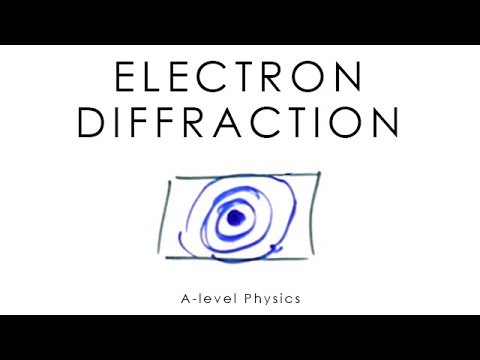
Electron Diffraction - A-level Physics
Science Shorts
Overview
This video explains the phenomenon of electron diffraction, a key piece of evidence for the wave-particle duality of matter. It begins by drawing parallels to Young's double-slit experiment with light, highlighting that diffraction and interference are characteristic of wave behavior. The video then introduces the concept that particles, like electrons, also exhibit wave-like properties, a concept first proposed by Louis de Broglie. This wave nature is only observable when particles interact with extremely small apertures, comparable to atomic dimensions. The experiment involves firing electrons at a thin metal foil, resulting in a circular diffraction pattern on a phosphorescent screen, analogous to the interference patterns produced by light waves. The de Broglie wavelength formula (λ = h/p) is presented, emphasizing that it's inversely proportional to momentum. The video also discusses the practical aspects of generating electrons with specific speeds using an electron gun and calculating their kinetic energy and velocity based on the accelerating voltage.
Want AI Chat, Flashcards & Quizzes from this video?
Sign Up FreeChapters
- •Young's double-slit experiment demonstrates the wave nature of light through diffraction and interference.
- •Light exhibits both wave-like (diffraction) and particle-like (photoelectric effect) properties.
- •The video questions whether particles like electrons also exhibit wave-like behavior.
- •Electron diffraction is observed only with very small gaps, on the order of atomic sizes (picometers).
- •When electrons are fired at a thin metal foil, a circular diffraction pattern is observed on a screen.
- •This pattern, consisting of concentric bright and dark fringes, is evidence of electron diffraction and interference.
- •The observation of diffraction and interference proves that particles, like electrons, also act like waves.
- •Louis de Broglie proposed the concept of matter waves and the de Broglie wavelength.
- •The de Broglie wavelength (λ) is given by the formula λ = h/p, where h is Planck's constant and p is the momentum (mass x velocity).
- •To observe meaningful diffraction, particles must have a sufficiently large wavelength.
- •This is why diffraction is seen with light electrons but not with larger particles (their wavelength is too small).
- •Electrons should not be too fast; higher speeds result in smaller wavelengths, making diffraction difficult to observe.
- •An electron gun generates electrons from a cathode and accelerates them towards an anode with a hole.
- •The potential difference (PD) between the cathode and anode is the accelerating voltage (VA).
- •The energy gained by the electrons is their kinetic energy (KE = 1/2 mv^2).
- •The energy gained by an electron is equal to the charge of the electron (e) multiplied by the accelerating voltage (VA).
- •KE = e * VA = 1/2 mv^2.
- •The speed (v) of the electron can be calculated by rearranging the kinetic energy formula: v = sqrt(2 * e * VA / m).
- •This speed can then be used in the de Broglie wavelength formula to find the electron's wavelength.
Key Takeaways
- 1Electron diffraction provides strong evidence for the wave nature of particles.
- 2The de Broglie hypothesis states that all matter exhibits wave-like properties.
- 3The de Broglie wavelength is inversely proportional to a particle's momentum.
- 4Observable diffraction requires wavelengths comparable to the size of the interacting structures (e.g., atomic dimensions).
- 5Electron diffraction experiments typically use thin metal foils with atomic-scale structures.
- 6The accelerating voltage in an electron gun determines the kinetic energy and speed of the electrons.
- 7The relationship between kinetic energy, accelerating voltage, and electron speed allows for calculation of the de Broglie wavelength.