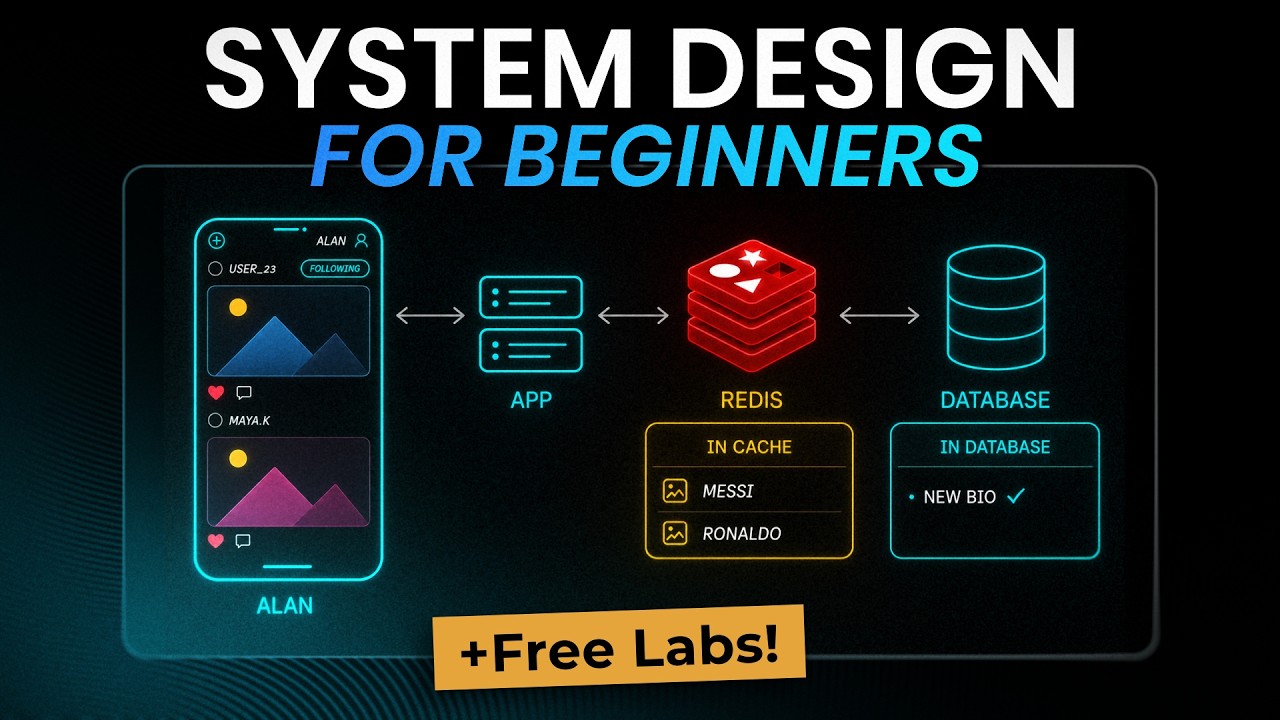
System Design for Beginners (2026)
KodeKloud
Overview
This video introduces system design for beginners by walking through the process of building a photo-sharing application. It explains core concepts like load balancing, caching, replication, and sharding by introducing them as solutions to problems encountered as the application scales. The video differentiates between high-level and low-level design, emphasizes the importance of functional and non-functional requirements, and discusses architectural choices like monolith vs. microservices. It also covers scaling strategies (vertical vs. horizontal), the request lifecycle (DNS, HTTP/S), stateful vs. stateless servers, data modeling, SQL vs. NoSQL databases, indexing, and caching strategies like TTL and invalidation.
Save this permanently with flashcards, quizzes, and AI chat
Chapters
- System design is the skill of selecting and arranging software components to solve a problem.
- It's crucial for transitioning from junior to senior engineering roles, where responsibilities shift from feature development to system architecture.
- Learning system design involves understanding how systems are built and how they fail.
- The course uses a hands-on approach by designing a real application and introducing concepts as needed.
- Initial setup with one server fails under high traffic due to CPU/RAM overload.
- A load balancer distributes traffic across multiple servers to prevent overload.
- Databases become bottlenecks when handling repetitive queries; caching popular data in memory speeds up responses.
- Single points of failure (e.g., server death) are addressed by replicating data and using external storage.
- High-Level Design (HLD) focuses on the overall architecture, components, and data flow (e.g., designing Instagram).
- Low-Level Design (LLD) focuses on the implementation details of a specific feature or component (e.g., designing the 'like' button functionality).
- Functional requirements define what the app should do (e.g., upload photo, sign up).
- Non-functional requirements define how well the app should perform (e.g., speed, availability, durability, cost).
- Monolith architecture: a single codebase deployed as one unit, simpler for small teams and early stages.
- Microservices architecture: breaking the application into small, independent services, allowing for independent scaling and team autonomy.
- Monoliths are suitable for smaller applications due to simplicity and fewer inter-service communication issues.
- Microservices are beneficial for large applications needing independent scaling of components or for large development teams.
- Vertical scaling: increasing the resources (CPU, RAM) of a single server; simple but has limits and high costs.
- Horizontal scaling: adding more servers to distribute the load; offers unlimited scalability and fault tolerance.
- The request lifecycle involves DNS lookup, HTTPS request to a server (often via a load balancer), server processing, and response.
- Latency (round-trip time) and bandwidth (data throughput) are key performance metrics.
- Load balancers distribute incoming traffic across multiple servers, acting as a reverse proxy.
- They perform health checks to ensure traffic is only sent to active, responsive servers.
- Stateful servers store session data locally, causing issues when requests are routed to different servers.
- Stateless servers do not store client-specific state, making them disposable and easier to scale horizontally; state is managed externally (e.g., in a shared store).
- Data modeling involves defining what data to store and how it relates, starting with user access patterns.
- SQL databases are ideal for structured, relational data with clear schemas and transactions (ACID properties).
- NoSQL databases are suited for unstructured or semi-structured data, offering flexibility and horizontal scalability.
- Real-world systems often use a polyglot persistence approach, employing both SQL and NoSQL databases for different data types.
- Indexing speeds up database queries by creating lookup structures for specific columns (e.g., 'posted_by', 'upload_time').
- Indexes improve read performance but add overhead to write operations.
- Caching stores frequently accessed data in a fast, in-memory store (like Redis) to reduce database load and latency.
- Cache consistency is managed using Time-To-Live (TTL) or active invalidation to prevent serving stale data.
Key takeaways
- System design is about solving problems by choosing and arranging components, often driven by scaling needs and failure scenarios.
- Understanding non-functional requirements (speed, reliability, cost) is as important as functional requirements for designing robust systems.
- Stateless servers are key to horizontal scaling, enabling applications to handle massive traffic by making servers easily replaceable.
- The choice between SQL and NoSQL databases depends heavily on the data's structure and access patterns.
- Indexing and caching are essential techniques to optimize database performance and reduce latency.
- Every design decision involves trade-offs, and the goal is to meet requirements cost-effectively.
- System design is an iterative process of identifying problems, applying solutions, and managing the new challenges that arise.
Key terms
Test your understanding
- What is the primary difference between functional and non-functional requirements, and why are both critical in system design?
- How does a load balancer contribute to the scalability and availability of an application?
- Explain why stateless servers are preferred over stateful servers for horizontal scaling, and what mechanisms are used to manage state externally?
- When would you choose a SQL database over a NoSQL database for storing application data, and vice-versa?
- What is the purpose of indexing in a database, and what are the trade-offs of adding too many indexes?