6:36
Machine Learning Fundamentals: Bias and Variance
StatQuest with Josh Starmer
Overview
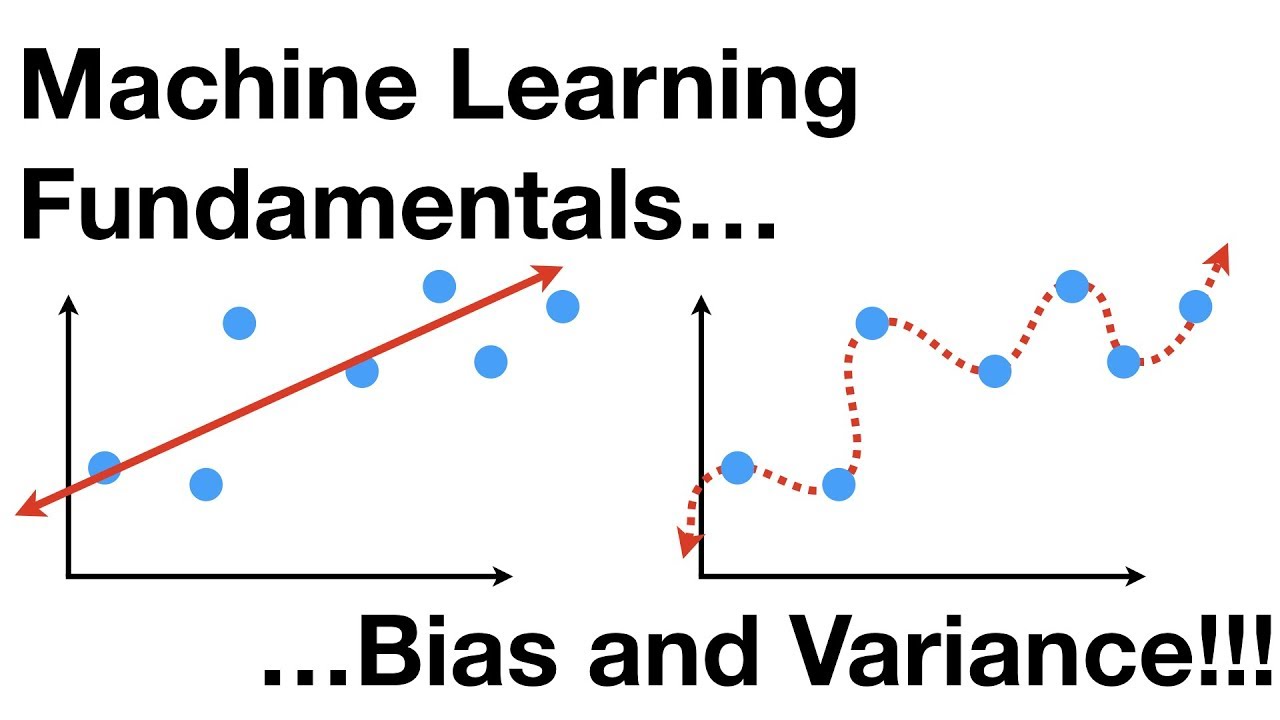
This video explains the fundamental machine learning concepts of bias and variance using a real-world example of predicting mouse height from weight. It illustrates how different models, like a simple linear regression (high bias, low variance) and a complex, flexible model (low bias, high variance), fit training data versus testing data. The core idea is to find a balance between model simplicity and complexity to achieve good generalization, avoiding both underfitting (high bias) and overfitting (high variance). Techniques like regularization, boosting, and bagging are mentioned as methods to find this optimal balance.
How was this?
Save this permanently with flashcards, quizzes, and AI chat
Chapters
- The goal is to predict a mouse's height based on its weight.
- The true relationship between weight and height is unknown and likely non-linear.
- Machine learning models are used to approximate this unknown relationship.
- Data is split into training sets (for model building) and testing sets (for evaluation).
Understanding the problem setup with a concrete example helps in visualizing the abstract concepts of bias and variance that will be explained later.
Plotting the weight and height of mice, where lighter mice are shorter and heavier mice are taller, but obesity doesn't increase height.
- Bias measures how far off a model's predictions are from the true values, on average.
- A simple linear regression model (a straight line) has high bias because it cannot capture the curved nature of the true relationship.
- High bias means the model is too simple and makes strong assumptions that don't fit the data well (underfitting).
- The sum of squared errors on the training data is used to quantify how well a model fits.
Bias highlights the limitations of overly simplistic models that fail to capture the underlying patterns in the data, leading to systematic errors.
A straight line failing to follow the arc of the true relationship between mouse weight and height, even when fit to the training data.
- Variance measures how much a model's predictions would change if trained on different datasets.
- A highly flexible, 'squiggly' line model can fit the training data perfectly but is sensitive to noise and specific data points.
- This sensitivity leads to high variance, meaning the model performs very differently on training versus testing data.
- High variance indicates the model has learned the training data too well, including its noise (overfitting).
Variance reveals the danger of overly complex models that become too tailored to the training data, leading to poor performance on new, unseen data.
A 'squiggly' line that perfectly matches the training data points but deviates significantly from the true relationship when applied to the separate testing data.
- The ideal machine learning model has both low bias and low variance.
- There is a trade-off: reducing bias often increases variance, and reducing variance often increases bias.
- The goal is to find a 'sweet spot' that balances simplicity (low variance) and complexity (low bias) for good generalization.
- Overfitting occurs when a model has low bias but high variance, performing well on training data but poorly on testing data.
Recognizing the bias-variance trade-off is crucial for selecting or building models that generalize well to new data, rather than just memorizing the training set.
Comparing the straight line (high bias, low variance) and the squiggly line (low bias, high variance) to show how one excels on training data while the other excels on testing data, illustrating the trade-off.
- Techniques exist to find the optimal balance between bias and variance.
- Regularization, boosting, and bagging are common methods to manage this trade-off.
- Bagging, as seen in Random Forests, is one approach to reduce variance.
- Future Stat Quests will cover regularization and boosting in more detail.
Knowing these techniques provides practical strategies for building more robust and accurate machine learning models in real-world applications.
Mentioning Random Forests as an example of bagging, a technique used to find the sweet spot between bias and variance.
Key takeaways
- Bias represents a model's tendency to consistently miss the mark due to oversimplification.
- Variance represents a model's sensitivity to the specific training data, leading to inconsistent performance on new data.
- Underfitting occurs when a model has high bias and fails to capture the underlying data patterns.
- Overfitting occurs when a model has high variance and learns the training data's noise, failing to generalize.
- The goal in machine learning is to minimize both bias and variance, finding a balance between model complexity and simplicity.
- Techniques like regularization, boosting, and bagging are employed to navigate the bias-variance trade-off and improve model generalization.
Key terms
BiasVarianceLinear RegressionTraining SetTesting SetSum of SquaresOverfittingUnderfittingGeneralizationRegularizationBoostingBagging
Test your understanding
- What is the difference between bias and variance in the context of machine learning models?
- Why does a simple linear model tend to have high bias?
- How does overfitting relate to high variance?
- What is the primary goal when trying to find the 'sweet spot' between bias and variance?
- How can techniques like regularization, boosting, or bagging help improve a model's performance?