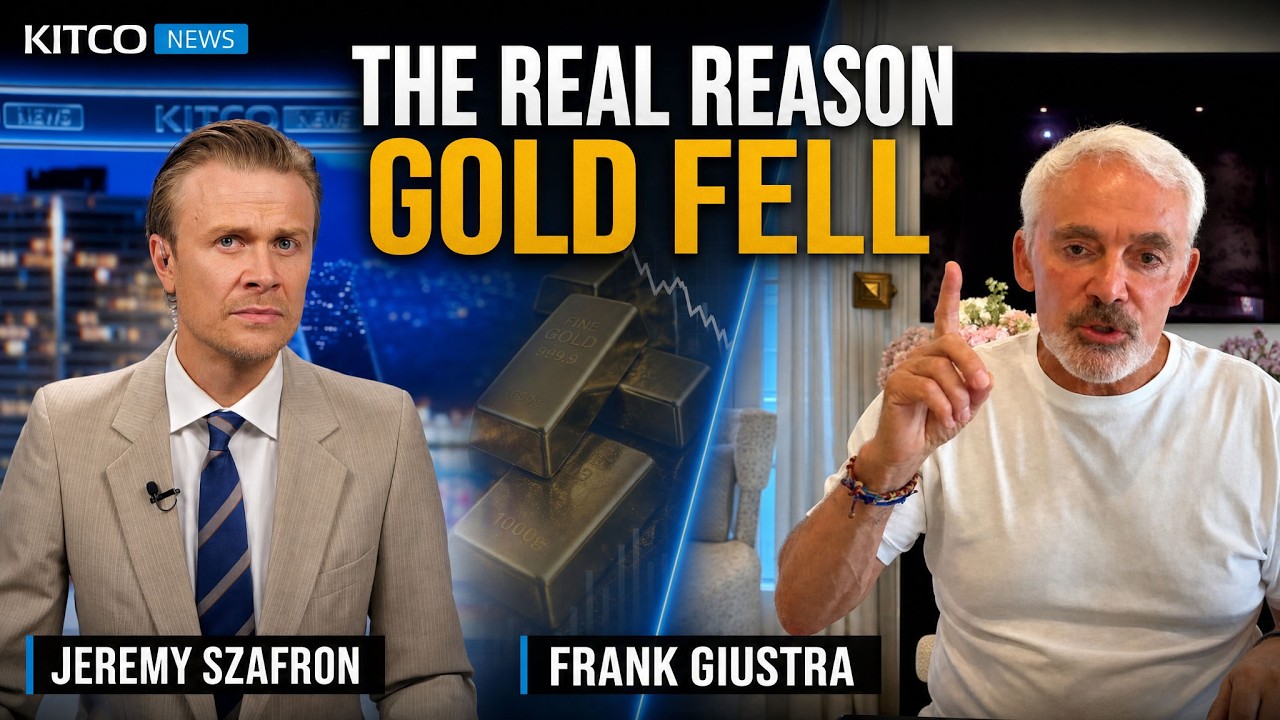
The Real Reason Gold Sold Off This Week | Frank Giustra
Kitco NEWS
Overview
This video discusses the recent sell-off in gold prices, challenging the mainstream narrative that it signifies the end of a bull market. Instead, the speaker argues that a structural shift is occurring in the gold market, driven by central bank diversification away from the US dollar due to geopolitical risks and concerns about US fiscal policy. The discussion also touches upon the future of the US dollar, the potential rise of alternative payment systems, and the strong outlook for copper driven by electrification and AI demand. The speaker, Frank Giustra, shares his investment philosophy, emphasizing long-term value in gold and copper, particularly in development projects with strong fundamentals.
Save this permanently with flashcards, quizzes, and AI chat
Chapters
- The US president's decision to unfreeze Iranian assets, citing the need to maintain global confidence in the dollar, signals a vulnerability in dollar dominance.
- Increased use of Chinese Yuan and crypto for oil trade, alongside record central bank gold purchases, indicates a move away from dollar reliance.
- Despite these trends, gold prices have fallen, and the dollar has strengthened, prompting a re-evaluation of the market narrative.
- A structural change in the gold market is underway, moving beyond traditional drivers and influenced by long-term central bank strategies.
- The freezing of Russian reserves by the US has instilled fear among nations about asset seizure, accelerating de-dollarization efforts.
- China is actively building alternative financial systems, like the M-Bridge project, to operate outside the US dollar's influence.
- The US's escalating national debt and interest costs, coupled with reckless fiscal policy, are making investors question the dollar's long-term stability.
- Gold is presented as the only truly neutral global currency with no counterparty risk, making it an attractive alternative for central banks.
- The traditional inverse relationship between gold, the dollar, and interest rates has broken down, with gold rising even with a strong dollar and positive real rates.
- This shift is attributed to consistent, strategic buying by global central banks, particularly non-Western ones, who operate on long-term objectives.
- While speculative investors and short-term traders are exiting, leading to price corrections, central bank demand remains 'price inelastic'.
- The value of foreign central bank gold holdings has increased significantly, reflecting both price appreciation and a strategic rotation from dollars.
- Premiums for physical gold and silver in Asian markets (China, Japan, Korea) indicate strong demand for tangible assets over paper derivatives.
- The paper gold market is seen as heavily manipulated, with price discovery increasingly influenced by those taking physical delivery.
- While some countries like Russia and Turkey have sold gold for specific reasons (war financing, currency defense), overall central bank net buying continues.
- The M-Bridge project, involving China, Hong Kong, UAE, Saudi Arabia, and Thailand, is developing a cross-border payment system outside the US dollar.
- The US is spending over $1.3 trillion annually on interest payments, a figure projected to rise significantly.
- Ferguson's Law suggests a great power's decline begins when interest costs exceed military spending; the US reportedly crossed this threshold in 2024.
- Historical patterns show great powers repeating mistakes of overextension, excessive consumption, and debt-fueled spending.
- The US dollar's global dominance is slowly eroding, with about 20% of oil now traded in non-dollar terms, and China actively promoting Yuan usage.
- The M-Bridge project and central bank gold accumulation suggest a future where gold could serve as a global settlement asset.
- China's establishment of physical gold vaults in key locations (Hong Kong, UAE, Saudi Arabia) supports this theory.
- Surplus currencies from bilateral trade outside the dollar system could be exchanged for physical gold, solving the 'what to hold' problem.
- The current fiat currency experiment is seen as failing, with gold poised to play a more significant role in a restructured global monetary system.
- Copper has hit record prices driven by a structural supply deficit and surging demand from electrification, AI, and data centers.
- Significant new copper mines are needed, but developing them is capital-intensive, time-consuming, and faces permitting challenges.
- The speaker believes copper prices must rise significantly to incentivize the necessary production to meet demand.
- While gold is a monetary asset, copper's value is primarily driven by industrial demand and supply constraints.
- The speaker advocates for a long-term investment approach, focusing on companies with strong fundamentals, good management, and significant 'grade and scale'.
- Development projects with high upside potential that are fully explored and de-risked are preferred over early-stage exploration.
- Mergers and acquisitions (M&A) in the mining sector are expected to increase as majors seek new, high-quality assets.
- Investors should be patient, as bull markets in mining stocks often lag the commodity price itself, and euphoria has not yet set in.
- Political risk and the threat of asset seizure are inherent in mining but are typically priced into valuations, especially for companies operating in less stable jurisdictions.
- While the US and Canada are improving permitting processes, they still face challenges compared to historically mining-friendly regions.
- The speaker recommends a diversified approach, including physical gold for wealth preservation and miners for potential capital appreciation.
- Caution is advised against overvalued tech stocks, with a preference for international companies paying dividends and trading at reasonable multiples.
Key takeaways
- The global financial system is undergoing a profound shift away from US dollar dominance, driven by geopolitical tensions and US fiscal policy.
- Central banks are strategically diversifying into gold, viewing it as a stable, neutral reserve asset, which is a primary driver of its long-term value.
- The traditional relationship between gold, the dollar, and interest rates has changed, indicating a new market regime.
- Physical gold demand is increasing, with premiums in Asian markets suggesting a move away from manipulated paper markets.
- US fiscal irresponsibility, characterized by high debt and interest costs, poses a long-term risk to the dollar's status.
- Copper is poised for significant growth due to a structural supply deficit and rising demand from technological advancements.
- Long-term investment success in mining relies on identifying quality assets, strong management, and patience, rather than chasing short-term trends.
- While geopolitical risks exist in mining, they are often priced into valuations, and stable jurisdictions are becoming more attractive due to improved permitting.
Key terms
Test your understanding
- What are the primary drivers behind the current de-dollarization trend, according to the speaker?
- How has central bank buying fundamentally altered the dynamics of the gold market compared to historical trends?
- According to Ferguson's Law, what economic indicator signals the beginning of a great power's decline, and how does it relate to the US?
- What is the M-Bridge project, and how might it contribute to a shift away from the US dollar as the primary global settlement asset?
- What are the main factors contributing to the projected supply deficit in the copper market, and how might this impact prices?
- What investment strategy does the speaker advocate for in the mining sector, and why is patience considered crucial?