7:23
MATH1061 003 Conditional Statements
UQ MATH1061 Discrete Mathematics
Overview
This video introduces conditional and biconditional statements in logic. It explains their truth tables, definitions, and logical equivalences. Key concepts covered include the hypothesis and conclusion of a conditional statement, and how to express these statements using different logical connectives like 'or' and negation. The video also defines the contrapositive and negation of a conditional statement, and explores various ways to phrase conditional and biconditional statements using terms like 'necessary' and 'sufficient' conditions. Finally, it reviews the order of operations for logical connectives.
How was this?
Save this permanently with flashcards, quizzes, and AI chat
Chapters
- A conditional statement, written as 'p implies q' or 'if p then q', is false only when the hypothesis (p) is true and the conclusion (q) is false.
- The hypothesis is the 'if' part of the statement, and the conclusion is the 'then' part.
- An example illustrates this: a promise 'If you do your homework, then you get a chocolate' is broken only if you do your homework but don't get a chocolate.
Understanding when a conditional statement is false is crucial for correctly interpreting logical arguments and promises.
The promise: 'If you do your homework, then you get a chocolate.' This is false only in the scenario where you do your homework (hypothesis true) and do not get a chocolate (conclusion false).
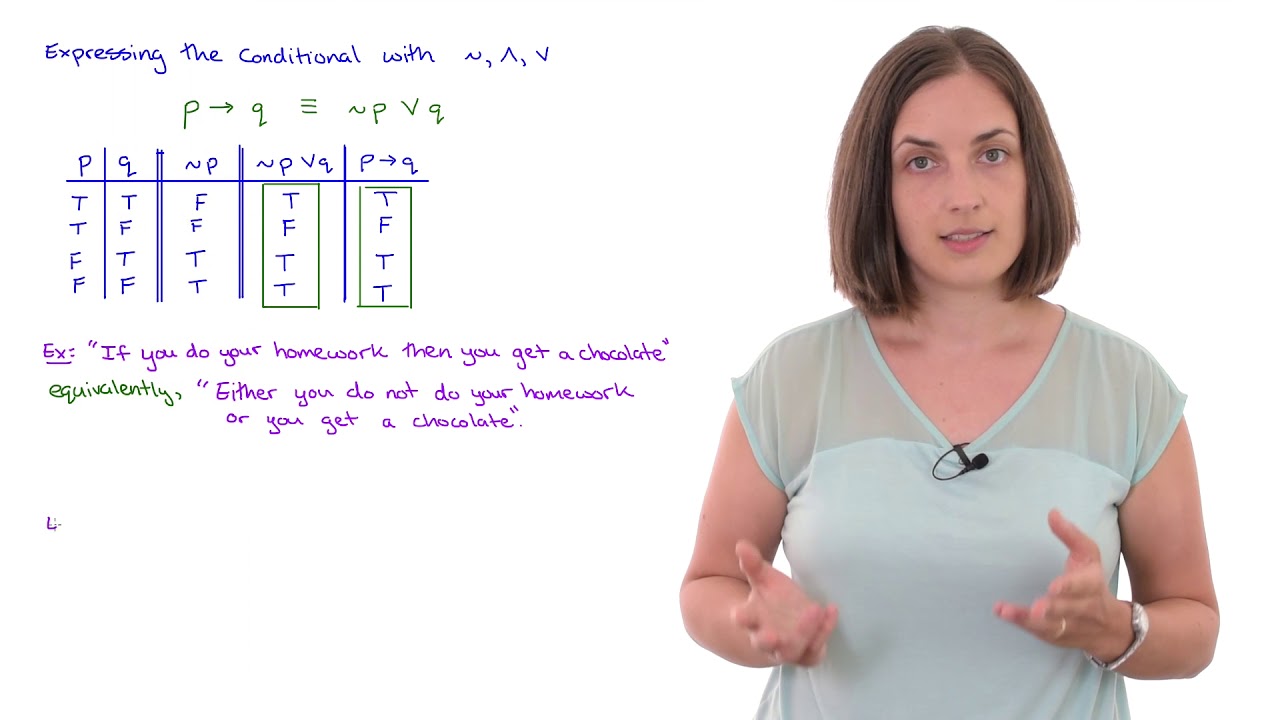
- The conditional statement 'p implies q' is logically equivalent to 'not p or q'.
- This equivalence can be verified by comparing their truth tables, which show identical truth values for all combinations of p and q.
- This means 'If p then q' can be rephrased as 'Either not p is true, or q is true'.
Knowing that 'p implies q' is equivalent to 'not p or q' provides an alternative way to understand and work with conditional statements, especially when dealing with negations or complex logical structures.
The statement 'If Jill forgets to wear sunscreen, then Jill will get a sunburn' is equivalent to 'Either Jill does not forget to wear sunscreen, or Jill will get a sunburn'.
- The contrapositive of 'p implies q' is 'not q implies not p'.
- A conditional statement and its contrapositive are logically equivalent, meaning they always have the same truth value.
- This equivalence can be proven using truth tables or logical equivalences.
The contrapositive is a powerful tool because proving a statement is often easier by proving its contrapositive, and vice versa.
The statement 'If you do your homework, then you get a chocolate' is equivalent to its contrapositive: 'If you did not get chocolate, then you did not do your homework'.
- The negation of 'p implies q' is logically equivalent to 'p and not q'.
- This means that to negate a conditional statement, you assert the hypothesis is true and the conclusion is false.
- This equivalence can be derived using De Morgan's laws and other logical equivalences.
Understanding how to negate a conditional statement is essential for identifying when a conditional claim is false and for constructing logical proofs.
The negation of 'If today is Monday, then tomorrow is my birthday' is 'Today is Monday, and tomorrow is not my birthday'.
- A biconditional statement, 'p if and only if q' (p iff q), is true when p and q have the same truth value (both true or both false).
- 'p if and only if q' is logically equivalent to '(p implies q) and (q implies p)'.
- Conditional statements can be expressed in various ways, such as 'p is a sufficient condition for q' (if p then q) or 'q is a necessary condition for p' (if not q then not p, which is equivalent to if p then q).
- Biconditional statements can be phrased as 'p is a necessary and sufficient condition for q'.
Recognizing the different ways conditional and biconditional statements can be phrased is crucial for accurately interpreting logical arguments and mathematical definitions.
The statement 'You get a chocolate if and only if you do your homework' means that doing homework guarantees chocolate, and getting chocolate guarantees you did your homework.
- Logical connectives have an order of operations, similar to arithmetic.
- Negation is applied first.
- Conjunction ('and') and disjunction ('or') are applied next, with equal precedence.
- Conditional ('implies') and biconditional ('if and only if') statements are applied last, also with equal precedence.
- Parentheses should be used to clarify the intended order when ambiguity exists.
Correctly applying the order of operations ensures that complex logical statements are interpreted and evaluated accurately, preventing misunderstandings.
Without parentheses, 'not p or q implies r' could be ambiguous. Using brackets like '(not p) or (q implies r)' or 'not p or (q implies r)' clarifies the intended meaning.
Key takeaways
- A conditional statement 'if p then q' is only false when p is true and q is false.
- The statement 'p implies q' is logically equivalent to 'not p or q'.
- The contrapositive 'not q implies not p' is logically equivalent to the original conditional statement 'p implies q'.
- The negation of 'p implies q' is 'p and not q'.
- 'p if and only if q' is true when p and q share the same truth value.
- Phrases like 'sufficient condition' and 'necessary condition' have precise logical meanings that correspond to conditional statements.
- Understanding the order of operations for logical connectives is vital for correct interpretation.
Key terms
Conditional statementHypothesisConclusionLogically equivalentContrapositiveNegationBiconditional statementNecessary conditionSufficient conditionOrder of operations
Test your understanding
- Under what specific conditions is a conditional statement 'p implies q' considered false?
- How can the statement 'p implies q' be rewritten using only negation and the 'or' connective?
- What is the contrapositive of a conditional statement, and why is it important?
- What is the logical structure of the negation of a conditional statement?
- When is a biconditional statement 'p if and only if q' true?