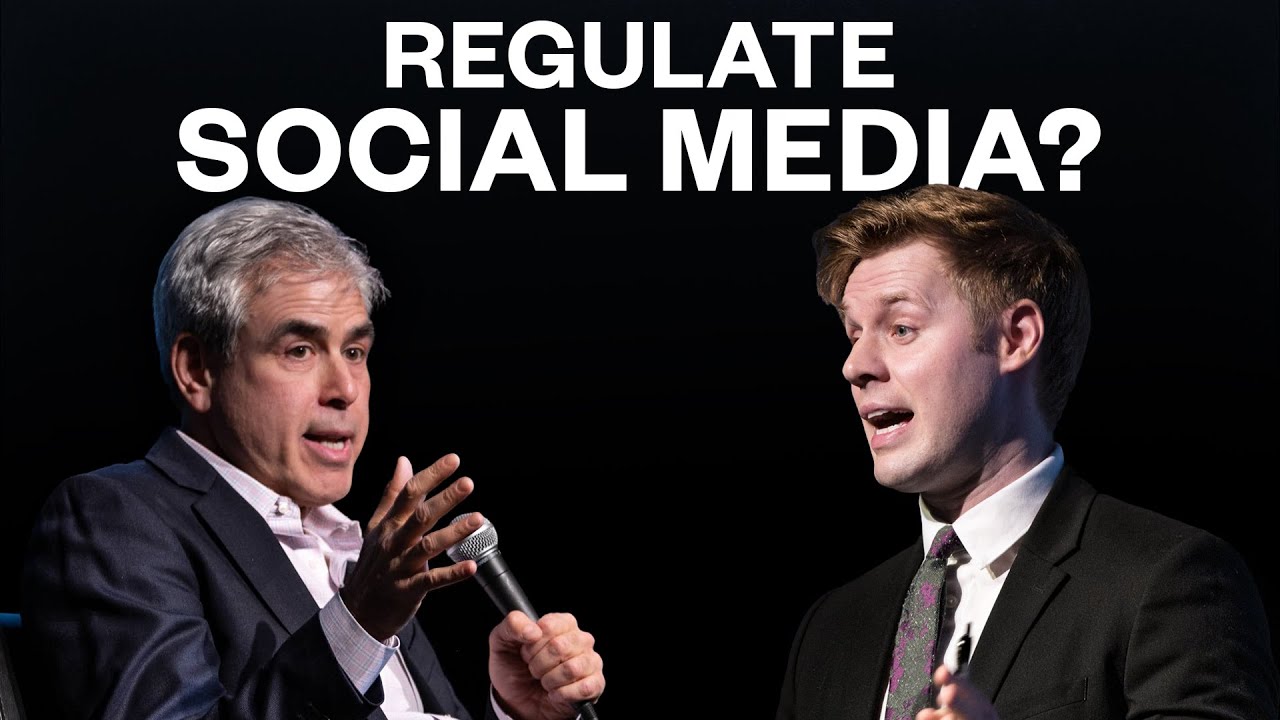
Jonathan Haidt Debates Robby Soave on Social Media
ReasonTV
Overview
This video features a debate between Jonathan Haidt and Robby Soave on the impact of social media, particularly on young people, universities, and democracy. Haidt argues that social media platforms, driven by an advertising-based business model, have caused significant harm to Gen Z's mental health, fostered a climate of fear and self-censorship in universities, and weakened democratic discourse. Soave counters that criticisms of social media often echo historical moral panics about new technologies, that the harms are often exaggerated or specific to certain platforms and demographics, and that government regulation is likely to be ineffective or even counterproductive, suggesting that market forces and individual choices are better solutions. Both acknowledge the complexity of the issue and the need for more research.
Save this permanently with flashcards, quizzes, and AI chat
Chapters
- Jonathan Haidt argues that social media is harming young people, universities, and democracy, advocating for government efforts to mitigate these harms.
- Robby Soave contends that criticisms of social media are often overblown moral panics and that the technology offers significant benefits, with government intervention being more harmful than helpful.
- The debate highlights the tension between concerns about social media's negative impacts and the historical pattern of public anxiety over new communication technologies.
- Haidt presents data showing significant increases in teen depression, anxiety, self-harm, and suicide rates since around 2012, correlating strongly with the rise of social media use, particularly among girls.
- He argues that studies showing weak correlations often lump all screen time and all users together, and that a closer look at girls and social media reveals a much stronger, concerning correlation.
- Soave acknowledges some negative effects on specific demographics but suggests these are often exaggerated, that many teens use social media healthily, and that platforms like Instagram are already declining in popularity, implying market forces will address the issue.
- Haidt argues that social media, particularly after 2009 with the introduction of features like the 'like' and 'share' buttons, shifted from a tool for connection to one that amplifies outrage and emotional content, damaging universities.
- He describes a resulting climate of fear and self-censorship on campuses, where students and faculty are afraid to speak freely due to the threat of online backlash, leading to a decline in viewpoint diversity.
- Soave suggests that criticisms of social media's impact on discourse mirror historical panics about new media and that the issues Haidt describes might be more reflective of broader cultural shifts or the inherent difficulties of adolescent life rather than solely social media's fault.
- Haidt posits that social media, especially platforms like Twitter, exploits democracy's vulnerability to factionalism and division, exacerbating political polarization.
- He advocates for changes to the architecture of social media to reduce virality and promote content-neutral, politically neutral mechanisms, rather than government censorship.
- Soave expresses skepticism about government's ability to regulate effectively, citing potential for industry capture and First Amendment violations, and suggests that existing media outlets also contribute significantly to political dysfunction.
- Haidt suggests government intervention is needed to address 'commons dilemmas' like social media use, proposing delayed entry for minors (e.g., age 16 or 18) with age verification, and architectural changes to platforms.
- Soave argues against government regulation, believing market forces will naturally lead to the decline of problematic platforms and that government intervention is prone to error, censorship, and industry capture, citing the example of proposed changes to Section 230.
- Both speakers acknowledge the need for more research, with Haidt emphasizing the importance of scientific evidence for policy decisions and Soave highlighting the potential for unintended consequences and the protection of free speech.
- The discussion touches on the potential impact of social media on adult attention spans and dating apps, with Haidt admitting less research in these areas but suspecting negative effects, while Soave highlights potential benefits of dating apps.
- A question is raised about the role of pornography and gender ideology in teen loneliness, with both debaters acknowledging pornography as a specific area where regulation might be more justifiable, though differing on the extent.
- Both speakers agree on the need for more research and acknowledge that social media is not the sole cause of societal problems, with factors like economic instability, political polarization, and cultural shifts also playing significant roles.
Key takeaways
- Social media platforms, particularly those driven by advertising, may be fundamentally rewiring societal interactions and individual psychology, especially for young people.
- The rise in adolescent mental health issues since roughly 2012 shows a strong correlation with increased social media use, particularly for girls, though causation is complex.
- Concerns about social media's impact on universities include fostering a climate of fear, self-censorship, and a decline in open discourse.
- Social media's architecture can exacerbate political polarization and undermine democratic processes by amplifying division and outrage.
- While historical panics over new technologies often fade, social media may represent a more profound, systemic challenge akin to 'leaded gas' or 'leaded pipes' due to its pervasive network effects.
- Government regulation of social media is debated, with arguments for protecting vulnerable minors and addressing systemic harms versus concerns about free speech, effectiveness, and unintended consequences.
- Market forces and platform evolution (e.g., the decline of Facebook and Instagram's popularity among youth) may offer some natural checks, but the underlying business model remains a concern.
- The complexity of societal problems means social media is not the sole cause of issues like teen mental health crises or political division, but it may act as a significant amplifier.
Key terms
Test your understanding
- What evidence does Jonathan Haidt present to support the claim that social media is harming teen mental health, and how does Robby Soave critique this evidence?
- How does Haidt argue that social media has negatively impacted universities and the broader public square, and what is Soave's counterargument?
- What are the main arguments for and against government regulation of social media presented by Haidt and Soave?
- According to Haidt, why is social media potentially more harmful than previous communication technologies, and what does he mean by 'network transformation'?
- How do both debaters address the historical pattern of public concern over new technologies, and what distinguishes social media in their views?