36:22
Understand Calculus in 35 Minutes
The Organic Chemistry Tutor
Overview
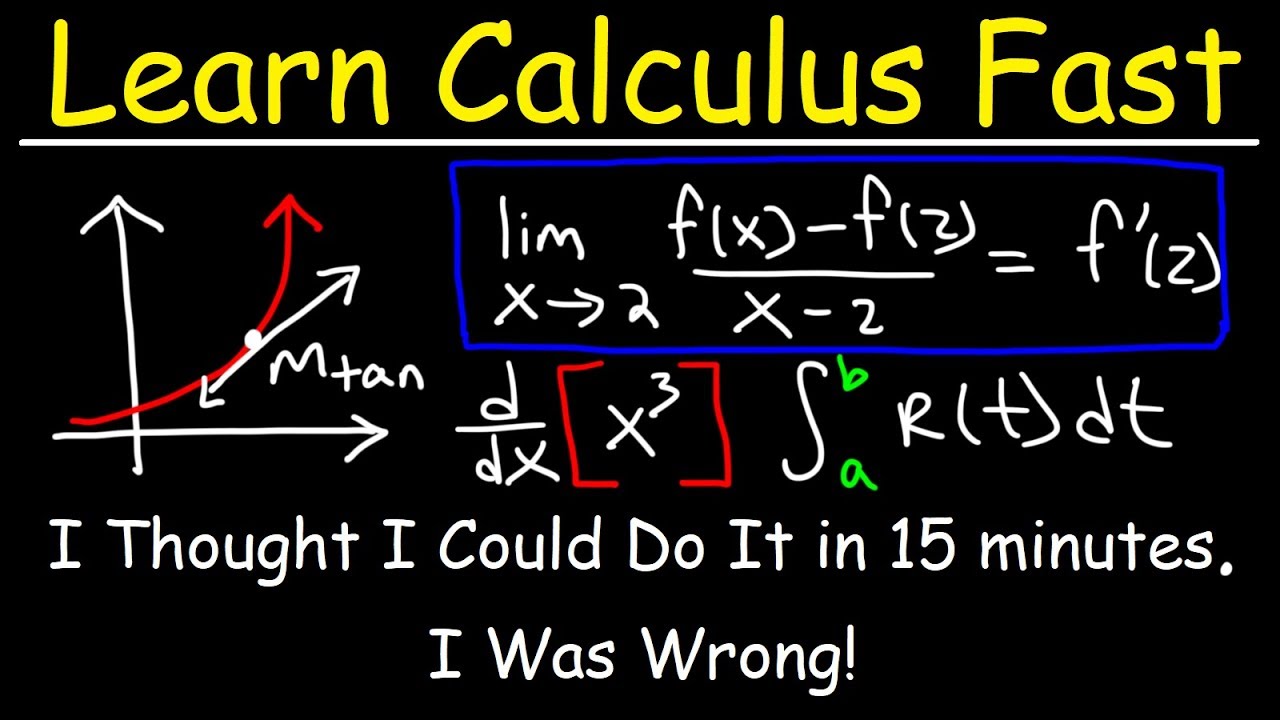
This video introduces the three fundamental concepts of calculus: limits, derivatives, and integration. Limits are explained as a way to understand a function's behavior as it approaches a specific value, especially when direct evaluation is impossible. Derivatives are presented as functions that calculate the instantaneous rate of change, visualized as the slope of a tangent line to a curve. Integration is described as the inverse of differentiation, used to find the accumulation of a quantity over time, often represented as the area under a curve. The video uses examples to illustrate how these concepts are applied in practical scenarios.
How was this?
Save this permanently with flashcards, quizzes, and AI chat
Chapters
- Calculus fundamentally deals with three core areas: limits, derivatives, and integration.
- Limits help determine a function's value as it gets arbitrarily close to a specific point, especially when direct substitution results in an undefined form.
- Derivatives measure the instantaneous rate of change of a function, equivalent to the slope of the tangent line at any given point.
- Integration is the inverse operation of differentiation and is used to calculate the accumulation of a quantity over time, often visualized as the area under a function's curve.
Understanding these three pillars provides a foundational framework for analyzing change and accumulation, which are central to many scientific and engineering disciplines.
- Limits are crucial when a function is undefined at a specific point (e.g., 0/0), allowing us to find the value the function approaches.
- By evaluating the function at values increasingly close to the target point, we can infer the limit.
- Algebraic manipulation, such as factoring and canceling terms, is often used to simplify the function and enable direct substitution to find the limit.
- A limit can exist even if the function itself is undefined at that exact point.
Limits are the bedrock of calculus, enabling the analysis of function behavior at points where direct calculation is impossible, which is essential for understanding continuity and change.
For the function f(x) = (x^2 - 4) / (x - 2), direct substitution at x=2 yields 0/0. However, by factoring the numerator to (x+2)(x-2) and canceling (x-2), the limit as x approaches 2 is found to be 4.
- The power rule is a fundamental technique for finding derivatives: the derivative of x^n is nx^(n-1).
- A derivative function, f'(x), provides the slope of the tangent line to the original function, f(x), at any point x.
- The slope of a tangent line represents the instantaneous rate of change of the function.
- The slope of a secant line, calculated between two points on a curve, approximates the slope of the tangent line as the two points get closer together.
- Using limits, we can precisely calculate the slope of the tangent line by finding the limit of the secant line's slope as the interval between points shrinks to zero.
Derivatives are essential for understanding how quantities change over time or with respect to other variables, enabling predictions and analysis of dynamic systems.
The derivative of f(x) = x^3 is f'(x) = 3x^2. At x=2, the slope of the tangent line is f'(2) = 3*(2^2) = 12, indicating the function increases by 12 units for every unit increase in x at that point.
- Integration is the reverse process of differentiation, also known as finding the anti-derivative.
- The power rule for integration involves adding 1 to the exponent and dividing by the new exponent: the integral of x^n is (x^(n+1))/(n+1) + C.
- A constant of integration, 'C', is always added in indefinite integrals because the derivative of any constant is zero.
- Integration is used to calculate the total accumulation of a quantity over a period, which can be visualized as the area under the function's curve.
- Definite integrals, with upper and lower bounds, yield a numerical value representing accumulation or area, while indefinite integrals yield a function.
Integration allows us to quantify total amounts or cumulative effects from rates of change, vital for problems involving total distance, volume, or accumulated work.
To find how much water accumulates in a tank when the rate of flow is r(t) = 0.5t + 20 from t=20 to t=100 minutes, we calculate the definite integral of r(t) from 20 to 100, which results in 4000 gallons.
- The function A(t) = 0.01t^2 + 0.5t + 100 represents the amount of water in a tank at time t.
- To find how fast the water amount is changing at a specific time (t=10), we calculate the derivative of A(t), which is A'(t) = 0.02t + 0.5.
- Plugging t=10 into A'(t) gives 0.7 gallons per minute, representing the instantaneous rate of change.
- This instantaneous rate can be approximated by the average rate of change (slope of the secant line) between nearby points, like t=9 and t=11.
- To find the total accumulation of water over a time interval, we use integration (definite integral).
This example demonstrates the practical application of both derivatives (for instantaneous rates) and integration (for total accumulation) in a real-world scenario.
The derivative of the water amount function A(t) at t=10 minutes is 0.7 gallons/minute, meaning the water level is increasing at that precise moment by 0.7 gallons every minute.
Key takeaways
- Calculus provides tools to understand continuous change and accumulation.
- Limits are fundamental for analyzing function behavior at points of discontinuity or undefined values.
- Derivatives quantify instantaneous rates of change, essential for understanding speed, growth, and slopes.
- Integration is the inverse of differentiation and calculates total accumulation or area under a curve.
- The relationship between derivatives and integration is inverse, forming the basis of the Fundamental Theorem of Calculus.
- Understanding the difference between average rate of change (secant line) and instantaneous rate of change (tangent line) is key to grasping derivatives.
- Definite integrals provide a numerical answer for accumulation over a specific interval, while indefinite integrals provide a general function.
Key terms
CalculusLimitDerivativeIntegrationTangent LineSecant LineRate of ChangeAccumulationPower RuleConstant of IntegrationDefinite IntegralIndefinite Integral
Test your understanding
- What is the primary purpose of a limit in calculus?
- How does a derivative relate to the graph of a function?
- Why is integration considered the inverse operation of differentiation?
- What does the area under the curve of a rate function represent?
- How can you approximate the instantaneous rate of change of a function at a point?