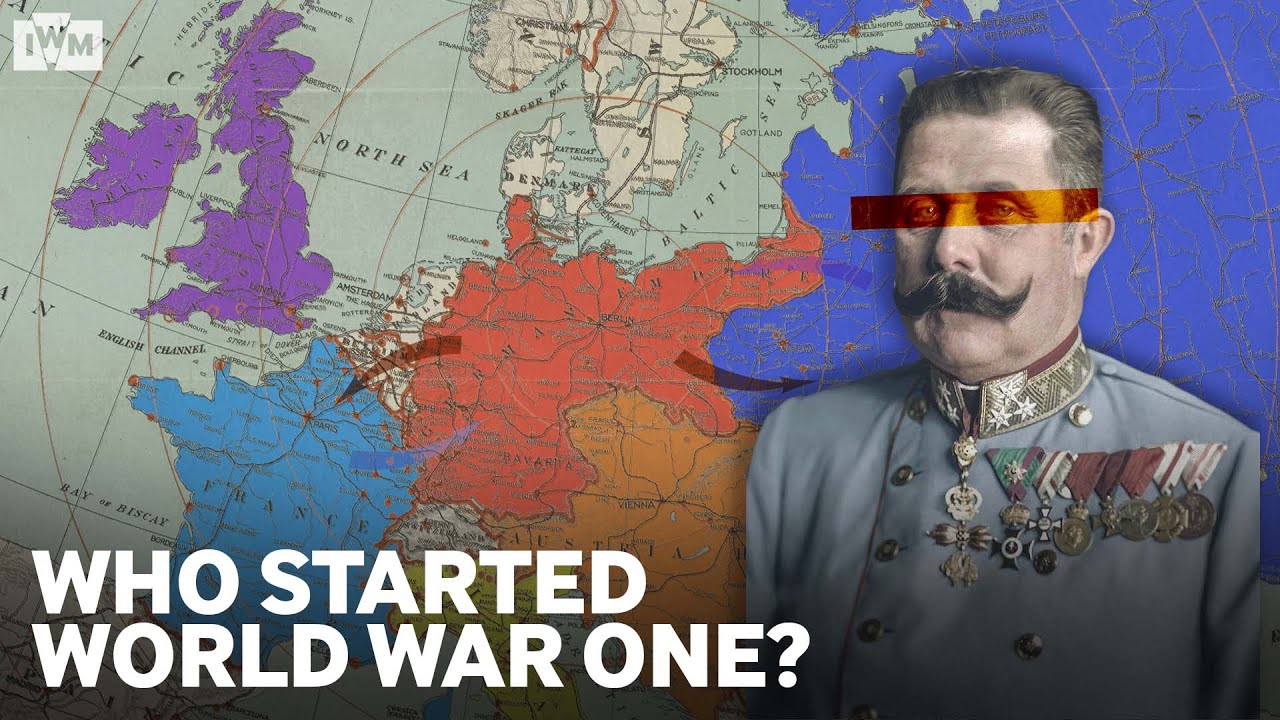
How did WW1 Start? | Causes of the First World War
Imperial War Museums
Overview
This video explains the complex origins of World War I, moving beyond a simple domino effect. It highlights that in June 1914, war in Europe seemed unlikely to Britain, which was preoccupied with its vast empire and domestic issues like Irish Home Rule. However, rising European tensions, particularly Germany's ambition and naval buildup, disrupted the balance of power, leading to opposing alliances. The assassination of Archduke Franz Ferdinand in Sarajevo acted as the catalyst, triggering a chain reaction through these alliances. Germany's invasion of neutral Belgium, a violation of a treaty Britain had guaranteed, ultimately drew Britain into the conflict, transforming a local crisis into a global war with profound 20th-century consequences.
Save this permanently with flashcards, quizzes, and AI chat
Chapters
- In the summer of 1914, Europe was on the brink of war following the assassination of Archduke Franz Ferdinand.
- Britain, despite its global empire, was not anticipating a European conflict and was focused on domestic issues.
- Significant internal divisions existed in Britain, including wealth inequality and the contentious issue of Home Rule for Ireland, which threatened violence.
- The idea of a European war seemed improbable to most Britons, who were more concerned about potential conflict stemming from Ireland.
- Germany, unified in 1871, emerged as an ambitious new European power seeking its own empire.
- Germany's rapid industrial growth and military expansion, especially its naval buildup, challenged Britain's global supremacy.
- The development of new warships, like Dreadnoughts, fueled an arms race between Britain and Germany.
- This rivalry shifted Britain's perception of Germany from a potential friend to a significant threat.
- Germany's rise disturbed the European balance of power, leading to the formation of two main opposing camps.
- France and Russia formed an alliance due to fears of German expansion.
- Germany, feeling encircled, allied with the Austro-Hungarian Empire and Italy.
- Britain, wary of German dominance, moved closer to France and Russia, though without a formal alliance.
- The Balkans, particularly Serbia, was a region of long-standing unrest, exacerbated by recent wars.
- The assassination of Archduke Franz Ferdinand by a Serbian-backed terrorist in Sarajevo provided Austria-Hungary with a pretext to act.
- Encouraged by Germany, Austria-Hungary issued a harsh ultimatum to Serbia to quell Serbian nationalism.
- Serbia's failure to meet all demands led Austria-Hungary to declare war, triggering the alliance system.
- The initial conflict between Austria-Hungary and Serbia rapidly drew in Russia, Germany, and France due to their alliances.
- Britain hesitated, weighing its options and fearing German domination of Europe.
- Germany's invasion of neutral Belgium, a violation of a treaty Britain had guaranteed, provided the immediate cause for Britain's involvement.
- Britain's declaration of war on Germany on August 4th, 1914, extended the conflict globally through its empire.
Key takeaways
- World War I did not start due to a single cause but a complex interplay of rising nationalism, imperial ambitions, and intricate alliance systems.
- The perceived unlikelihood of war in June 1914 highlights how rapidly geopolitical situations can deteriorate.
- Germany's rapid industrial and military growth fundamentally challenged the existing European power balance, creating significant tension.
- The assassination of Archduke Franz Ferdinand acted as a catalyst, igniting a pre-existing powder keg of European rivalries.
- Alliance systems, intended for security, ultimately ensured that a local conflict would escalate into a widespread war.
- Britain's decision to enter the war was driven by strategic concerns about German dominance and treaty obligations, specifically the protection of neutral Belgium.
- The outbreak of WWI had profound and lasting consequences, reshaping the political map of Europe and setting the stage for future conflicts.
Key terms
Test your understanding
- How did Germany's rise as an industrial and military power contribute to the pre-war tensions in Europe?
- Why was Britain initially hesitant to engage in a European war in 1914, despite its global power status?
- What role did the assassination of Archduke Franz Ferdinand play in triggering the chain of events leading to World War I?
- Explain how the system of alliances in Europe transformed a regional conflict into a world war.
- What specific action by Germany ultimately led to Britain's declaration of war?