34:42
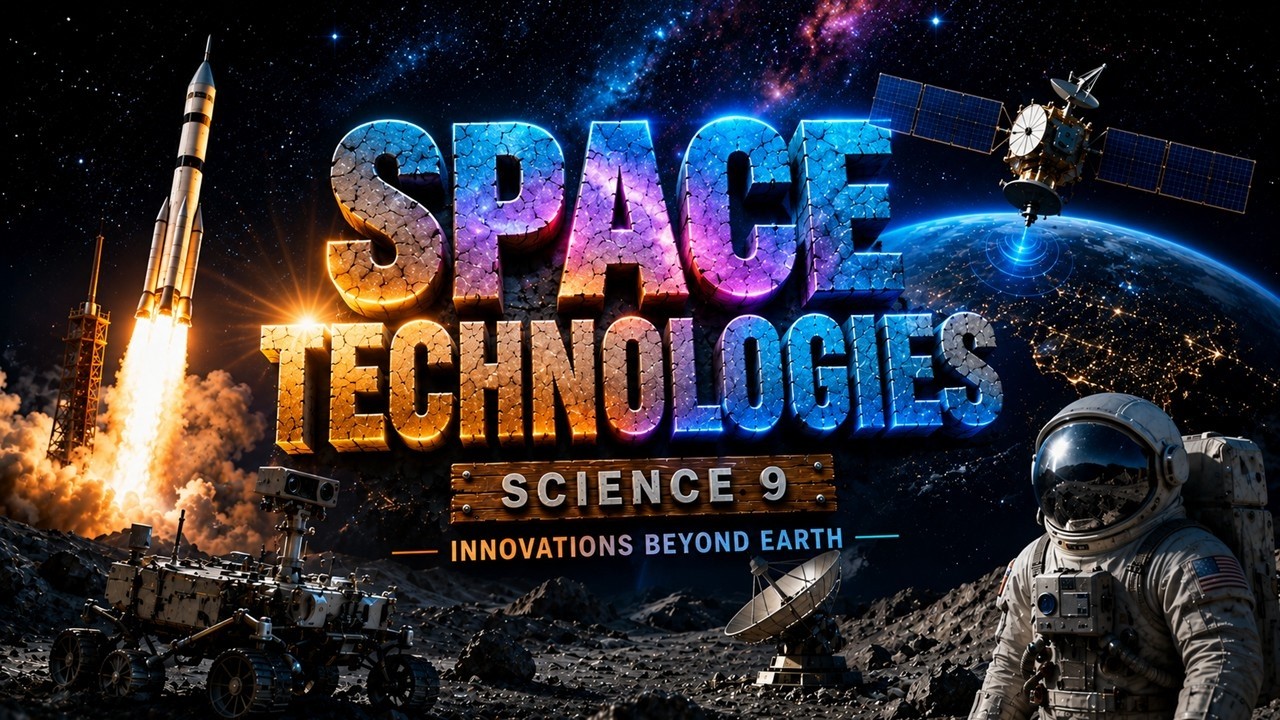
Term 2 Science 9 | Lesson 7: Space Technologies | MATATAG Curriculum
Sir Wowie Studios
Overview
This video introduces Grade 9 students to space technologies used in astronomy. It defines celestial objects and explains why scientists study them, highlighting the challenges posed by vast distances and extreme environments. The lesson details various technologies like telescopes (optical, radio, infrared, space-based), space probes (fly-by, orbiter, lander, rover), satellites, and the role of artificial intelligence. It contrasts ancient and modern astronomical methods, emphasizing how advanced tools enable deeper understanding of the universe and the search for extraterrestrial life.
How was this?
Save this permanently with flashcards, quizzes, and AI chat
Chapters
- Space technologies are tools astronomers use to study celestial objects.
- Key technologies include telescopes, space probes, satellites, and artificial intelligence.
- Scientists aim to understand the universe, its origins, and the potential for life beyond Earth.
- Studying space presents challenges like immense distances, extreme temperatures, and radiation.
Understanding these technologies is crucial for grasping how we gather information about the vast universe and its components.
The video mentions the ongoing study of Mars as a potential 'next Earth' to illustrate the drive for space exploration.
- Celestial objects are natural bodies found in space, such as stars, planets, galaxies, comets, asteroids, and nebulae.
- Stars produce their own light and heat (e.g., the Sun), while planets orbit stars and reflect light.
- Galaxies are massive collections of stars, gas, dust, and planets bound by gravity (e.g., the Milky Way).
- Nebulae are vast clouds of gas and dust where new stars are born.
Identifying and understanding the characteristics of different celestial objects is fundamental to comprehending the structure and evolution of the universe.
The Sun is given as an example of a star, and Earth as an example of a planet.
- Scientists face challenges in studying space due to great distances, extreme temperatures, and harmful radiation.
- Telescopes, satellites, and space probes are used to overcome these challenges by collecting data from afar.
- Ancient astronomy relied on naked-eye observations for navigation and calendars, while modern astronomy uses advanced technology.
- The goal of studying space includes understanding the universe's formation, searching for extraterrestrial life, and predicting space hazards.
Recognizing the difficulties and the innovative solutions developed highlights human ingenuity in exploring the unknown.
Venus is mentioned as a planet where probes often fail due to extreme heat, illustrating the challenge of temperature.
- Telescopes are instruments that collect and focus light or other electromagnetic radiation to observe distant objects.
- Optical telescopes use visible light, radio telescopes detect radio waves, and infrared telescopes detect heat.
- Space telescopes, like Hubble and James Webb, are placed outside Earth's atmosphere for clearer images, free from distortion.
- Telescopes work by gathering light, focusing it, and forming an image that can be viewed or recorded.
Different types of telescopes allow us to observe the universe across various wavelengths, revealing phenomena invisible to the naked eye.
The Hubble Space Telescope and the James Webb Space Telescope are highlighted as examples of advanced space telescopes.
- Space probes are robotic spacecraft sent to collect information about celestial bodies.
- Types include fly-by probes (e.g., New Horizons), orbiters (e.g., Mars Reconnaissance Orbiter), landers (e.g., Viking 1), and rovers (e.g., Curiosity, Perseverance).
- These probes are controlled from Earth and explore places humans cannot easily reach.
- They collect data, take images, analyze samples, and measure environmental conditions.
Space probes enable direct exploration and data collection from celestial bodies, providing invaluable insights without risking human lives.
The Perseverance rover on Mars is mentioned for its mission to search for signs of ancient microbial life.
- Satellites orbit celestial bodies; artificial satellites are human-made for communication, navigation, weather monitoring, and research.
- Artificial intelligence (AI) analyzes vast amounts of astronomical data, identifies celestial objects, and detects patterns.
- Space stations, like the International Space Station (ISS), are habitats for astronauts to live and conduct research in space.
- These technologies collectively enhance our ability to collect, analyze, and interpret data about the universe.
These modern tools are essential for continuous observation, data processing, and long-term scientific research in space, pushing the boundaries of our knowledge.
The International Space Station (ISS) serves as a multinational laboratory orbiting Earth, housing astronauts for extended research periods.
Key takeaways
- Modern space technologies are essential for studying celestial objects that are too distant or dangerous for direct human exploration.
- Different types of telescopes (optical, radio, infrared, space-based) allow us to observe the universe across various parts of the electromagnetic spectrum.
- Space probes, including orbiters, landers, and rovers, provide robotic means to explore planets, moons, and other bodies, collecting crucial data.
- Satellites play vital roles in Earth observation, communication, and scientific research from orbit.
- Artificial intelligence significantly aids astronomers by processing massive datasets and identifying complex patterns.
- Space stations offer platforms for long-duration human presence and research in space, complementing robotic exploration.
- Understanding space technologies helps us appreciate the scientific advancements that expand our knowledge of the cosmos.
Key terms
Celestial ObjectTelescopeSpace ProbeSatelliteArtificial Intelligence (AI)OrbiterLanderRoverNebulaGalaxy
Test your understanding
- How do scientists overcome the challenges of great distances and extreme environments when studying celestial objects?
- What is the primary function of a telescope, and how do different types (optical, radio, infrared) contribute to our understanding of space?
- Describe the roles of different types of space probes (fly-by, orbiter, lander, rover) in exploring celestial bodies.
- How does artificial intelligence assist astronomers in analyzing astronomical data and making discoveries?
- Why are space telescopes placed outside Earth's atmosphere, and what advantages do they offer over ground-based telescopes?