9:48
02.02. How does light interact with molecules?
Scott Stachelhaus
Overview
This video explains how light interacts with molecules, focusing on infrared radiation's role in the greenhouse effect. It differentiates interactions based on light's energy: UV light causes ionization, visible light excites electrons to higher energy states, and infrared light causes molecular vibrations. The key concept is that polar covalent bonds, due to uneven charge distribution, can absorb infrared radiation if its frequency matches the molecule's natural vibration frequency. More complex molecules, like CO2 and methane, have more ways to vibrate (stretch, bend), allowing them to absorb more infrared radiation, making them effective greenhouse gases.
How was this?
Save this permanently with flashcards, quizzes, and AI chat
Chapters
- Different types of light (UV, visible, infrared) have different energy levels based on their frequency.
- High-energy UV light can ionize atoms by knocking off electrons.
- Medium-energy visible light excites electrons to higher, unstable energy states, responsible for color.
- Low-energy infrared light causes molecules to vibrate, increasing their normal oscillations.
Understanding how different light energies affect molecules is crucial for explaining phenomena like molecular color and the greenhouse effect.
Visible light excites electrons in transition metal solutions, making them vibrantly colored.
- Molecules naturally vibrate because covalent bonds constantly change length as electrons move.
- Only molecules with polar covalent bonds can interact with infrared radiation.
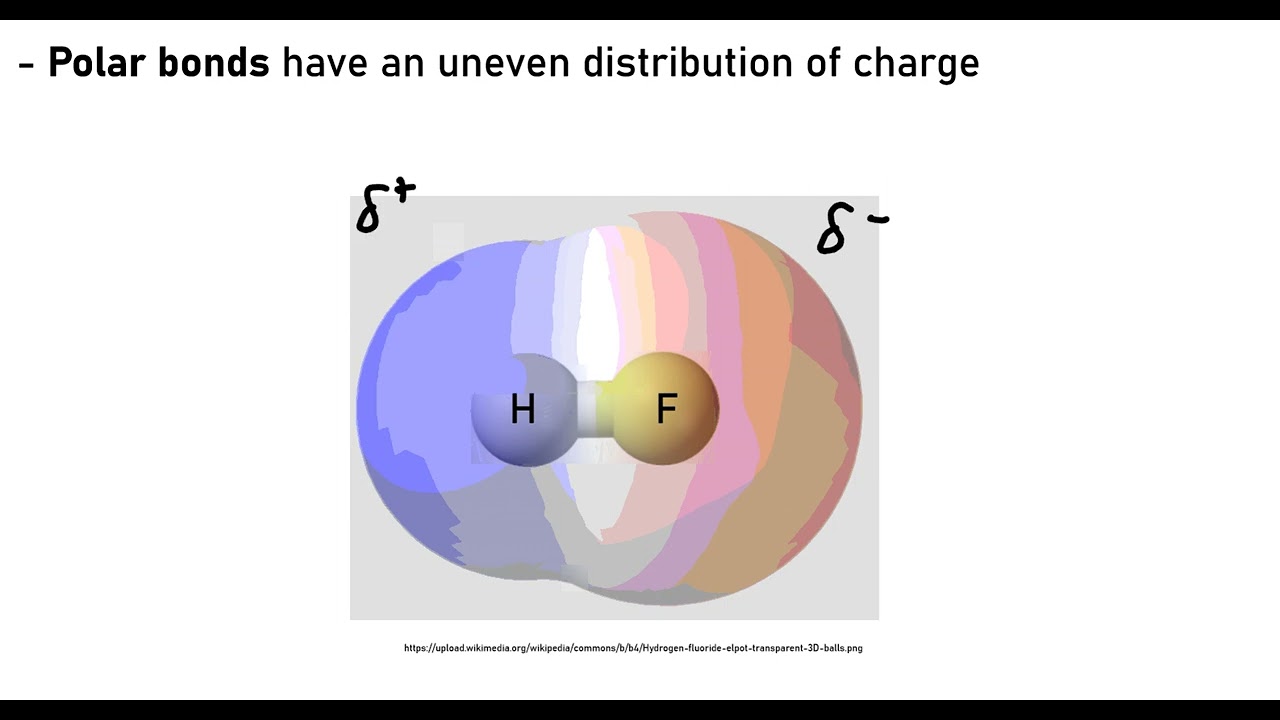
- Polar bonds have an uneven distribution of electron density due to differences in electronegativity between bonded atoms.
- This uneven distribution creates slight positive and negative charges on different parts of the molecule.
The presence of polar bonds is the critical factor determining whether a molecule can absorb infrared radiation and contribute to heat retention.
In hydrogen fluoride (HF), fluorine's higher electronegativity pulls electrons, creating a slight negative charge near fluorine and a slight positive charge near hydrogen.
- Electromagnetic radiation consists of oscillating electric and magnetic fields.
- The oscillating electric field of infrared radiation interacts with the charged ends of polar molecules.
- This interaction causes the polar molecule to stretch, compress, or bend in sync with the radiation's field.
- If the radiation's frequency matches the molecule's natural vibration frequency, the molecule absorbs the energy.
This absorption of infrared radiation by molecules is the fundamental mechanism behind the greenhouse effect, trapping heat in the atmosphere.
An oscillating electric field with a positive end on the left and a negative end on the right will cause a polar molecule's positive end to be repelled and attracted, and its negative end to be attracted and repelled, leading to bond length changes.
- Simpler molecules like HF have limited ways to vibrate.
- More complex molecules, like carbon dioxide (CO2) and methane (CH4), have multiple atoms and can vibrate in more ways (e.g., stretching, bending).
- The more ways a molecule can vibrate, the more frequencies of infrared radiation it can absorb.
- Molecules that absorb more infrared radiation are more effective greenhouse gases.
The shape and complexity of molecules directly influence their ability to absorb infrared radiation, explaining why certain gases are more potent greenhouse gases than others.
Carbon dioxide can stretch and bend, unlike the simpler stretching/compressing motion of hydrogen fluoride, allowing it to interact with a wider range of infrared frequencies.
Key takeaways
- Infrared light's energy is sufficient to induce molecular vibrations, unlike UV or visible light.
- Molecular vibration is a prerequisite for absorbing infrared radiation, but only polar bonds enable this interaction.
- The absorption of infrared radiation occurs when the radiation's frequency matches a molecule's natural vibrational frequency.
- The oscillating electric field of infrared radiation interacts with the partial charges in polar molecules, causing them to vibrate.
- More complex molecular structures allow for a greater variety of vibrational modes, increasing their capacity to absorb infrared radiation.
- Understanding molecular structure and vibrational modes is key to comprehending the varying effectiveness of different greenhouse gases.
Key terms
Infrared lightMolecular vibrationCovalent bondPolar covalent bondElectronegativityElectron densityPartial chargeElectromagnetic radiationOscillating electric fieldGreenhouse gas
Test your understanding
- How does the energy of infrared light differ from that of visible or ultraviolet light, and what type of molecular interaction does each enable?
- What characteristic of a chemical bond allows a molecule to interact with infrared radiation, and why is this characteristic important?
- Explain the process by which a polar molecule absorbs infrared radiation, including the role of oscillating electric fields and vibrational frequencies.
- Why are more complex molecules generally more effective greenhouse gases than simpler ones?
- How does the concept of electronegativity relate to the formation of polar bonds and a molecule's ability to absorb infrared radiation?