5:28
Prokaryotic vs. Eukaryotic Cells (Updated)
Amoeba Sisters
Overview
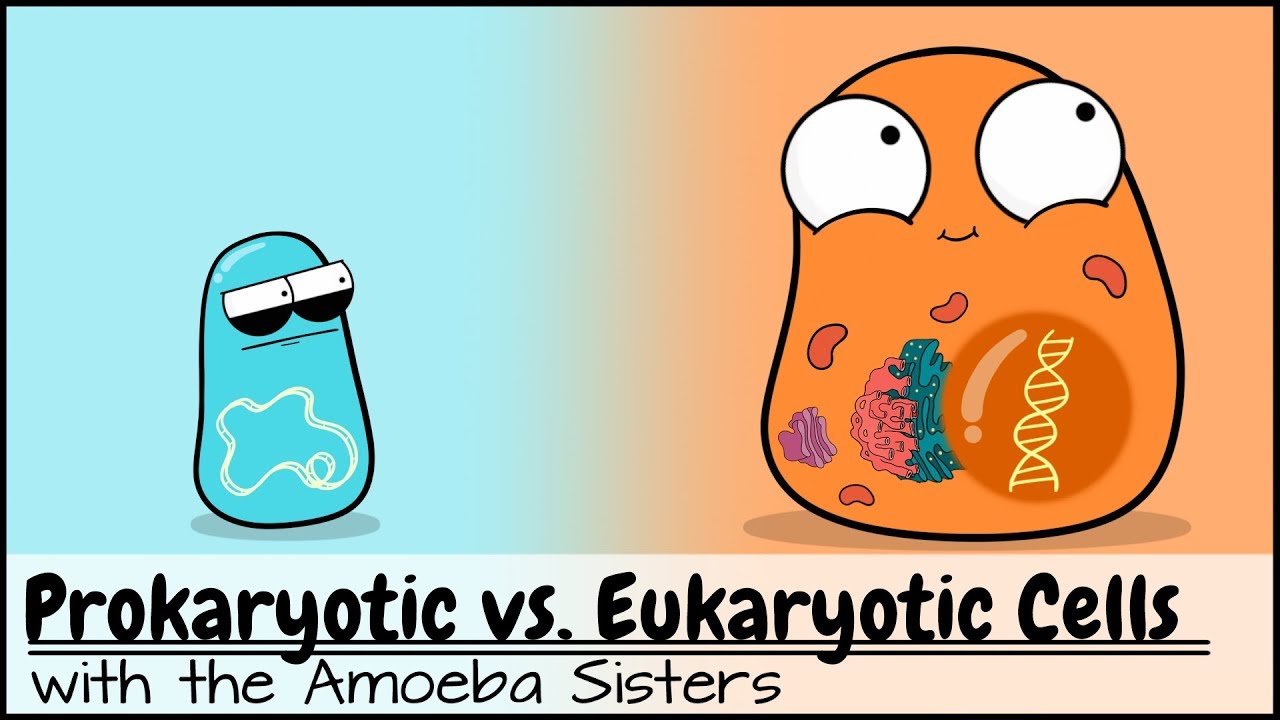
This video explains the fundamental differences between prokaryotic and eukaryotic cells, the two primary categories of cells found in living organisms. It highlights shared features like DNA, ribosomes, cytoplasm, and a cell membrane, while emphasizing key distinctions such as the presence of a nucleus and membrane-bound organelles in eukaryotes, which are absent in prokaryotes. Understanding these differences is crucial for comprehending the diversity of life and for medical applications, like distinguishing between bacterial and fungal infections.
How was this?
Save this permanently with flashcards, quizzes, and AI chat
Chapters
- The speaker's childhood experience with ringworm, a fungal infection, led to questions about why it was treated differently than bacterial infections.
- Antibiotics target bacteria by disrupting their reproduction, cell walls, or protein synthesis.
- Fungal cells, unlike bacterial cells, share more similarities with human (animal) cells, a difference rooted in prokaryotic vs. eukaryotic cell structures.
This personal anecdote makes the abstract concept of cell differences relatable and sets the stage for understanding why different treatments are needed for different types of infections.
Ringworm infection treated with antifungal cream instead of antibiotics because it's caused by a fungus, not bacteria.
- The modern cell theory states that all living things are composed of one or more cells.
- Prokaryotes (bacteria and archaea) are typically unicellular organisms.
- Eukaryotes (protists, plants, animals, fungi) can be unicellular or multicellular.
This provides the foundational biological context for classifying all living organisms based on their cellular structure.
Humans are multicellular eukaryotes, while bacteria are unicellular prokaryotes.
- Both prokaryotic and eukaryotic cells possess DNA as their genetic material.
- Both cell types have ribosomes, essential for protein synthesis.
- All cells contain cytoplasm, the jelly-like substance filling the cell.
- A cell membrane (or plasma membrane) is present in all cells, regulating the passage of substances and maintaining homeostasis.
Understanding these commonalities helps learners appreciate the fundamental unity of life at the cellular level before exploring the differences.
The cell membrane is a universal component that controls what enters and leaves any cell, prokaryotic or eukaryotic.
- Eukaryotic cells are generally larger and more complex than prokaryotic cells.
- Prokaryotic cells lack a nucleus; their DNA is located in the cytoplasm.
- Eukaryotic cells possess a nucleus that houses their DNA.
- Eukaryotic cells have membrane-bound organelles (like mitochondria, ER, Golgi), which prokaryotic cells lack.
The presence or absence of a nucleus and membrane-bound organelles is the defining characteristic that separates these two fundamental cell types and dictates their internal organization and complexity.
The nucleus in a eukaryotic cell acts like a protective container for the DNA, whereas in a prokaryotic cell, the DNA floats more freely within the cytoplasm.
- While most prokaryotes have cell walls, many eukaryotes do not (e.g., animal cells).
- Some eukaryotic cells have cell walls (e.g., plant and fungal cells), while others do not.
- Specific membrane-bound organelles, like chloroplasts, are found in certain eukaryotic cells (e.g., plant cells) but not others (e.g., animal cells).
This highlights that while eukaryotes share a basic structure, there is significant diversity among them, allowing for specialized functions in different organisms.
Plant cells have chloroplasts for photosynthesis, a membrane-bound organelle absent in animal cells.
Key takeaways
- All living organisms are composed of cells, which are classified as either prokaryotic or eukaryotic.
- Prokaryotic cells are simpler, lacking a nucleus and membrane-bound organelles, while eukaryotic cells are more complex and contain these structures.
- Despite their differences, all cells share essential components like DNA, ribosomes, cytoplasm, and a cell membrane.
- The presence of a nucleus is a defining feature that distinguishes eukaryotic cells from prokaryotic cells.
- Understanding cell types is crucial for biology and medicine, impacting how we classify organisms and treat diseases.
- Fungal infections, caused by eukaryotic cells, require different treatments than bacterial infections, caused by prokaryotic cells.
Key terms
Prokaryotic cellEukaryotic cellNucleusMembrane-bound organellesRibosomesCell membraneCytoplasmDNAUnicellularMulticellular
Test your understanding
- What are the main structural differences between prokaryotic and eukaryotic cells, particularly regarding the nucleus and organelles?
- Why is the cell membrane considered a universal component found in all cell types?
- How does the presence or absence of a nucleus affect the organization of genetic material within a cell?
- What are some examples of membrane-bound organelles found in eukaryotic cells, and why are they significant?
- Why is it important to distinguish between prokaryotic (bacterial) and eukaryotic (fungal) cells when considering medical treatments?