18:29
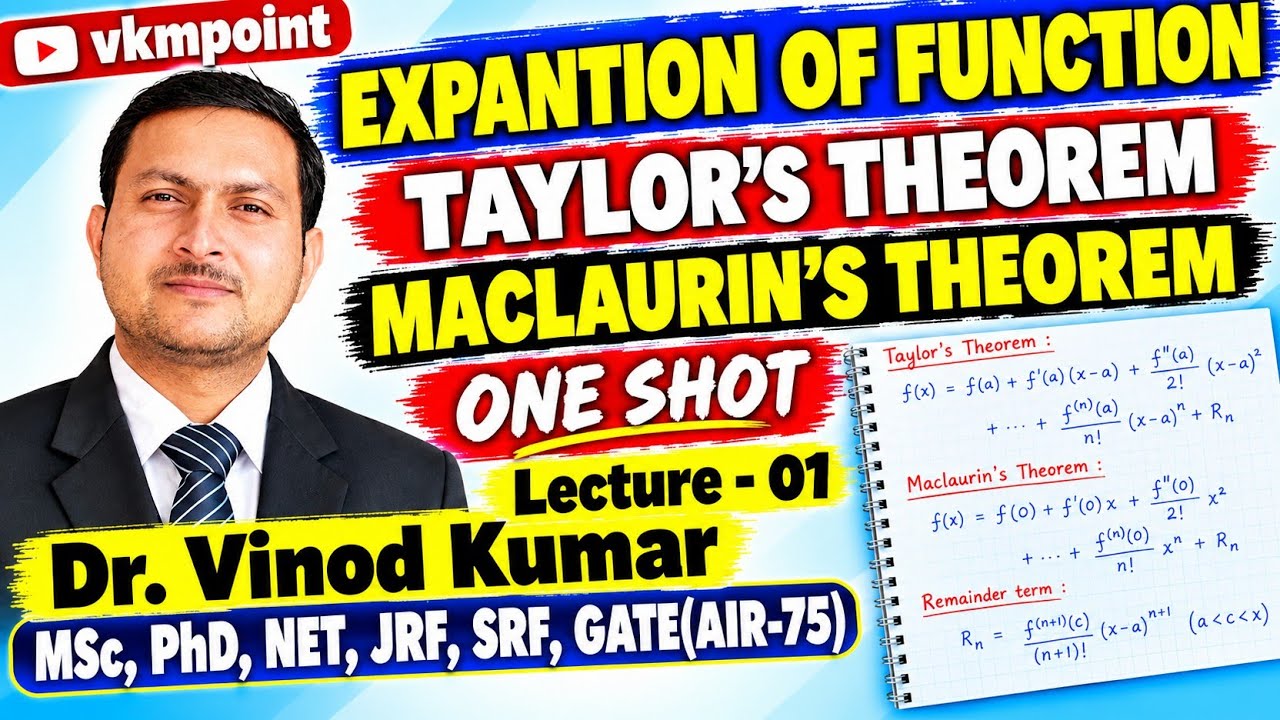
Maclaurin Theorem | Taylor Theorem |maclaurin series engineering mathematics taylor series expansion
VKMPOINT
Overview
This video explains the concepts of Taylor and Maclaurin series expansions for functions, which are crucial in engineering mathematics. It details the formulas for both Taylor's theorem (expansion around a point 'a') and Maclaurin's theorem (a special case of Taylor's theorem where the expansion is around the origin, x=0). The video demonstrates how to derive these expansions and apply them to solve problems, including expanding trigonometric functions like sin(x) and e^x around specific points. It emphasizes the importance of understanding the formulas and practicing differentiation to solve these problems effectively.
How was this?
Save this permanently with flashcards, quizzes, and AI chat
Chapters
- Taylor's theorem allows expansion of a function f(x) around a point x=a.
- Maclaurin's theorem is a special case of Taylor's theorem where the expansion is around the origin (x=0).
- These series expansions are used to approximate complex functions with simpler polynomial forms.
- Common series expansions for e^x, sin(x), and cos(x) are often memorized but can be derived using these theorems.
Understanding these series is fundamental for approximating function behavior, solving differential equations, and performing complex calculations in engineering and mathematics.
The video mentions the memorized series for e^x, sin(x), and cos(x) as examples of what can be derived.
- The Taylor series expansion of f(x) around x=a is given by: f(a) + (x-a)f'(a)/1! + (x-a)^2 f''(a)/2! + ...
- This formula requires the function and its derivatives to exist at point 'a'.
- The expansion is 'in powers of (x-a)', meaning the terms involve (x-a), (x-a)^2, etc.
- To use Taylor's theorem, one must be able to differentiate the function multiple times and evaluate these derivatives at the expansion point.
Taylor's theorem provides a systematic way to approximate a function using a polynomial, which is essential for numerical methods and understanding local function behavior.
The general formula for Taylor's series expansion is presented.
- Maclaurin's theorem is obtained by setting a=0 in the Taylor's theorem formula.
- The Maclaurin series expansion of f(x) is: f(0) + x f'(0)/1! + x^2 f''(0)/2! + x^3 f'''(0)/3! + ...
- This expansion is 'in powers of x'.
- It's a powerful tool for approximating functions near the origin.
Maclaurin series simplify calculations when expanding around zero, a common scenario in many physical and engineering problems.
The formula for Maclaurin series expansion is derived from Taylor's theorem by substituting a=0.
- To expand sin(x), we find its derivatives: f(x)=sin(x), f'(x)=cos(x), f''(x)=-sin(x), f'''(x)=-cos(x), etc.
- Evaluating these derivatives at x=0 gives: f(0)=0, f'(0)=1, f''(0)=0, f'''(0)=-1.
- Substituting these values into the Maclaurin series formula yields: x - x^3/3! + x^5/5! - ...
- This derived series matches the known Maclaurin series for sin(x).
This example demonstrates the practical application of the theorems, showing how known series expansions can be rigorously derived.
The step-by-step derivation of the sin(x) Maclaurin series is shown, including calculating derivatives and evaluating them at x=0.
- For functions like e^(sin(x)), we need to calculate derivatives and evaluate them at x=0.
- The process involves repeated differentiation, often using the product rule and chain rule.
- The first few derivatives evaluated at x=0 are f(0)=1, f'(0)=1, f''(0)=1.
- Substituting these into the Maclaurin series formula gives the expansion: 1 + x + x^2/2! + ... (Note: The video shows a simplified calculation leading to 1+x+x^2/2, implying a potential simplification or error in the presented calculation for the third term).
This example illustrates how to handle more complex composite functions, requiring careful differentiation and substitution.
The video shows the calculation of f(0), f'(0), and f''(0) for f(x) = e^(sin(x)) and their substitution into the Maclaurin series.
- Practice problems are provided for expanding functions like e^x in powers of (x-2) and log(x) in powers of (x-1).
- When the expansion point is not zero, Taylor's theorem is used.
- When the expansion point is zero, Maclaurin's theorem is used.
- The core skill required is accurate and repeated differentiation and evaluation of derivatives at the specified point.
Consistent practice with varied problems solidifies understanding and builds confidence in applying Taylor and Maclaurin series.
The video walks through expanding log(x) in powers of (x-1) using Taylor's theorem, demonstrating the process of finding derivatives and evaluating them at x=1.
Key takeaways
- Taylor's theorem provides a method to represent a function as an infinite sum of terms, calculated from the function's derivatives at a single point.
- Maclaurin's theorem is a specific instance of Taylor's theorem, simplifying the expansion around the origin (x=0).
- The ability to compute derivatives accurately is essential for applying both Taylor and Maclaurin series.
- Series expansions approximate complex functions with polynomials, which are easier to work with in many analytical and numerical contexts.
- Understanding the 'about' or 'in powers of' phrase indicates the point around which the function is being expanded.
- Memorizing common series expansions is helpful, but understanding their derivation via Taylor/Maclaurin theorems is crucial for problem-solving.
- The choice between Taylor and Maclaurin depends solely on the point of expansion (a=0 for Maclaurin, a!=0 for Taylor).
Key terms
Taylor's TheoremMaclaurin's TheoremSeries ExpansionDerivativePoint of ExpansionOrigin (x=0)FactorialPolynomial Approximation
Test your understanding
- What is the fundamental difference between Taylor's theorem and Maclaurin's theorem?
- How does the ability to compute derivatives relate to the application of Taylor series?
- Why are series expansions useful in engineering mathematics?
- What does it mean to expand a function 'in powers of x-a'?
- How would you determine whether to use Taylor's theorem or Maclaurin's theorem for a given expansion problem?