Carbon cycling, climate change and practices for reducing greenhouse gas emissions
Professor Matthew Harrison FTSE
Overview
This presentation introduces the concept of the carbon cycle and how human activities, particularly the burning of fossil fuels, have disrupted the Earth's natural carbon budget, leading to climate change. It highlights that the focus should be on 'de-fossilization' rather than 'decarbonization.' The video discusses the Australian livestock sector's progress in reducing greenhouse gas emissions, primarily through avoided deforestation and the potential of various farm-level practices like planting native vegetation, improving animal genetics, and optimizing fertilizer use. It emphasizes that addressing underlying deficiencies in farming systems often yields the greatest benefits, leading to win-win outcomes for productivity, profitability, and environmental health. The presentation also touches on the complexities of carbon sequestration versus emission mitigation and the importance of considering co-benefits and trade-offs in implementing these practices.
Save this permanently with flashcards, quizzes, and AI chat
Chapters
- Carbon is constantly cycling between the Earth, oceans, and atmosphere, and is essential for life.
- Human activities, especially burning fossil fuels, have released vast amounts of stored carbon into the atmosphere, disrupting the natural balance.
- The term 'decarbonization' is misleading; the real goal is 'de-fossilization,' meaning a reduced reliance on fossil fuels.
- Climate change creates a positive feedback loop, leading to more extreme weather events like droughts, heavy rainfall, and heatwaves.
- The Australian livestock sector has significantly reduced its greenhouse gas emissions since 2010, largely due to avoiding deforestation.
- Achieving net-zero emissions requires further reductions in methane, particularly from enteric fermentation.
- Planting native vegetation offers co-benefits for biodiversity and carbon sequestration over time.
- Interventions like anti-methanogenic pastures and improved animal genetics are promising for reducing emissions while potentially increasing productivity.
- Farm emissions come from sources like enteric methane, nitrous oxide from fertilizers, and CO2 from energy use.
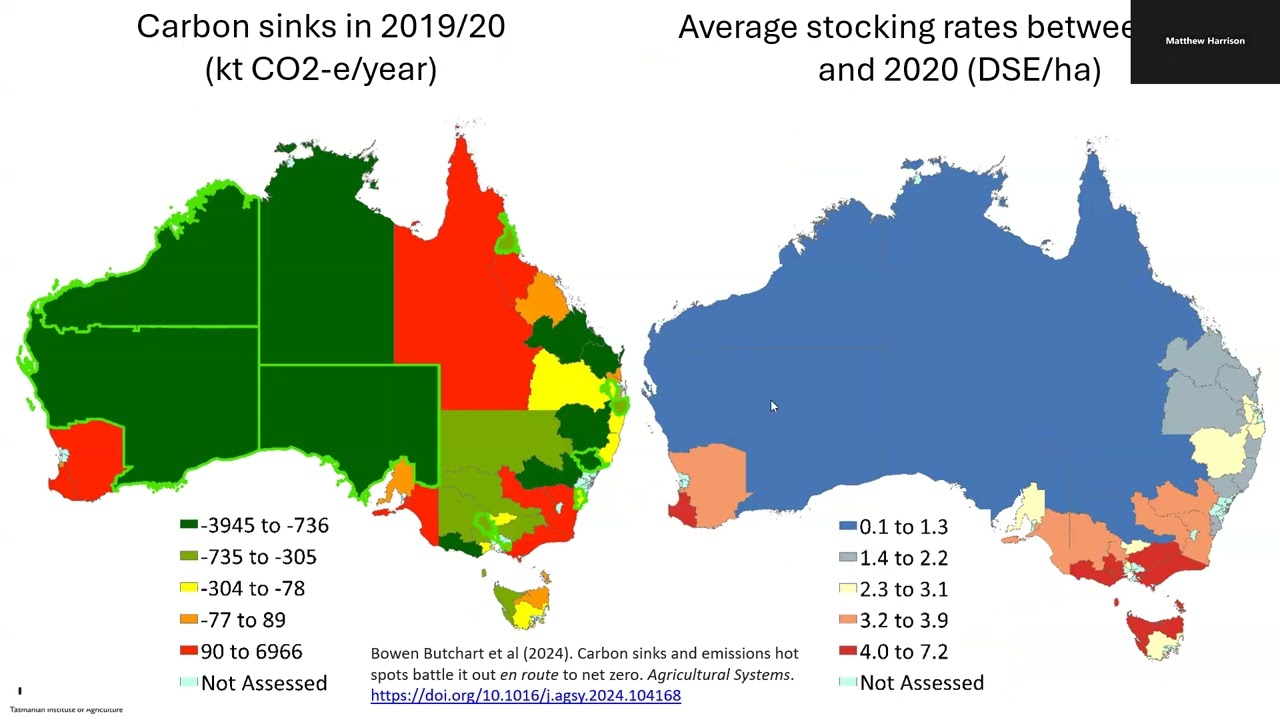
- Carbon sinks, such as vegetation and soil carbon, offset these emissions.
- Net farm emissions (carbon footprint) are calculated annually, considering both direct (scope 1 & 2) and indirect (scope 3) emissions.
- Emissions intensity measures emissions per unit of product, which is increasingly important for corporate and government reporting.
- Reducing emissions can be achieved by decreasing carbon sources (e.g., faster animal growth, low-emission supplements, better fertilizer management) or increasing carbon sinks (e.g., restoring degraded land, planting trees).
- Specific interventions include using feed supplements like 3-NOP or seaweed, adopting anti-methanogenic pasture species, improving animal genetics, and optimizing nitrogen fertilizer application.
- Increasing carbon sinks involves restoring degraded landscapes, using organic amendments, planting deep-rooted legumes, and implementing agroforestry.
- Addressing underlying farm deficiencies, such as land degradation or pest issues, often leads to the most significant co-benefits for emissions, productivity, and profit.
- Most emission reduction practices have both positive co-benefits and potential trade-offs that need to be managed.
- Interventions that address underlying deficiencies in a farming system (e.g., land degradation, pests, high costs) yield the greatest overall benefits across emissions, profit, biodiversity, and food production.
- Regenerative agriculture practices, such as adaptive grazing and pasture species diversity, can reduce emissions and improve soil carbon, but their effectiveness depends on the starting conditions of the land.
- The greatest benefits are achieved when emission reduction strategies are integrated with improvements in productivity and profitability, creating win-win scenarios.
- Carbon sequestration in vegetation slows down as plants mature, making it harder to reach net-zero targets solely through removals over time.
- Mitigation strategies, like using feed supplements to permanently avoid methane emissions, offer a more consistent and cumulative benefit.
- Agroforestry, involving harvesting timber and replanting, can create a more linear and sustained carbon removal profile compared to single-stage planting.
- Reliance on sequestration alone for net-zero goals becomes increasingly challenging as sinks approach their capacity.
Key takeaways
- Human activities have significantly altered the global carbon cycle, necessitating a shift away from fossil fuels.
- Reducing greenhouse gas emissions in agriculture is achievable through a combination of reducing emission sources and enhancing carbon sinks.
- Practices that address underlying farm deficiencies often provide the most substantial co-benefits for emissions, productivity, and profitability.
- The Australian livestock sector has made progress in emission reduction, primarily through avoided deforestation, but further innovation is needed for methane reduction.
- Accurate quantification of farm-level emissions and emissions intensity is essential for effective management and reporting.
- Strategies like improving animal genetics, using low-emission feed supplements, and optimizing fertilizer use can directly reduce emissions.
- Restoring degraded landscapes and planting native vegetation offer significant co-benefits for biodiversity and carbon sequestration.
- Direct emission mitigation strategies often provide more permanent and cumulative climate benefits than carbon sequestration alone.
Key terms
Test your understanding
- What is the primary difference between 'decarbonization' and 'de-fossilization' as discussed in the video?
- How have human activities disrupted the natural carbon cycle, and what are the consequences?
- What are the main sources of greenhouse gas emissions on a farm, and how are carbon sinks calculated?
- Describe at least three strategies for reducing greenhouse gas emissions from livestock farming.
- Why is addressing underlying deficiencies in a farming system often more beneficial than implementing isolated emission reduction practices?