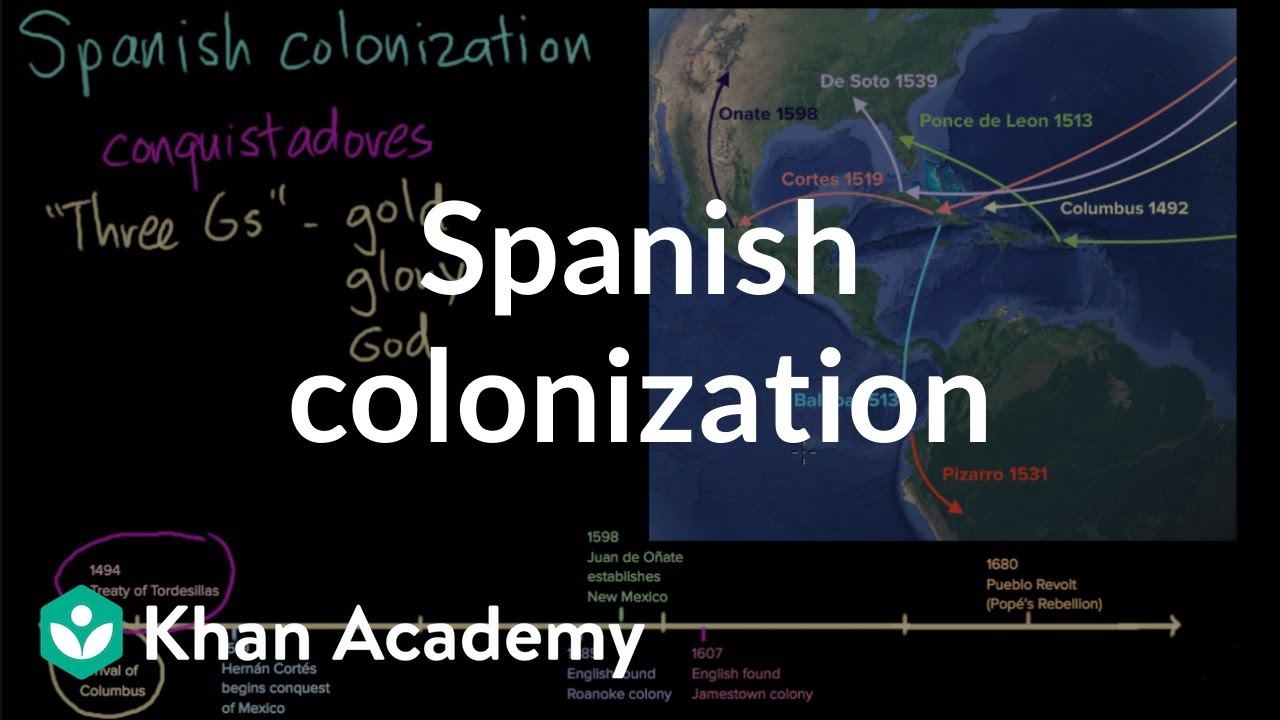
Spanish colonization | Period 1: 1491-1607 | AP US History | Khan Academy
Khan Academy
Overview
This video explores the Spanish colonization of the Americas, beginning with the arrival of Columbus and the motivations of "gold, glory, and God." It details the conquest of the Aztec Empire by Hernán Cortés, highlighting the role of native allies and European diseases like smallpox. The video explains the Encomienda system, a form of forced labor that decimated Native American populations, leading to the introduction of enslaved Africans. It also covers Native American resistance, exemplified by the Pueblo Revolt, and the development of a complex racial caste system (casta) in Spanish colonial society, which assigned social status based on ancestry. This system is contrasted with the English approach of eradication.
Save this permanently with flashcards, quizzes, and AI chat
Chapters
- Spanish explorers initially sought a passage to Asia but discovered vast riches in the Americas.
- The primary motivations for colonization were the 'three Gs': Gold (wealth), Glory (national prestige), and God (spreading Catholicism).
- Following Columbus's 1492 voyage, Spain and Portugal quickly moved to claim and divide New World territories.
- Hernán Cortés landed in Mexico in 1519 with a small force, exploiting the widespread resentment towards the Aztec Empire.
- The Aztec capital, Tenochtitlán, was a large, sophisticated city, but the Aztecs were disliked by many subordinate tribes who allied with Cortés.
- Superior Spanish weaponry (cannons, war dogs) and the devastating impact of European diseases like smallpox, to which Native Americans had no immunity, were key factors in the Spanish victory.
- Despite initial hospitality from Aztec emperor Moctezuma II, the relationship quickly deteriorated, leading to the fall of Tenochtitlán by 1521.
- The Spanish Crown implemented the Encomienda system, granting Spanish landowners rights to Native American labor and tribute.
- In theory, Native Americans received Christianization and protection in exchange for their labor; in practice, it was a brutal system akin to slavery.
- Harsh treatment and disease, particularly smallpox, caused a catastrophic decline in the Native American population, from an estimated 20 million to 2 million by 1600.
- Due to the drastic reduction in Native American labor, the Spanish began importing enslaved Africans.
- Native peoples resisted Spanish colonization through various means, including outward adoption of Christianity while secretly maintaining traditional beliefs (syncretism).
- The Pueblo Revolt of 1680, led by Pope, was a significant armed uprising against Spanish religious oppression.
- During the revolt, Pueblo people destroyed churches, killed priests, and expelled the Spanish for over a decade, forcing a more accommodating Spanish approach upon their return.
- Due to limited Spanish women migrating, Spanish men formed relationships with Native American and African women, leading to significant cultural and racial mixing.
- The Spanish developed a complex racial hierarchy called the casta system to categorize individuals based on their ancestry and perceived 'purity' of Spanish blood.
- Social status and legal rights were tied to one's position within this hierarchy, with 'criollos' (pure Spanish blood) at the top.
- This system created a place for diverse populations within colonial society, contrasting sharply with the English policy of eradication.
Key takeaways
- Spanish colonization was driven by a complex mix of economic, political, and religious motivations.
- The conquest of the Aztec Empire was facilitated by Native American alliances and the devastating impact of European diseases.
- The Encomienda system and subsequent labor demands led to catastrophic population decline among Native Americans and the rise of African slavery.
- Indigenous peoples actively resisted colonization through both subtle cultural adaptations and open rebellion.
- The Spanish established a rigid racial caste system that determined social status and legal rights based on ancestry.
- The Spanish approach aimed to incorporate and control indigenous populations, often through forced assimilation and labor, contrasting with the English goal of removal.
Key terms
Test your understanding
- What were the primary motivations behind Spanish colonization in the Americas, and how did they manifest in practice?
- How did Hernán Cortés manage to conquer the vast Aztec Empire with a relatively small Spanish force?
- Explain the Encomienda system and its devastating impact on the indigenous populations of the Americas.
- What were the different forms of Native American resistance to Spanish rule, and what was the significance of the Pueblo Revolt?
- How did the Spanish caste system attempt to categorize and control the diverse populations within their colonies, and what were its social implications?