6:36
Types of Experimental Designs (3.3)
Simple Learning Pro
Overview
This video explains three common types of experimental designs: completely randomized, randomized block, and matched pairs. It details how each design works, provides examples, and highlights why each is useful for controlling variables and drawing valid conclusions. The core idea is to systematically assign subjects or units to treatments to isolate the effect of the treatment being studied.
How was this?
Save this permanently with flashcards, quizzes, and AI chat
Chapters
- Experimental units are randomly assigned to different treatment groups.
- Each unit within a group receives the same treatment.
- This design is used to compare the effects of multiple treatments.
- Random assignment helps ensure that groups are similar at the start, minimizing bias.
This is the simplest design and is effective when there are no obvious confounding variables that need to be controlled for beforehand.
Assigning 30 students randomly into three groups of 10 to test studying in a library, own room, or outside.
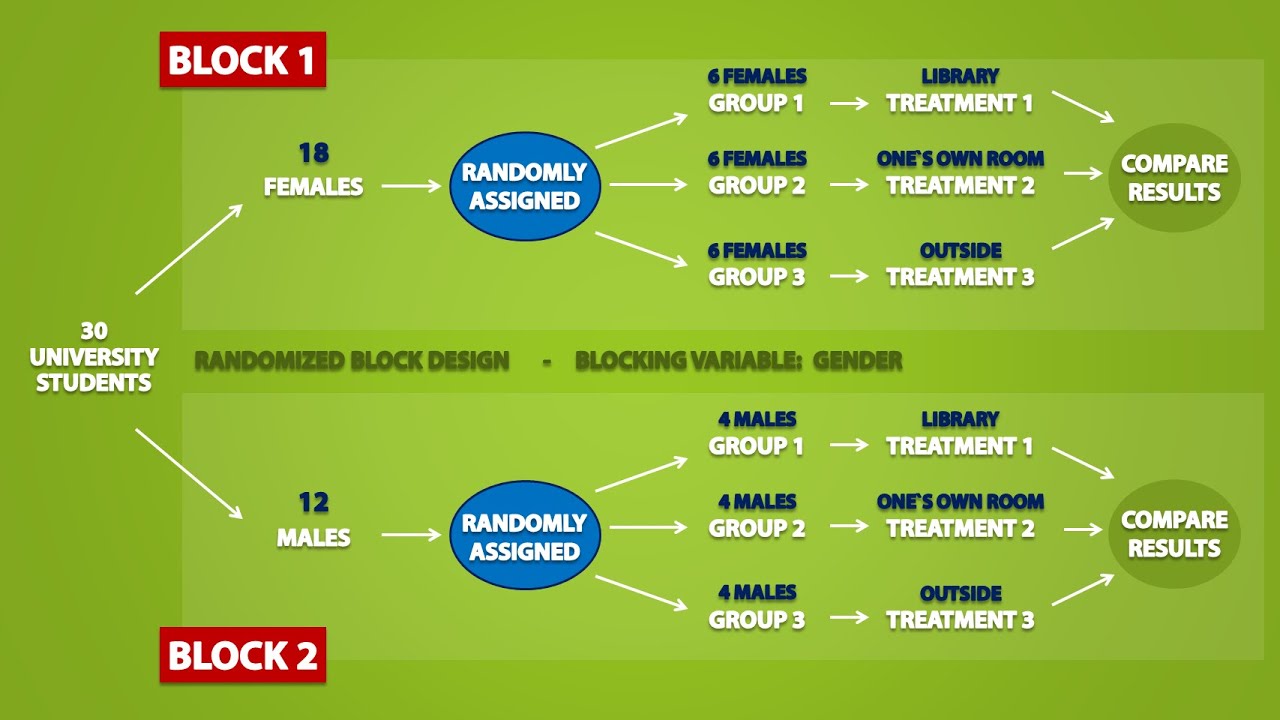
- Experimental units are first grouped into 'blocks' based on a characteristic that might affect the outcome (e.g., gender, age).
- Within each block, units are then randomly assigned to treatments.
- This design accounts for variability introduced by the blocking variable.
- It allows for a more precise comparison of treatments by reducing noise from known sources of variation.
This design is crucial when a specific characteristic is known or suspected to influence the results, allowing researchers to isolate the treatment effect more effectively.
Separating students by gender (blocks) and then randomly assigning males and females within their blocks to different study environments (library, room, outside).
- This design is used to compare only two treatments.
- It involves pairing experimental units that are similar or using the same unit for both treatments.
- When using the same unit, the order of treatments is randomized to avoid order effects.
- When using similar units, pairs are formed based on shared characteristics, and then each unit in the pair is randomly assigned to one of the two treatments.
This design is powerful for reducing variability because comparisons are made between units that are very similar or identical, leading to more sensitive detection of treatment effects.
Using the same three cars to test two types of gasoline (A and B), with each car receiving both treatments in a randomized order, or pairing students with similar GPAs and having one from each pair get a sleep-deprived treatment and the other a normal sleep treatment before a test.
Key takeaways
- Experimental designs aim to isolate the effect of a treatment by controlling for other factors.
- Random assignment is a core principle in experimental design to ensure unbiased comparisons.
- Completely randomized designs are simple but may not account for all sources of variability.
- Randomized block designs improve precision by controlling for known sources of variation through blocking.
- Matched pairs designs are best for comparing two treatments by minimizing variability through paired comparisons.
- The choice of design depends on the research question, the number of treatments, and the expected sources of variability.
Key terms
Experimental DesignCompletely Randomized DesignRandomized Block DesignMatched Pairs DesignExperimental UnitTreatmentRandom AssignmentBlocking VariablePairing
Test your understanding
- What is the primary goal of random assignment in experimental designs?
- How does a randomized block design differ from a completely randomized design, and why would you choose one over the other?
- In what situations is a matched pairs design most appropriate, and what are its two main approaches?
- Why is it important to randomize the order of treatments when using the same experimental unit in a matched pairs design?
- How can blocking help to increase the precision of an experiment?