1:27:57
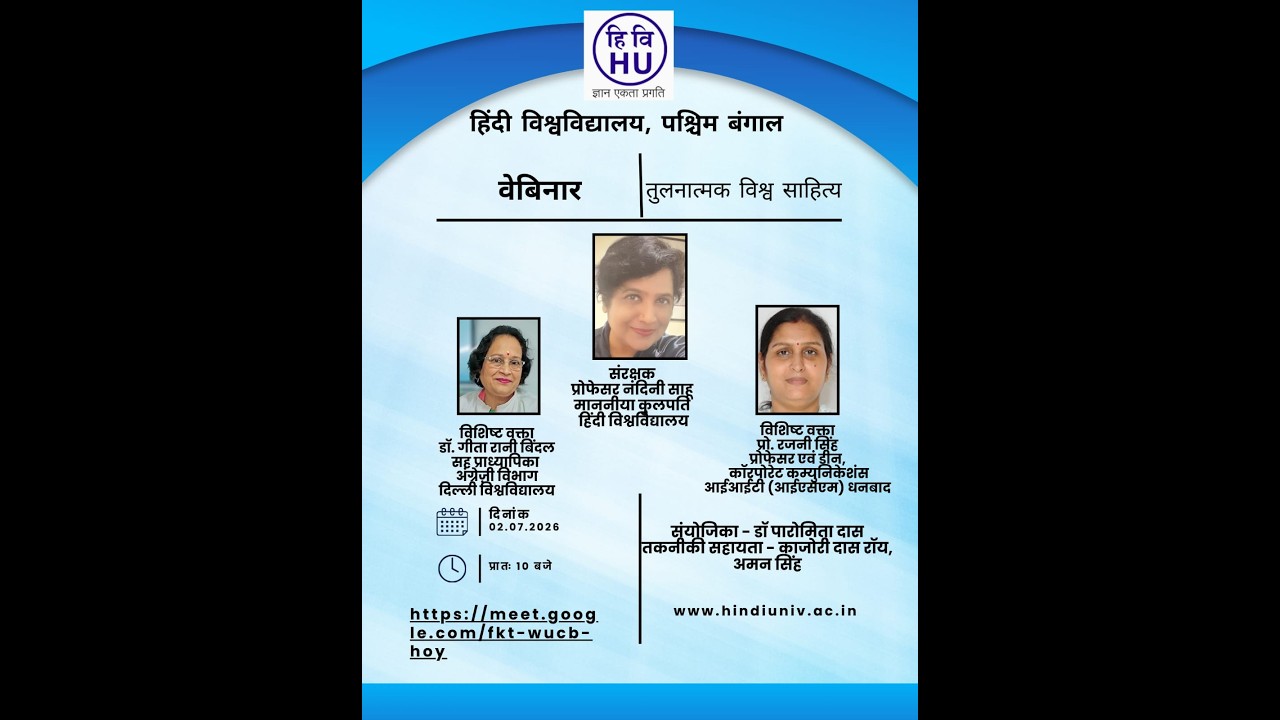
LECTURE: 47- COMPARATIVE WORLD LITERATURES SERIES.
Hindi University
Overview
This lecture series features two scholars discussing comparative world literature through distinct lenses. The first lecture focuses on Dalit feminist life writing, specifically Urmila Pawar's "The Weave of My Life," exploring how it serves as a counter-archive against dominant narratives by articulating the intersectional experiences of Dalit women. The second lecture examines "Vedic Echoes in Shakespeare," drawing parallels between Vedic/Upanishadic wisdom and Shakespeare's plays to illustrate universal human concerns about desire, wealth, and power, suggesting a cross-civilizational dialogue on ethical living.
How was this?
Save this permanently with flashcards, quizzes, and AI chat
Chapters
- The lecture series aims to explore comparative world literatures, bringing diverse scholarly perspectives.
- Dalit feminist life writing, though marginalized, is crucial for understanding subaltern experiences.
- Shakespeare's works can be re-examined through non-Western philosophical and ethical frameworks, like Vedic thought.
- The series emphasizes dialogue between civilizations and the importance of indigenous knowledge systems.
Understanding these diverse literary traditions and their underlying philosophies enriches our comprehension of human experience across cultures and historical periods.
- Urmila Pawar's memoir, 'The Weave of My Life,' documents the intersectional experiences of Dalit Mahar women, challenging dominant caste narratives.
- The memoir functions as a counter-archive, preserving collective memory and offering a feminist epistemology rooted in lived experience.
- Weaving (iden) is a central metaphor, symbolizing the weaving of fragmented memories into historical testimony and connecting generational labor.
- Pawar's writing politicizes pain into collective resistance, moving beyond individual suffering to community solidarity and activism.
- The text critiques both Brahminical and Dalit patriarchy, highlighting Dalit women's position at the intersection of multiple oppressions.
This chapter demonstrates how marginalized life writings can disrupt established historical accounts and theorize resistance from the perspective of those historically silenced.
Pawar's recollection of being forced to stand outside upper-caste homes and being sprinkled with water to purify the baskets she carried illustrates the lived reality of caste discrimination and pollution.
- Dalit feminist life writing transforms silence into testimony, creating an epistemic rupture that challenges dominant knowledge systems.
- Self-representation in these narratives asserts agency and claims narrative authority, shifting from passive subject to active producer of knowledge.
- The memoir becomes a collective archive, expanding the individual 'I' into a community 'we,' reflecting shared struggles and identities.
- Writing itself is presented as an inherited labor and a form of resistance, an intellectual artifact alongside material labor.
Understanding how marginalized voices articulate their experiences as testimony reveals the political power of narrative and its capacity to generate new forms of knowledge.
Pawar's memoir is not just about her personal story but reflects the collective experiences and struggles of the Mahar community, making her 'I' consistently expand into a 'we'.
- The Upanishadic concept of 'Da' (restraint, generosity, compassion) offers a framework for understanding ethical dilemmas in Shakespeare's plays.
- Shakespeare's comedies explore the consequences of excess in wealth, desire, and power, mirroring the need for ethical guidance.
- The plays highlight the dangers of confusing possession with fulfillment and the importance of recognizing limits.
- The Vedic emphasis on renunciation ('enjoy through renunciation') contrasts with the logic of absolute ownership seen in characters like Shylock.
Connecting Vedic wisdom with Shakespeare reveals universal human concerns and demonstrates how different civilizations offer complementary insights into ethical living.
The Upanishadic syllable 'Da' is interpreted by gods as restraint, humans as generosity, and demons as compassion, paralleling the ethical lessons explored in Shakespeare's 'The Merchant of Venice' (generosity), 'Twelfth Night' (restraint), and 'The Tempest' (compassion).
- The Merchant of Venice critiques the logic of possession, where wealth becomes detached from life and human relationships are reduced to contracts.
- Twelfth Night examines desire not as repression but as a force needing guidance, showing how excess leads to self-enclosure rather than fulfillment.
- The Tempest explores the ultimate form of possession – land and sovereignty – questioning the legitimacy of Prospero's narrative of authority against Caliban's claim of dispossession.
- Resolution in these plays comes not through mastery but through reciprocity, renunciation, and the recognition of limits.
Analyzing these plays through the lens of possession reveals how unchecked desire, wealth, and power lead to ethical crises, and how their resolution lies in relationality and humility.
In 'The Merchant of Venice,' Shylock's insistence on the pound of flesh, prioritizing a legal contract over human life, exemplifies the destructive nature of absolute possession.
- Comparative literature facilitates a dialogue where civilizations converse, using texts as bridges to share wisdom.
- Shakespeare's comedies, like the Vedic tradition, embed ethical instruction within narratives, guiding characters toward recognizing error and recovering proportion.
- The ongoing relevance of these lessons lies in the continuous human struggle with desire, wealth, and power, requiring constant re-evaluation.
- Both traditions emphasize that true enjoyment comes from renunciation and that ethical living requires maintaining relation with the world and others.
This approach encourages a deeper understanding of shared human values and ethical challenges, transcending cultural and historical boundaries.
Prospero's final act of breaking his staff and drowning his book in 'The Tempest' signifies a voluntary relinquishment of power, mirroring the Vedic concept of renunciation and moving from mastery to relation.
Key takeaways
- Dalit feminist life writing is essential for challenging dominant historical narratives and understanding intersectional oppression.
- Life writing by marginalized communities functions as a counter-archive, preserving memory and generating alternative epistemologies.
- The metaphor of weaving in Dalit literature symbolizes the connection between labor, memory, and the construction of historical testimony.
- Vedic and Upanishadic concepts like 'Da' offer timeless ethical guidance applicable to understanding human motivations and conflicts.
- Shakespeare's plays, when read through non-Western philosophical lenses, reveal universal concerns about managing desire, wealth, and power.
- True ethical living involves recognizing limits, practicing restraint, generosity, and compassion, and prioritizing relation over possession.
- Comparative literature fosters cross-civilizational dialogue, enriching our understanding of human experience and ethical frameworks.
Key terms
Dalit feminist life writingCounter-archiveIntersectional resistanceFeminist epistemologyVedic echoesUpanishadic wisdomDa (restraint, generosity, compassion)Possession vs. RelationSubaltern studiesEpistemic rupture
Test your understanding
- How does Urmila Pawar's 'The Weave of My Life' function as a counter-archive against dominant historical narratives?
- In what ways does the metaphor of weaving in Dalit literature connect personal memory with collective history?
- Explain the significance of the Upanishadic concept of 'Da' and how it can be applied to understanding characters in Shakespeare's plays.
- What are the consequences of the logic of possession as depicted in Shakespeare's 'The Merchant of Venice' and 'The Tempest'?
- How does the lecture argue that comparative literature facilitates a cross-civilizational dialogue on ethical living?