10:06
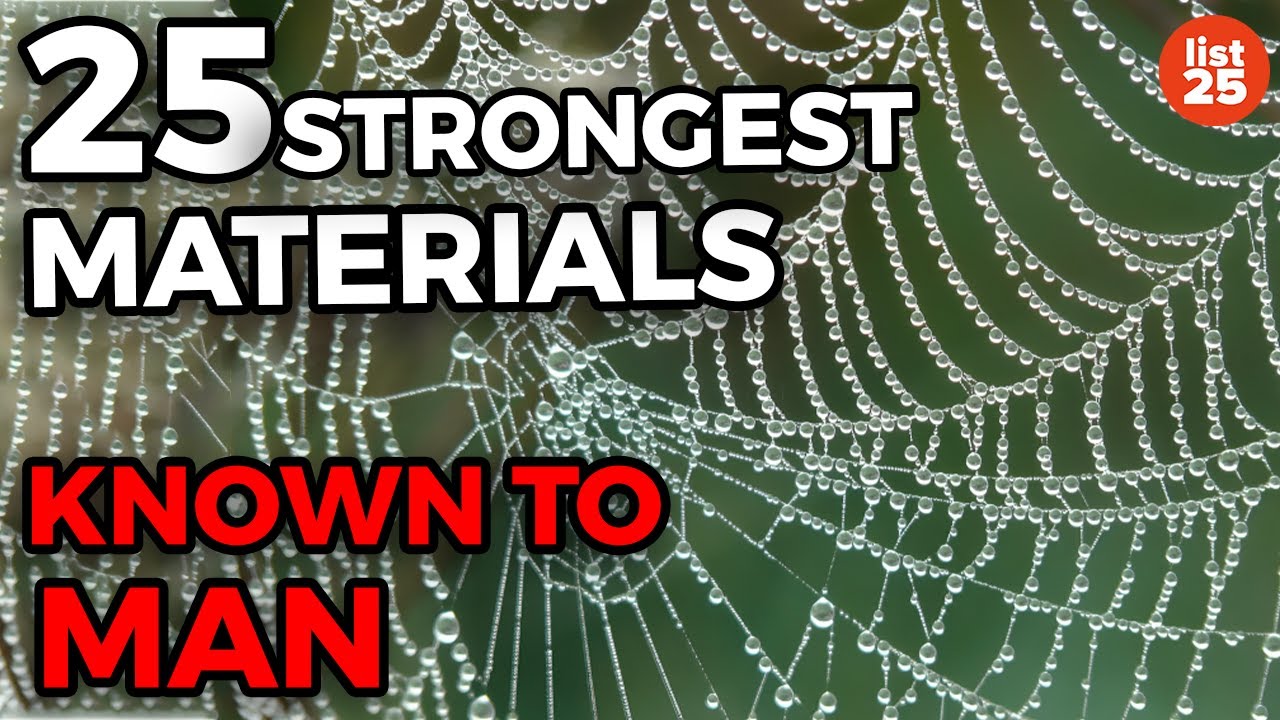
25 STRONGEST Materials Known to Man
List 25
Overview
This video explores the 25 strongest materials known to humankind, moving beyond common assumptions like diamonds. It highlights that 'strength' is multifaceted, encompassing hardness, toughness, and tensile strength. The list features a mix of natural and synthetic materials, from diamond and spider silk to advanced composites like graphene and carbon nanotubes. Each material's unique properties and potential applications, such as in aerospace, defense, and environmental cleanup, are briefly discussed, emphasizing the ongoing innovation in material science.
How was this?
Save this permanently with flashcards, quizzes, and AI chat
Chapters
- Hardness and strength are not single properties; materials can excel in one aspect while lacking in another.
- Commonly perceived 'strongest' materials like diamond are often defined by scratch resistance (hardness) rather than other strength metrics.
- Synthetic materials are increasingly combining desirable properties, challenging natural materials.
- The video will explore a range of materials, from natural to engineered, based on various strength metrics.
Understanding that 'strength' is complex helps in selecting the right material for specific applications, rather than relying on single, oversimplified measures.
Diamond is hard (resists scratching) but can be brittle, unlike tougher materials.
- Darwin's bark spider silk is noted for its toughness and strength relative to its weight, though its 'toughest biological substance' claim is contested.
- Limpet teeth are presented as potentially stronger than spider silk, with a fibrous structure that could inspire future engineering.
- Wurtzite boron nitride and Lonsdaleite (hexagonal diamond) are natural substances harder than diamond, but are rare and difficult to test/produce.
- Osmium is a dense natural element valued for durability and hardness in specific applications.
Nature provides incredible examples of strong materials, offering blueprints for synthetic materials and demonstrating extreme strength evolved for survival.
Limpet teeth are tough enough to scrape algae off rocks, showcasing extreme biological resilience.
- Aero graphite is an extremely light synthetic foam that can withstand significant compression and weight.
- Palladium micro-alloy glass combines toughness with strength, overcoming the typical brittleness of glass.
- Tungsten carbide and silicon carbide are exceptionally hard materials used in demanding applications like armor and grinding.
- Cubic boron nitride rivals diamond in strength and offers better performance at high temperatures with certain metals.
- Dyneema and Spectra are high-performance polyethylene fibers, lighter than water but capable of stopping bullets.
Engineered materials offer tailored properties, often surpassing natural limits in terms of strength-to-weight ratio and specific performance characteristics.
Dyneema, despite being lighter than water, is used in bulletproof vests.
- Graphene, a single layer of carbon atoms, is exceptionally strong (200x stronger than steel) and lightweight.
- Carbon nanotubes (CNTs) are seamless cylindrical structures of graphite, exhibiting remarkable strength at the nanoscale.
- Buckypaper, made from CNTs, is significantly stronger and lighter than steel.
- Aero graphene (graphene aerogel) combines graphene's strength with extreme lightness and oil absorption capabilities.
- New MIT developments aim to maximize graphene's 2D strength in 3D structures.
Carbon-based nanomaterials like graphene and nanotubes represent a frontier in material science, offering unprecedented strength and lightness with vast application potential.
To puncture a sheet of graphene, one might need to balance a school bus on a pencil tip placed on the graphene.
- Kevlar, a synthetic fiber, is known for its high tensile strength (8x that of steel) and heat resistance, used in protective gear.
- Titanium alloys offer high tensile strength and flexibility, though they are not as hard as some steel alloys.
- Maraging steel combines extreme strength and toughness with malleability, crucial for aerospace and tooling.
- Carbine, a single chain of atoms, demonstrates immense tensile strength and stiffness.
Materials with high tensile strength are critical for applications requiring resistance to pulling forces, such as cables, structural components, and protective equipment.
Kevlar's high tensile strength makes it suitable for bulletproof vests.
Key takeaways
- Material strength is a complex, multi-dimensional property, not a single measure.
- Nature provides inspiration for strong materials, with biological substances like spider silk and limpet teeth exhibiting remarkable properties.
- Synthetic materials, especially those based on carbon (graphene, nanotubes), are pushing the boundaries of strength-to-weight ratios.
- Different materials excel in different strength aspects: hardness (resisting scratches), toughness (absorbing impact), and tensile strength (resisting pulling).
- Advanced materials have diverse applications ranging from aerospace and defense to environmental solutions like oil spill cleanup.
- The development of new materials is an ongoing process, with research constantly uncovering substances with superior properties.
Key terms
HardnessToughnessTensile StrengthMohs ScaleDiamondSpider SilkAero GraphiteDyneemaKevlarGrapheneCarbon NanotubesWurtzite Boron NitrideLonsdaleite
Test your understanding
- What are the key differences between hardness and toughness in materials?
- How do natural materials like spider silk compare to synthetic materials like Dyneema in terms of strength and application?
- Why are carbon-based nanomaterials like graphene considered revolutionary in material science?
- Explain the trade-offs between different types of strength (e.g., hardness vs. brittleness) using examples from the video.
- How might the development of materials like aero graphene address environmental challenges?