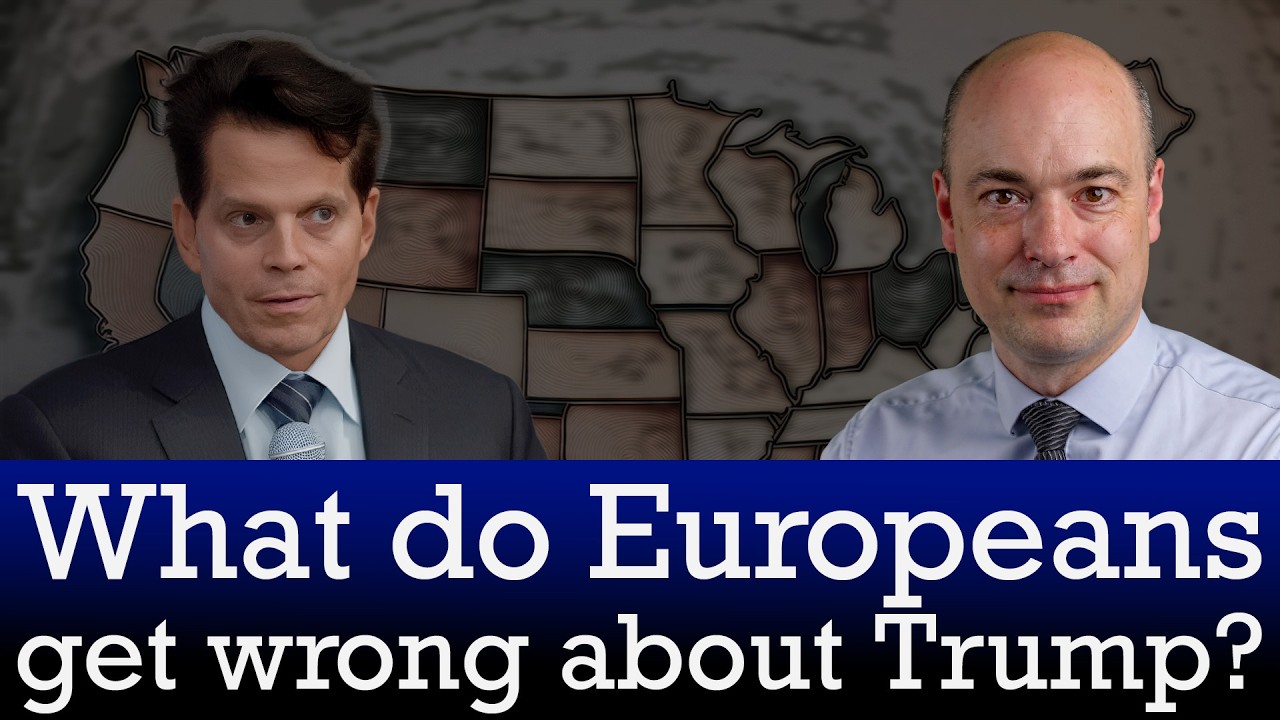
Would the US actually defend NATO? — Interview with Anthony Scaramucci
Anders Puck Nielsen — conversations
Overview
This interview with Anthony Scaramucci explores the complexities of American politics, particularly concerning Donald Trump's influence, foreign policy implications for Europe, and the underlying economic and social factors driving American discontent. Scaramucci argues that Trump, despite his perceived flaws, is a highly intelligent and effective political operator who understands and exploits cultural and economic anxieties. The discussion delves into the potential weakening of NATO, the impact of economic inequality, and the challenges facing the Democratic party. Scaramucci expresses concern about the future of American alliances and democratic norms, but ultimately remains optimistic about the potential for reform and renewal in the United States.
Save this permanently with flashcards, quizzes, and AI chat
Chapters
- Donald Trump is a far more intelligent and politically astute figure than many perceive, capable of remarkable comebacks and strategic execution.
- His appeal to a significant portion of the American electorate stems from his understanding of cultural grievances and his role as a 'culture warrior'.
- Trump's ability to capture the imagination of evangelical Christians is linked to his judicial appointments, which have advanced conservative values.
- Despite his intelligence, Trump can be a knee-jerk, reactionary decision-maker, possibly due to attention deficit disorder, but this does not equate to a lack of intelligence.
- A significant majority of Americans, particularly in swing states, are uncomfortable with 'woke' culture, including pronoun designations and perceived overrepresentation in media.
- Donald Trump effectively leverages these social conservative sentiments, using cultural issues as a tool to mobilize voters, even if he doesn't personally embody all these values.
- The Democratic party's focus on progressive social issues can alienate the white working-class and middle-class voters they need to win elections.
- AOC's decision to remove her pronoun designation from her Twitter account illustrates how even progressive politicians adapt to the prevailing social conservative sentiment driven by Trump.
- Decades of economic policies have led to a significant decline in disposable income and purchasing power for the average American, making homeownership unattainable for many.
- Capital has captured an disproportionate share of economic profits from labor, disrupting the balance that previously fueled middle-class prosperity.
- The current economic system, characterized by high taxes and stagnant wages, leaves many Americans feeling like 'ants' working for the benefit of others.
- Proposed policies like a national wealth tax are viewed with suspicion by Americans who fear further government overreach and taxation.
- Donald Trump's rhetoric and actions suggest a potential weakening or disavowal of NATO, undermining an 80-year tradition of American commitment to collective security.
- Scaramucci posits that Trump's praise for Vladimir Putin and his disavowal of defense agreements with Ukraine indicate he is 'owned' by Russia, likely due to compromising information.
- The US faces a divided political landscape, with 80 million voters supporting Trump, making it imperative for any future leader to address their grievances.
- The erosion of trust in US alliances poses a significant threat to global stability and the fight against authoritarianism.
- Scaramucci believes that Trump's norm-breaking behavior, while dangerous, has inadvertently provided a 'playbook' for reform by highlighting the flaws in the American political system.
- Key reforms needed include removing big money from politics, ending gerrymandering, and increasing support for low-income workers through programs like earned income tax credits.
- The US has a history of cyclical crises and subsequent renewal, with the current period being approximately 80 years after the Great Depression and WWII.
- Despite current challenges, Scaramucci remains optimistic due to America's dynamic, entrepreneurial culture and its capacity for innovation and economic advancement.
Key takeaways
- Donald Trump's political success is rooted in his strategic intelligence and his ability to tap into deep-seated American cultural and economic anxieties.
- The 'culture war' in the US is a significant factor in political polarization, with social conservatism playing a key role in mobilizing voters.
- Economic inequality and the decline of the middle class are primary drivers of public discontent and the appeal of populist movements.
- A potential shift away from traditional US foreign policy commitments, particularly regarding NATO, poses a serious risk to global security.
- Despite current challenges, the US possesses inherent strengths, such as its dynamic economy and capacity for reform, that foster optimism for the future.
- Removing the influence of big money in politics and addressing gerrymandering are critical steps towards restoring democratic accountability.
- The US has a historical pattern of overcoming significant crises through periods of renewal and reform.
Key terms
Test your understanding
- How does Scaramucci explain Donald Trump's ability to maintain political relevance despite significant controversies?
- What are the key economic factors that Scaramucci identifies as driving American discontent and populism?
- Why does Scaramucci believe Donald Trump might be influenced by Russia, and what are the implications for US foreign policy?
- What specific reforms does Scaramucci propose to address the economic and political challenges facing the United States?
- Based on historical patterns, why does Scaramucci express optimism about the future of American democracy despite current difficulties?