What is Positive Psychology?
Test Prep Gurus (Newport Beach)
Overview
This video introduces positive psychology as the scientific study of what makes life most worth living, contrasting it with traditional psychology's focus on pathology. It highlights that positive psychology aims to enhance well-being by identifying and building on strengths, rather than solely treating weaknesses. Key concepts like 'flow,' mindfulness, and learned optimism are explained as pathways to a more fulfilling life, emphasizing that sustained well-being requires effort and is not achieved through shortcuts. The video also touches on the 'good work' project, suggesting that societal structures can be improved by fostering excellence and meaning in work.
Save this permanently with flashcards, quizzes, and AI chat
Chapters
- Positive psychology is the scientific investigation of what makes life most worth living.
- It focuses on identifying and cultivating strengths and positive experiences, asking 'What is right with you?'
- It complements, rather than replaces, traditional psychology's focus on treating mental illness and pathology.
- The goal is to help individuals move from a neutral state towards greater fulfillment, not just back from a negative state.
- Well-being is distinct from simple happiness and is comprised of five key elements.
- These elements are: positive emotion, engagement, relationships, meaning, and accomplishment.
- Each pillar represents a different facet of a fulfilling life that can be actively cultivated.
- Flow is a state of complete absorption in an activity, characterized by intense focus and a loss of self-consciousness.
- Flow occurs when challenges are perfectly matched to one's skills, preventing boredom or overwhelm.
- Mindfulness is the practice of intentionally focusing awareness on the present moment, observing thoughts, feelings, and sensations without judgment.
- Practicing mindfulness can lead to reduced stress, anxiety, and depression.
- Learned optimism is the belief that a positive outlook can be developed, contrasting with learned helplessness where individuals feel powerless.
- Achieving sustained happiness and well-being requires significant effort and is not based on shortcuts.
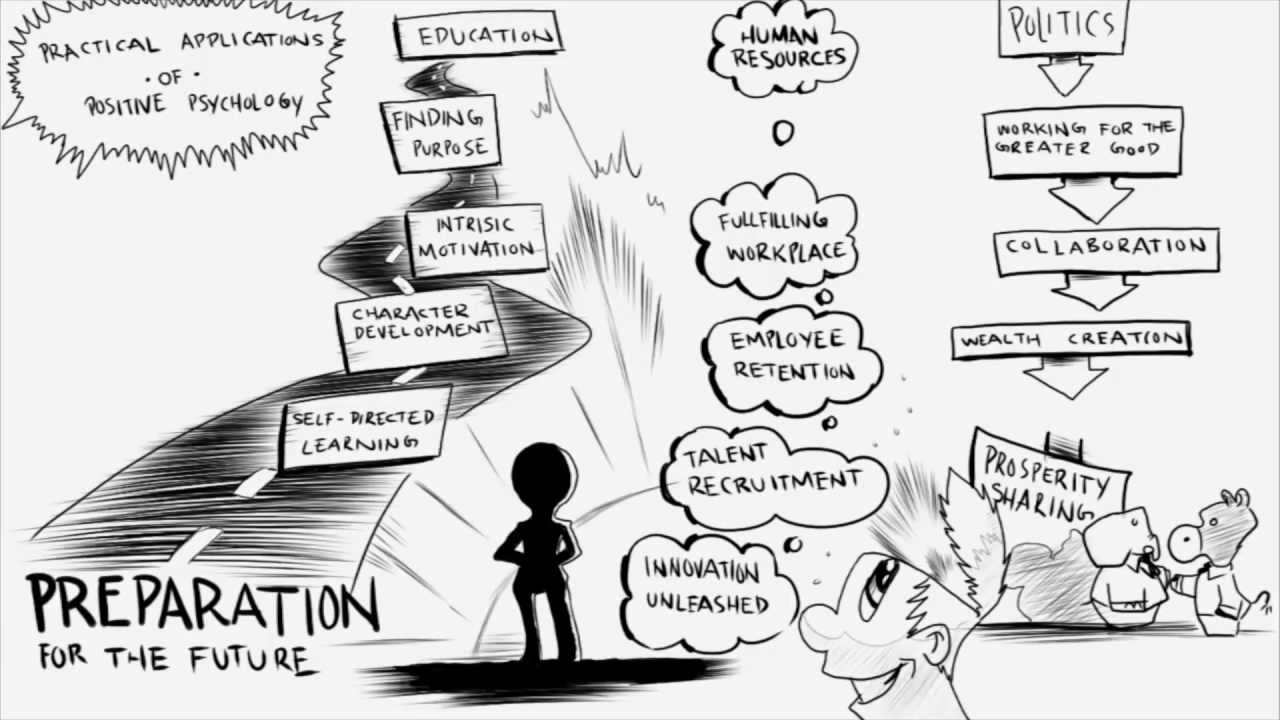
- The 'good work' project seeks to identify and promote work that is excellent, socially responsible, and meaningful to practitioners.
- Encouraging individuals to pursue excellence and find fulfilling work can benefit society as a whole.
Key takeaways
- Positive psychology scientifically studies what makes life fulfilling, focusing on strengths and positive experiences.
- Well-being is a multifaceted concept built upon positive emotions, engagement, relationships, meaning, and accomplishment.
- Flow states, characterized by deep absorption and optimal challenge, are crucial for engagement and creativity.
- Mindfulness cultivates present-moment awareness, offering benefits like stress reduction.
- Optimism can be learned, and actively working towards it is essential for well-being, countering learned helplessness.
- True fulfillment requires sustained effort; beware of those promising easy shortcuts to happiness.
- Promoting 'good work'—work that is excellent, meaningful, and socially responsible—can enhance both individual lives and society.
Key terms
Test your understanding
- How does positive psychology differ in its core questions and goals compared to traditional psychology?
- What are the five pillars that constitute well-being according to positive psychology?
- Describe the characteristics of a 'flow' state and explain why it is important for fulfillment.
- What is the difference between learned optimism and learned helplessness, and how does each relate to well-being?
- How can the principles of positive psychology be applied to improve aspects of society like education or business?