A History of Western Architecture: Greece & Rome, Part I
ClassicistORG
Overview
This lecture introduces the fundamentals of Western architecture, focusing on ancient Greece. It emphasizes that much of our understanding is based on interpretation and reconstruction due to the limited surviving evidence. The video explores various building types beyond temples, such as stoas, theaters, and bouleuteria, highlighting their social and civic functions. It then delves into the defining characteristics of Greek temples, particularly the Doric and Ionic orders, explaining their structural elements, decorative features, and historical significance. The lecture also touches upon urban planning and domestic architecture, contrasting the grandeur of public buildings with the simplicity of houses. Finally, it discusses the enduring influence of Greek architectural principles on later periods, including Roman and modern Western architecture.
Save this permanently with flashcards, quizzes, and AI chat
Chapters
- Ancient Greek architecture is subject to much scholarly debate and uncertainty regarding dating and interpretation.
- The lecture aims to provide a basic understanding, not definitive answers, encouraging further exploration.
- Greek architectural elements are still present in modern buildings, demonstrating Greece's continuous influence.
- Understanding Greek architecture can enhance appreciation of the built environment around us.
- The Greek world extended beyond mainland Greece to include Asia Minor, Southern Italy, and Sicily.
- Classical Greek architecture is broadly categorized into the Archaic, Classical, and Hellenistic periods.
- Key figures like Pericles, Phidias, Plato, and Aristotle shaped Greek culture and thought during crucial periods.
- The Periclean Age, though brief, was a period of immense artistic and architectural flourishing, often occurring between wars.
- Athens, though small by modern standards, was a significant administrative and cultural center.
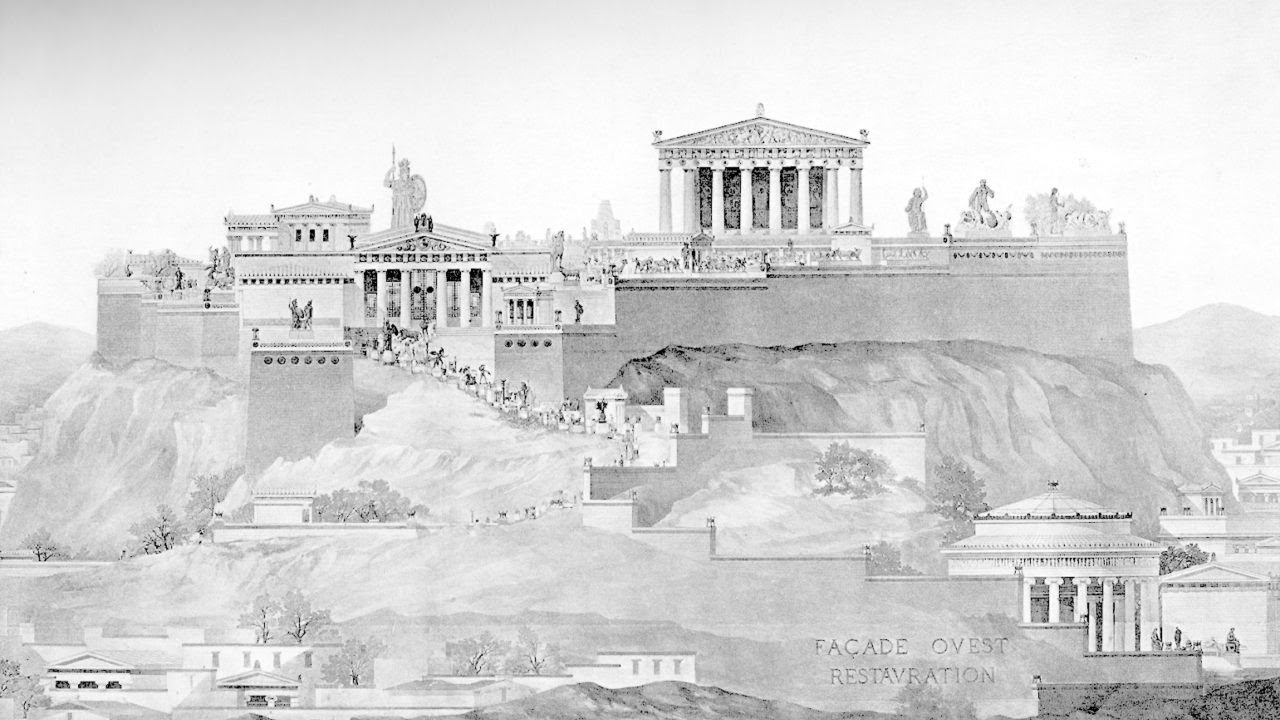
- The Agora served as the bustling marketplace and social hub, while the Acropolis was the religious center.
- Stoas were covered walkways in public spaces, vital for social interaction and shelter.
- Theaters, with their semi-circular seating and orchestra, were central to Greek civic life and drama.
- Bouleuteria functioned as council houses for civic debate and decision-making.
- Greek houses were generally simple, often built around courtyards, contrasting with grand public structures.
- The grid-iron street plan, pioneered by Hippodamus of Miletus, is a significant urban planning legacy.
- Olynthos provides insights into domestic architecture, including houses with floor mosaics.
- Symposia were exclusive male gatherings for drinking and conversation, while fountain houses served as social hubs for women.
- Temples represented the greatest investment of resources and architectural energy in ancient Greece.
- Early Greek temples were constructed of wood, with forms derived from post-and-lintel construction, later translated into stone (trabeation).
- The Doric and Ionic orders are the primary architectural systems, distinguished by their column capitals.
- The Doric order is characterized by its simple, robust capital, while the Ionic features distinctive scrolls (volutes).
- The Corinthian order, though invented by Greeks, was more extensively used by the Romans.
- Temples are classified by the number of columns (e.g., distyle, tetrastyle, octastyle) and their arrangement (e.g., prostyle, amphiprostyle, peripteral).
- The entablature, consisting of the architrave, frieze, and cornice, is a key component above the columns.
- Pediments, the triangular gables above the entablature, were often filled with elaborate relief sculpture.
- Doric friezes feature alternating triglyphs and metopes, the latter often containing sculpture.
- Optical corrections, such as entasis (the slight bulging of columns), were employed to achieve visual harmony and a sense of weight.
- The Ionic order is recognized by its voluted (scroll-like) capitals and often features more elaborate column bases and moldings.
- The Erechtheum on the Acropolis is considered a masterpiece of the Ionic order, known for its elegant columns and caryatids (female figures used as columns).
- The Temple of Artemis at Ephesus and the Temple on the Ilissus showcase variations and influential examples of the Ionic order.
- Greek architectural elements, particularly the Ionic order, were widely adopted and adapted in the New World, influencing American architecture.
- The study of Greek architecture is often enriched by examining surviving elements in museums like the British Museum.
Key takeaways
- Ancient Greek architecture, though subject to scholarly debate, provides foundational principles for Western design.
- Greek cities were meticulously planned, with distinct zones for public life, religion, and domesticity.
- The development from wooden to stone construction, particularly in temples, marked a significant technological and aesthetic shift.
- The Doric and Ionic orders, defined by their column capitals and structural systems, are the defining elements of Greek temple architecture.
- Greek temples were not merely structural but also highly decorated, featuring intricate sculptural programs.
- Optical refinements like entasis demonstrate the Greeks' sophisticated understanding of visual perception in architecture.
- The legacy of Greek urban planning, architectural orders, and decorative motifs continues to influence buildings worldwide.
Key terms
Test your understanding
- What are the main challenges in studying ancient Greek architecture, and how do they affect our understanding?
- How did the function and design of stoas, theaters, and bouleuteria contribute to the social and civic life of Greek cities?
- Explain the transition from wooden to stone temple construction in ancient Greece and the concept of 'trabeation'.
- What are the key visual differences between the Doric and Ionic architectural orders, and how are they identified?
- Describe the main components of a Greek temple's entablature and pediment, and explain the purpose of sculptural decoration in these areas.