9:22
1580-7.1c CI for proportions and sample size
OCC Math Prof
Overview
This video explains how to determine the necessary sample size for a confidence interval for a proportion, given a desired margin of error. It covers two scenarios: when a prior estimate of the population proportion (p-hat) is available, and when it is not. The video also demonstrates how to calculate the point estimate (p-hat) and margin of error from an existing confidence interval, emphasizing intuitive methods over complex formulas.
How was this?
Save this permanently with flashcards, quizzes, and AI chat
Chapters
- The goal is to find the required sample size before collecting data, based on a desired margin of error for a confidence interval.
- This differs from calculating a confidence interval from existing data.
- Two formulas exist for sample size calculation, depending on whether a prior estimate of the population proportion is available.
Determining the sample size beforehand ensures that the collected data will yield a confidence interval with the desired precision, saving time and resources.
- When a prior estimate (p-hat) of the population proportion is known (from previous studies or data), use the formula: n = (z^2 * p-hat * q-hat) / E^2.
- Here, 'z' is the critical value for the desired confidence level, 'p-hat' is the prior estimate, 'q-hat' is (1 - p-hat), and 'E' is the desired margin of error.
- The calculated sample size 'n' must always be rounded up to the nearest whole number because it represents the minimum required size.
Using a prior estimate allows for a more efficient sample size calculation, potentially requiring a smaller sample than if no estimate is available.
To achieve a 95% confidence interval with a 1% margin of error for the proportion of students using Snapchat, given a prior p-hat of 0.63, the required sample size is calculated as (1.96^2 * 0.63 * 0.37) / 0.01^2, which rounds up to 8955 students.
- If there's no prior information about the population proportion, use the formula: n = (z^2 * 0.25) / E^2.
- The value 0.25 comes from using p-hat = 0.5 and q-hat = 0.5, which represents the most conservative (worst-case) scenario for sample size calculation.
- This formula generally yields a larger required sample size compared to using a specific prior estimate.
This conservative approach guarantees that the sample size will be sufficient regardless of the true population proportion, ensuring the desired margin of error is met.
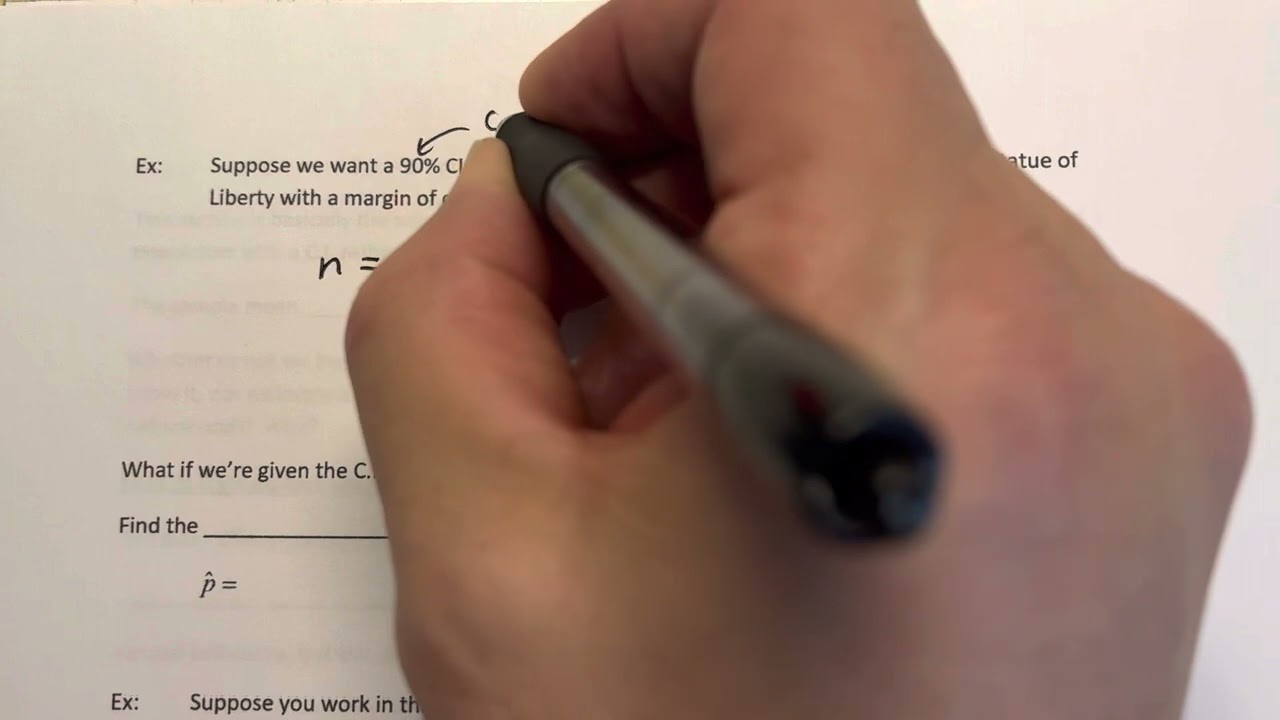
For a 90% confidence interval with a 3% margin of error for the proportion of students who visited the Statue of Liberty, with no prior estimate, the sample size is calculated as (1.645^2 * 0.25) / 0.03^2, resulting in approximately 752 students.
- The point estimate (p-hat) of a confidence interval is always the midpoint between the lower and upper bounds.
- The margin of error is the distance from the point estimate to either the lower or upper bound of the interval.
- These values can be found by simple averaging and subtraction, rather than relying solely on formulas.
Understanding how to extract the point estimate and margin of error from a given confidence interval is crucial for interpreting study results and performing related calculations.
Given a confidence interval of (0.25, 0.33), the p-hat is the average (0.25 + 0.33) / 2 = 0.29, and the margin of error is 0.29 - 0.25 = 0.04 (or 0.33 - 0.29 = 0.04).
Key takeaways
- To ensure a desired level of precision (margin of error) in a confidence interval, the sample size must be calculated *before* data collection.
- When a prior estimate of the population proportion is available, it can be used in the sample size formula to potentially reduce the required sample size.
- If no prior estimate exists, use p-hat = 0.5 for the sample size calculation to ensure a conservative and sufficient sample size.
- The calculated sample size for confidence intervals must always be rounded up to the next whole number.
- The point estimate (p-hat) of a confidence interval is the average of its lower and upper bounds.
- The margin of error is the difference between the point estimate and either bound of the confidence interval.
Key terms
Confidence IntervalMargin of ErrorSample SizePopulation ProportionPrior Estimate (p-hat)Critical Value (z)Conservative EstimatePoint Estimate
Test your understanding
- Why is it important to calculate the sample size before collecting data when aiming for a specific margin of error?
- How does the availability of a prior estimate for the population proportion affect the calculation of the required sample size?
- What is the rationale behind using p-hat = 0.5 when no prior estimate is available for sample size calculation?
- How can you determine the point estimate (p-hat) and margin of error if you are only given the lower and upper bounds of a confidence interval?
- Why is it necessary to always round up the calculated sample size?