29:18
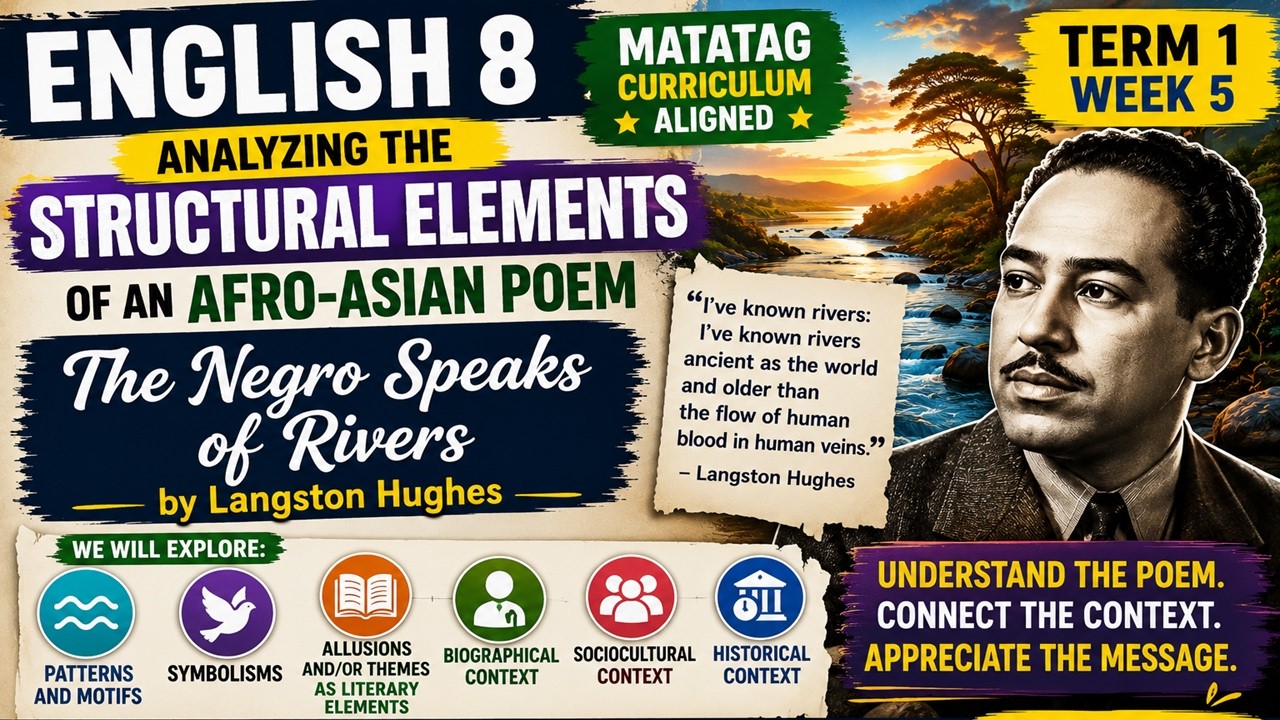
English 8 Term 1 Week 5 | Structural Elements & Contexts of Afro-Asian Poem | Complete PPT + ILAW LP
MATATAG Learning Hub
Overview
This video explores Langston Hughes' poem "The Negro Speaks of Rivers" by analyzing its literary elements and contextual backgrounds. It delves into how biographical, sociocultural, and historical factors influence the poem's themes of identity, heritage, and resilience. The lesson uses the poem to teach about literary devices like patterns, motifs, symbolism, and allusions, and connects these to the broader experiences and history of African people. Ultimately, it emphasizes the importance of understanding cultural heritage and historical context for a deeper appreciation of literature and identity.
How was this?
Save this permanently with flashcards, quizzes, and AI chat
Chapters
- The lesson aims to identify literary elements in "The Negro Speaks of Rivers" and analyze how biographical, sociocultural, and historical contexts shape its message.
- Rivers are introduced as vital elements for communities, symbolizing life, sustenance, and growth.
- Key vocabulary such as 'ancient,' 'dawn,' 'current,' 'bosom,' and 'soul' is defined using context clues from example sentences.
Understanding the poem's core message and the meaning of key terms is essential before diving into deeper analysis and contextual connections.
Defining 'ancient' as 'very old' because the clue 'has flowed for thousands of years' indicates great age.
- Patterns, like the repetition of 'I've known rivers,' are used by writers to highlight important ideas and make poems memorable.
- A motif is a recurring image or idea that develops deeper meaning; in this poem, the river motif represents life, ancestry, wisdom, resilience, and history.
- Symbolism uses simple representations for deeper ideas; rivers symbolize life, history, identity, and the continuous flow of time, while the soul represents inner self and memory.
Identifying these literary devices helps unlock the poem's layers of meaning beyond its literal words, revealing the poet's intended message.
The repeated phrase 'I've known rivers' serves as a pattern that emphasizes the speaker's profound connection to rivers and their historical significance.
- Allusions are indirect references to well-known people, places, or events that add depth without explicit explanation.
- The poem alludes to the Euphrates (early civilization), the Congo (African heritage), the Nile (ancient Egypt), and the Mississippi (slavery and hope).
- The central theme is the deep connection between identity, heritage, and resilience, shaped by ancestral experiences and cultural history.
Recognizing allusions enriches the understanding of the poem's historical and cultural connections, while identifying the theme provides the core message the author wishes to convey.
Langston Hughes alludes to the Nile River to connect African identity to the achievements of ancient Egypt, highlighting a rich and powerful heritage.
- Biographical context explores how an author's life experiences, beliefs, and background influence their work.
- Langston Hughes, a key figure of the Harlem Renaissance, focused on equality, hope, and pride in African heritage.
- Hughes's childhood experiences, stories from his grandmother about African-American history, and his journey along the Mississippi River inspired his writing, particularly this poem.
Understanding Langston Hughes's personal life and influences provides insight into the motivations and specific references within his poetry.
Hughes's grandmother sharing stories about African-American history, courage, and perseverance influenced his view of history as something living and passed through generations, mirroring the river's flow.
- Sociocultural context examines how society, culture, traditions, and values influence a literary work.
- Despite facing discrimination, African-Americans preserved their history, traditions, and values, fostering a strong sense of pride and identity.
- The poem's 'I' represents a collective voice, speaking for African ancestors, communities, and generations connected by shared history and heritage.
This context reveals how the poem reflects the collective experiences, struggles, and cultural resilience of the African-American community.
The speaker's statement 'My soul has grown deep like the rivers' signifies carrying the memories, experiences, and wisdom passed down through many generations of African people.
- Historical context involves significant events, people, and time periods that shape a literary work.
- The poem references ancient civilizations like Mesopotamia (Euphrates), Egypt (Nile), and African kingdoms (Congo) to connect African identity to early human history and achievements.
- The Mississippi River alludes to the history of slavery and the subsequent struggle for freedom and equality in America, particularly during the Harlem Renaissance.
Examining historical events provides a framework for understanding the specific references in the poem and the broader historical narrative it engages with.
The mention of the Mississippi River and Abraham Lincoln symbolizes the journey from the suffering of slavery to the hope for freedom and equality for African Americans.
Key takeaways
- Literary elements like patterns, motifs, symbolism, and allusions are tools poets use to convey complex messages about identity and heritage.
- The river is a powerful symbol representing life, history, ancestry, resilience, and the continuous flow of time.
- An author's personal life (biographical context) significantly influences the themes and specific references in their writing.
- The collective experiences and cultural values of a community (sociocultural context) are often reflected and celebrated in literature.
- Understanding historical events (historical context) is crucial for interpreting the allusions and deeper meanings within a poem.
- Langston Hughes's poem celebrates the rich and enduring legacy of African people, connecting their identity to ancient civilizations and their resilience to historical struggles.
- Appreciating one's own cultural heritage and history fosters a stronger sense of identity and respect for others.
Key terms
PatternMotifSymbolismAllusionThemeBiographical ContextSociocultural ContextHistorical ContextHarlem RenaissanceIdentityHeritageResilience
Test your understanding
- How does the repetition of 'I've known rivers' function as a pattern in Langston Hughes' poem?
- What deeper meanings do the rivers symbolize in 'The Negro Speaks of Rivers,' and how do these symbols contribute to the poem's theme?
- In what ways did Langston Hughes's personal life experiences and background (biographical context) shape the message of 'The Negro Speaks of Rivers'?
- How does the sociocultural context of the African-American experience during the Harlem Renaissance inform the collective voice and themes in the poem?
- Explain how the historical allusions to the Euphrates, Congo, Nile, and Mississippi rivers connect the poem's message to broader human history and the African-American journey.