Jung Kwak Presentation Recording
Rosa Diaz
Overview
This presentation discusses the challenges and disparities faced by individuals living with advanced dementia and their family caregivers, particularly within complex healthcare settings. The speaker, drawing from personal experiences and research, highlights the need for culturally sensitive and individually tailored support. The research presented focuses on understanding the influence of social determinants of health, cultural values, and spiritual beliefs on end-of-life care decisions and experiences. Two current research projects are detailed: one investigating decision-making and healthcare team interactions, and another piloting a community health worker-led post-discharge navigator program to improve care transitions and address social needs. The presentation emphasizes the importance of stakeholder engagement and sustainable solutions to improve the quality of life for individuals with dementia and their families.
Save this permanently with flashcards, quizzes, and AI chat
Chapters
- The speaker shares her background, growing up in South Korea and moving to the US, which shaped her understanding of diversity and equity.
- Witnessing her mother's experience as a caregiver for her grandmothers with dementia inspired her research focus.
- Early research and clinical experiences at hospice organizations solidified her interest in dementia caregiving and end-of-life equity.
- Her research is driven by a commitment to cultural diversity, equity, and understanding the influences of culture, spirituality, and social determinants on caregiving.
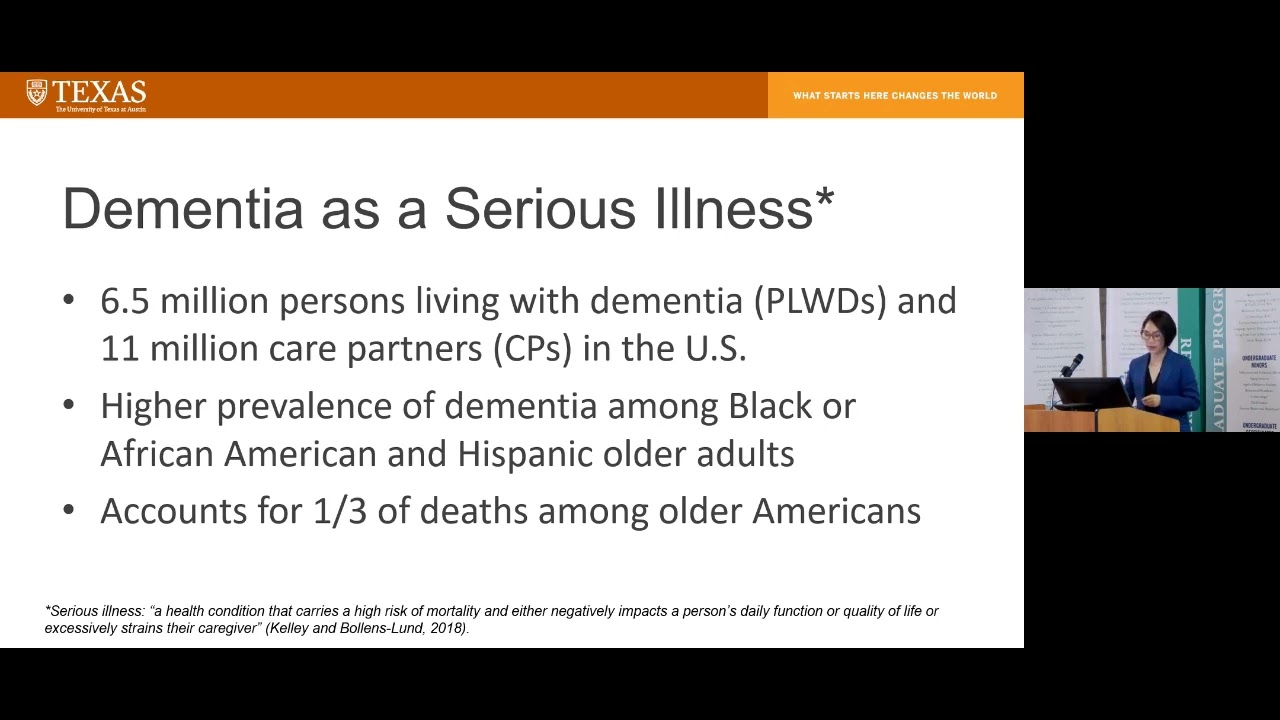
- The number of individuals with dementia and their family caregivers is rapidly increasing, with disproportionate impacts on minority groups.
- Dementia is a significant end-of-life issue, with a substantial portion of older adults dying with dementia.
- Individuals with dementia often receive excessive medical interventions (e.g., feeding tubes, antibiotics) and experience burdensome transitions, not aligned with their or their families' stated preferences.
- Challenges include the unpredictable trajectory of dementia, low rates of advanced care planning, communication barriers, and a lack of evidence-based interventions for caregivers.
- Minority groups are less likely to engage in advanced care planning and hospice use, and more likely to receive intensive treatments and die in hospitals.
- Social and cultural factors, such as beliefs, family-centered decision-making, and distrust of the healthcare system, influence end-of-life treatment preferences.
- It is often unclear whether observed differences in care reflect informed preferences or systemic disparities.
- Improving palliative care for persons with dementia and addressing cultural influences at the end of life are critical public health priorities.
- The study aimed to describe how cultural/religious/spiritual beliefs influence decision-making and identify healthcare team characteristics that support shared decision-making.
- The research uses a longitudinal, mixed-methods design, including qualitative interviews with diverse caregivers and healthcare team members.
- The study encountered challenges, leading to revisions in aims to incorporate social determinants of health and social needs assessments.
- Preliminary findings indicate a high need for support in managing caregiver stress, care navigation, and understanding dementia, with positive caregiver ratings of hospital communication.
- Current inpatient palliative care support often ends at discharge, leaving a gap in continuity of care.
- Many palliative care teams lack social workers, despite significant social care needs among patients and families.
- Referrals to palliative care are often ad hoc, late, and patients may lack formal dementia diagnoses.
- Recruitment and retention of participants (hospitalized, advanced dementia, from minority/vulnerable backgrounds) are significant challenges.
- Effective research in complex healthcare systems requires early planning, flexibility, stakeholder engagement, and building trust through relationship-building activities.
- A new pilot project aims to develop and test a post-discharge palliative care navigator intervention using community health workers (CHWs).
- The intervention is designed to address resource constraints and the fragmented healthcare system by providing continued support after hospital discharge.
- CHWs are proposed as a feasible and effective resource to bridge cultural gaps, provide health education, coaching, and care navigation.
- The study will be a single-site randomized controlled pilot trial focusing on vulnerable patient and caregiver dyads.
- Stakeholder engagement, including forming an advisory council and working groups, is critical for aligning research goals with stakeholder needs and building trust.
- Social determinants of health and individual values profoundly influence end-of-life care, yet healthcare systems often lack the resources or understanding to address these complex needs.
- Rigorous investigation and collaborative research are needed to generate knowledge and create sustainable solutions for advanced dementia care.
- The research is worthwhile despite the significant effort required, driven by a commitment to improving the quality of life for patients and families.
- Future steps include finalizing intervention manuals, conducting pilot testing, and addressing anticipated challenges like recruitment, retention, and training fidelity.
Key takeaways
- Dementia is a critical end-of-life issue with significant caregiving burdens and disparities, particularly for minority groups.
- Effective dementia care at the end of life requires addressing social determinants of health, cultural values, and spiritual beliefs alongside medical needs.
- Current healthcare systems often fail to provide continuous, culturally sensitive support for dementia patients and their caregivers, especially during care transitions.
- Community health workers offer a promising avenue for bridging gaps in care navigation, education, and support for vulnerable populations.
- Research in complex healthcare settings is challenging but essential for developing evidence-based, sustainable interventions.
- Early and ongoing stakeholder engagement is crucial for the success and relevance of research and intervention design.
- Addressing caregiver needs, including emotional stress and practical support, is as vital as addressing patient medical needs.
Key terms
Test your understanding
- What are the primary challenges faced by individuals with advanced dementia and their family caregivers at the end of life?
- How do social determinants of health and cultural values influence end-of-life care decisions for individuals with dementia?
- Why is the role of community health workers being explored as a solution for improving care transitions in dementia care?
- What are the key lessons learned from conducting research with vulnerable populations in complex healthcare settings?
- How can healthcare systems better support family caregivers of individuals with dementia, particularly during and after hospital discharge?