RIZAL LECTURE
Gurong Magaling
Overview
This video lecture provides a comprehensive overview of the life and works of Dr. Jose Rizal, a pivotal figure in Philippine history. It begins by explaining the Rizal Law (Republic Act No. 1425) and its significance in mandating the study of Rizal's life and writings. The lecture then delves into Rizal's early life, family background, education, and his extensive travels across Europe, Asia, and America. It highlights his intellectual prowess as a polyglot and polymath, his literary contributions including the novels 'Noli Me Tángere' and 'El Filibusterismo,' and his involvement in various socio-political movements. The summary concludes with Rizal's trial and execution, emphasizing his enduring legacy as a national hero.
Save this permanently with flashcards, quizzes, and AI chat
Chapters
- The study of Jose Rizal's life and works is mandated by Republic Act No. 1425, known as the Rizal Law.
- This law ensures that all tertiary and college students, regardless of school type (public or private), learn about Rizal.
- The primary objective of the law is to rekindle the spirit of the Filipino people, especially after World War II.
- Key figures involved in the passage of the Rizal Law include Claro M. Recto (author) and Jose P. Laurel (sponsor).
- Jose Rizal was born on June 19, 1861, in Calamba, Laguna, to Francisco Mercado and Teodora Alonzo.
- His family belonged to the 'Principalia' class, indicating a comfortable socio-economic status.
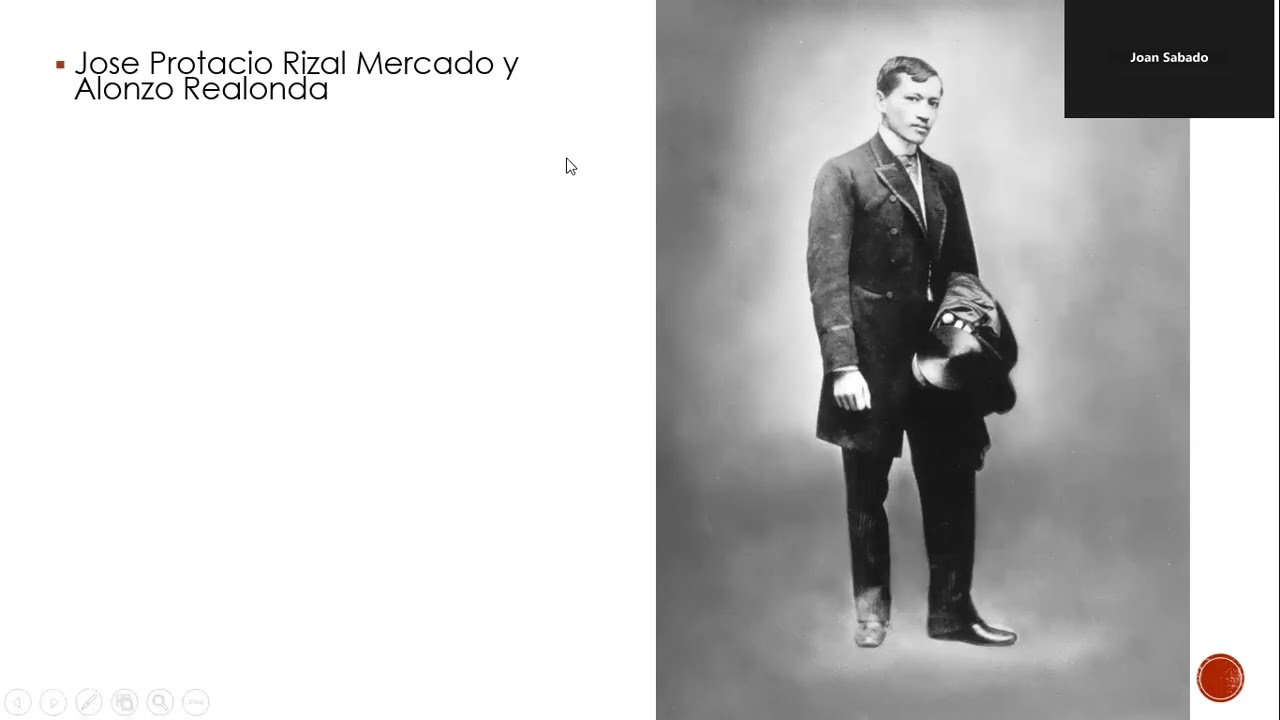
- Rizal's full name was Jose Protacio Rizal Mercado Alonzo y Realonda, with 'Rizal' being an adopted surname.
- He was a gifted child, showing early signs of intelligence by memorizing prayers at age five and writing his first poem at age eight ('Sa Aking Mga Kabata').
- His family lineage included Chinese, Japanese, Malay, Spanish, and even Jewish ancestry.
- Rizal received his early education in Calamba, Laguna, and later attended the Ateneo Municipal de Manila, where he earned a Bachelor of Arts degree with highest honors.
- He pursued higher education at the University of Santo Tomas (UST), initially studying Philosophy and Letters before shifting to Medicine.
- Rizal was a polyglot, proficient in over 10 languages, and a polymath, excelling in various fields like medicine, arts, sculpture, athletics, and architecture.
- His education in Europe, particularly in Madrid, Spain, where he studied Medicine and Philosophy and Letters at the University of Central de Madrid, further honed his skills and broadened his perspective.
- Rizal embarked on extensive travels throughout Europe, Asia, and America, documenting his observations and experiences.
- In Europe, he studied in Madrid, Paris, and Germany, engaging with prominent intellectuals and physicians, and specializing in ophthalmology.
- His travels exposed him to different cultures, political systems, and social conditions, influencing his understanding of colonialism and nationalism.
- He formed significant friendships, notably with Ferdinand Blumentritt, whom he considered his best friend, and collaborated with other Filipino expatriates in movements like La Solidaridad.
- 'Noli Me Tángere' (Touch Me Not or Social Cancer) exposed the injustices and abuses of the Spanish colonial regime and the friars in the Philippines.
- 'El Filibusterismo' (The Reign of Greed or The Subversive) depicted a more radical and revolutionary path, reflecting Rizal's evolving views on achieving freedom.
- Both novels were written in Spanish and published abroad, with 'Noli' in Berlin (1887) and 'El Fili' in Ghent (1891).
- Maximo Viola financed the publication of 'Noli Me Tángere,' while Valentin Ventura provided financial support for 'El Filibusterismo.'
- Upon his return to the Philippines, Rizal was exiled to Dapitan, Zamboanga, from 1892 to 1896.
- During his exile, he engaged in various community projects, including building a water system, establishing a school, and practicing medicine.
- He met Josephine Bracken in Dapitan, and they had a child who tragically died shortly after birth.
- Rizal was accused of rebellion, sedition, and conspiracy, leading to his trial by a military court.
- Despite a defense that highlighted his humanitarian work and lack of direct involvement in the revolution, he was found guilty and sentenced to death.
- Jose Rizal was executed by a Spanish firing squad on December 30, 1896, at Bagumbayan (now Rizal Park).
- His final poem, 'Mi Último Adiós' (My Last Farewell), is a poignant expression of his love for his country and his acceptance of his fate.
- His death further fueled the Philippine Revolution, solidifying his image as a national hero and martyr.
- Rizal's enduring legacy lies in his advocacy for education, reform, and national identity, inspiring generations of Filipinos.
Key takeaways
- The Rizal Law is a cornerstone of Philippine education, ensuring the study of national heroes to foster patriotism and national identity.
- Rizal's multifaceted talents as a polyglot and polymath underscore the importance of holistic education and the pursuit of diverse knowledge.
- His novels, 'Noli Me Tángere' and 'El Filibusterismo,' serve as powerful social commentaries and enduring calls for reform and justice.
- Rizal's travels broadened his perspective, enabling him to critically analyze colonial systems and inspire nationalist movements.
- His life demonstrates the profound impact an individual can have through intellectual pursuits, advocacy, and ultimately, sacrifice.
- The events leading to Rizal's execution highlight the suppression of dissent by colonial powers and the bravery required to challenge injustice.
- Rizal's legacy transcends his literary works, encompassing his contributions to community development, education, and the very idea of Filipino nationhood.
Key terms
Test your understanding
- What was the primary motivation behind the enactment of the Rizal Law, and why is it still relevant today?
- How did Rizal's diverse educational background and his experiences abroad shape his views on colonialism and the need for reform in the Philippines?
- Compare and contrast the themes, tone, and intended impact of 'Noli Me Tángere' and 'El Filibusterismo.'
- In what ways did Rizal's exile in Dapitan contribute to his legacy, despite being a period of confinement?
- What is the significance of Rizal's execution in the context of the Philippine Revolution and his enduring status as a national hero?