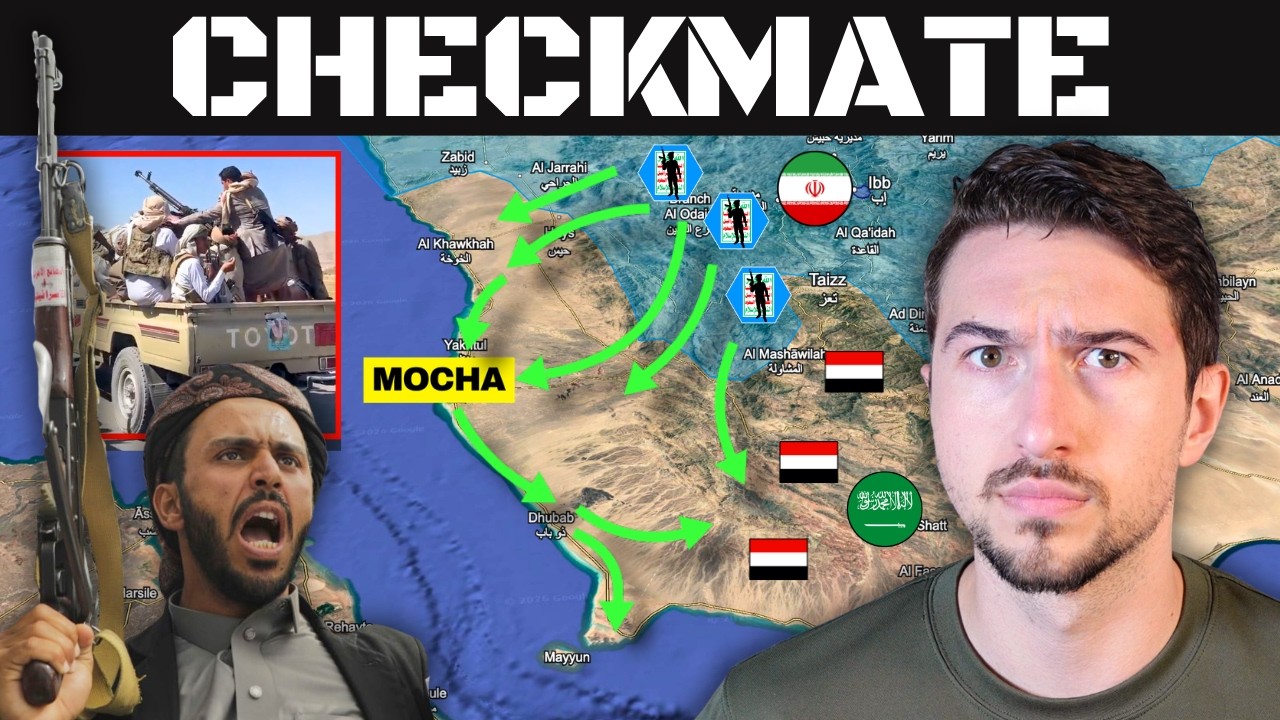
How The Houthis STEAMROLLED Strategic Red Sea Coast
HistoryLegends
Overview
This video provides a tactical analysis of how the Houthi forces (referred to as UIS) achieved a rapid and decisive victory along Yemen's Red Sea coast, culminating in the capture of the strategic port city of Mocha. It details how a large-scale, seemingly conventional offensive by Saudi-backed Yemeni government forces was cleverly used as a diversion by the Houthis. The Houthis then executed a sophisticated infiltration and flanking maneuver through difficult mountainous terrain, overwhelming government defenses and seizing key coastal areas, including the Bab el-Mandeb Strait. The analysis highlights the strategic implications of this Houthi success, including its impact on global shipping lanes and Saudi Arabia's regional standing.
Save this permanently with flashcards, quizzes, and AI chat
Chapters
- Saudi-backed Yemeni government forces launched a large, visible offensive across the desert, appearing to be on the verge of victory.
- This offensive was a deliberate diversion, drawing Houthi attention and forces away from their true objective.
- The Houthis employed a strategy of infiltration, using specialized assault detachments to navigate difficult mountainous terrain.
- These Houthi units bypassed enemy strongholds and outmaneuvered government positions, leading to a rapid collapse of defenses.
- The Houthi infiltration culminated in the swift capture of the strategically vital port city of Mocha.
- This victory gave the Houthis control over the Bab el-Mandeb Strait, a critical global shipping lane.
- The loss of Mocha and control of the strait represents a significant strategic blow to Saudi Arabia and its allies.
- This event has broader geopolitical consequences, impacting Iran's regional influence and potentially increasing global shipping costs.
- The conflict is set against a backdrop of internal Yemeni civil war, with shifting alliances and internal power struggles.
- A previous conflict saw the UAE-backed Southern Transitional Council briefly seize territory before being pushed back by Saudi-backed forces.
- The UAE's withdrawal from Yemen and the broader US-Iran conflict altered the regional dynamics, creating opportunities for the Houthis.
- Saudi Arabia's requests for military support from allies like the US, Turkey, and Pakistan went unanswered, highlighting its isolation.
- Houthi forces utilized specialized, small-unit assault detachments for their infiltration.
- They effectively used drones for reconnaissance and to disrupt enemy reinforcements.
- The Houthis demonstrated proficiency in navigating difficult terrain, often on foot through narrow mountain paths.
- Captured equipment, including MRAPs and trucks, indicates the spoils of war and the effectiveness of their surprise attacks.
- The Houthi control of the Bab el-Mandeb Strait and the earlier closure of the Strait of Hormuz severely impacts global shipping.
- Saudi Arabia's critical East-West oil pipeline was forced to shut down due to drone attacks, highlighting its vulnerability.
- The Houthi attacks on oil facilities and refineries pose an existential threat to the Saudi economy.
- The situation forces Saudi Arabia into a defensive posture, seeking aid while facing significant regional humiliation.
Key takeaways
- Deception and diversion are powerful military tactics that can neutralize a numerically superior or better-equipped opponent.
- Control of strategic chokepoints like the Bab el-Mandeb Strait has profound global economic and geopolitical implications.
- Agile, light infantry units can be highly effective when operating in challenging terrain against conventional forces.
- Internal political fragmentation within a country can create vulnerabilities that external or internal non-state actors can exploit.
- The Houthi's success highlights the limitations of air power alone in countering well-planned ground infiltrations.
- Global supply chains and energy markets are highly susceptible to regional conflicts in critical maritime transit zones.
- Saudi Arabia's regional influence and military effectiveness have been significantly challenged by the Houthi advances.
Key terms
Test your understanding
- How did the Houthi forces use the Saudi-backed offensive as a diversion to achieve their objective?
- What are the primary strategic implications of the Houthi capture of Mocha and control over the Bab el-Mandeb Strait?
- Describe the key tactical elements employed by the Houthis during their offensive through the mountainous terrain.
- Why did Saudi Arabia's attempts to secure external military support prove largely unsuccessful in this scenario?
- How did the Houthi victory impact Saudi Arabia's critical oil infrastructure and its regional standing?