11:08
Solving Hardy Weinberg Problems
Bozeman Science
Overview
This video explains how to solve Hardy-Weinberg problems, a tool used in genetics and evolutionary biology. It breaks down the core concepts of allele frequencies (p and q) and genotype frequencies (p², 2pq, q²). The video emphasizes the importance of understanding whether a problem provides information about allele frequencies or genotype frequencies, as this dictates the starting point for calculations. It walks through two example problems, demonstrating how to derive p and q from given information and then use them to answer various questions about a population's genetic makeup.
How was this?
Save this permanently with flashcards, quizzes, and AI chat
Chapters
- Hardy-Weinberg Equilibrium is a principle used by geneticists and evolutionary biologists.
- Problems often involve calculating allele and genotype frequencies within a population.
- Understanding the difference between allele frequencies (p, q) and genotype frequencies (p², 2pq, q²) is crucial for solving these problems.
This chapter introduces the fundamental concepts and the purpose of Hardy-Weinberg problems, setting the stage for understanding how to approach them.
A problem asking about a population where 16% are unable to taste a chemical.
- A gene pool represents all the genes in a population, not tied to individuals.
- p represents the frequency of the dominant allele in the gene pool.
- q represents the frequency of the recessive allele in the gene pool.
- The sum of allele frequencies always equals 1 (p + q = 1).
Understanding gene pools and allele frequencies is the foundational step for all Hardy-Weinberg calculations, as these values are the building blocks for genotype frequencies.
In a population of 10 people with 4 red-haired individuals (requiring two recessive alleles) and 6 non-red-haired individuals, the recessive allele frequency (q) is 0.7 and the dominant allele frequency (p) is 0.3.
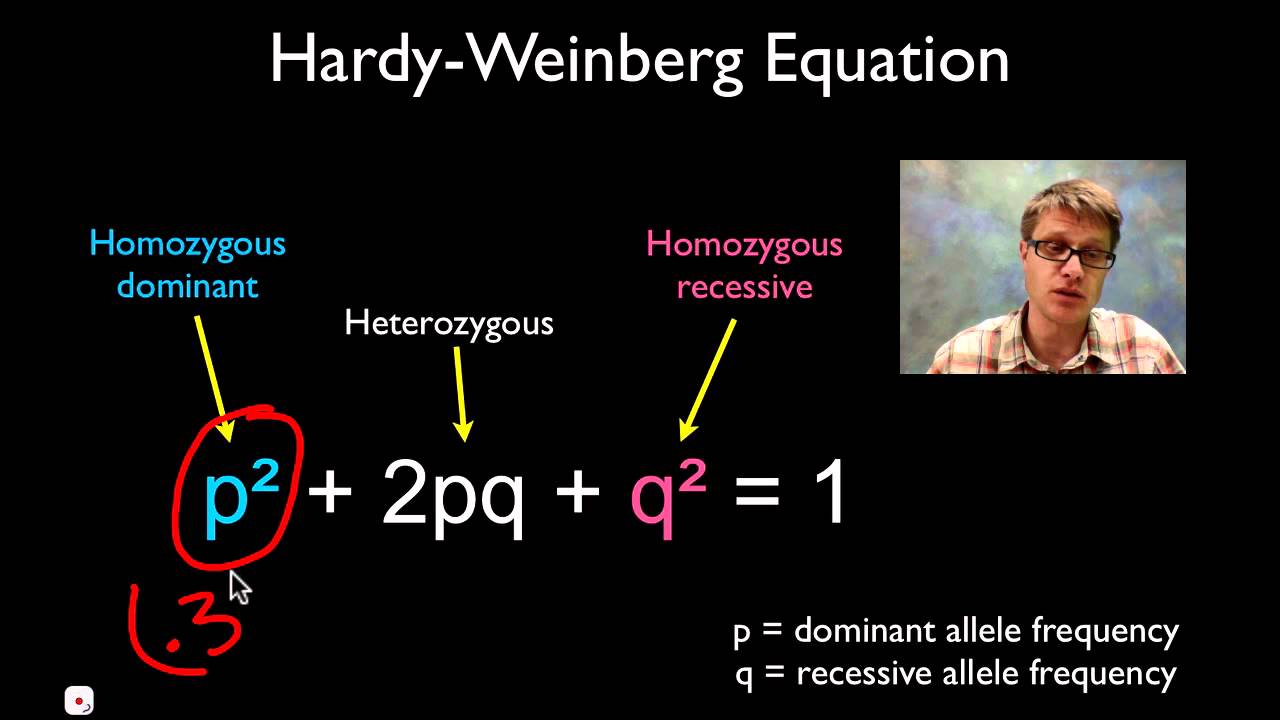
- p² represents the frequency of homozygous dominant individuals (two dominant alleles).
- q² represents the frequency of homozygous recessive individuals (two recessive alleles).
- 2pq represents the frequency of heterozygous individuals (one dominant and one recessive allele).
- The sum of genotype frequencies also equals 1 (p² + 2pq + q² = 1).
These genotype frequencies allow us to predict the proportions of different genetic types within a population, which is often the goal of Hardy-Weinberg problems.
If p=0.3 and q=0.7, then p² = 0.09 (homozygous dominant), q² = 0.49 (homozygous recessive), and 2pq = 0.42 (heterozygous).
- Many problems provide the percentage of homozygous recessive individuals (q²).
- To find the recessive allele frequency (q), take the square root of q².
- Once q is known, calculate the dominant allele frequency (p) using p = 1 - q.
- With p and q known, you can calculate p² and 2pq to find other genotype frequencies.
This is the most common starting point for Hardy-Weinberg problems, so mastering this method allows you to solve a large number of typical questions.
If 16% (0.16) of a population are non-tasters (homozygous recessive, q²), then q = √0.16 = 0.4, and p = 1 - 0.4 = 0.6. The heterozygous frequency (2pq) is 2 * 0.6 * 0.4 = 0.48 or 48%.
- Some problems directly provide an allele frequency (p or q).
- If given the recessive allele frequency (q), you can immediately find p using p = 1 - q.
- If given the dominant allele frequency (p), you can find q using q = 1 - p.
- Once p and q are known, you can calculate all genotype frequencies (p², 2pq, q²).
Recognizing when an allele frequency is given allows for a quicker path to solving for all other genetic components of the population.
If the recessive allele frequency (q) for a gene conferring HIV protection is 0.20, then p = 1 - 0.20 = 0.80. The frequency of individuals with two copies of the recessive gene (q²) is 0.20² = 0.04 or 4%.
Key takeaways
- Hardy-Weinberg problems require distinguishing between allele frequencies (p, q) and genotype frequencies (p², 2pq, q²).
- Allele frequencies (p and q) represent the proportion of each allele in the gene pool, and they always add up to 1.
- Genotype frequencies (p², 2pq, and q²) represent the proportion of individuals with specific genotypes, and they also add up to 1.
- The most common starting point in Hardy-Weinberg problems is being given the frequency of homozygous recessive individuals (q²).
- From q², you can calculate q (by taking the square root), then p (using p = 1 - q), and subsequently p² and 2pq.
- Less commonly, problems might directly provide an allele frequency (p or q), which simplifies the initial steps.
- Always ensure you are using the correct values (alleles vs. genotypes) for your calculations to avoid errors.
Key terms
Hardy-Weinberg EquilibriumGene PoolAllele FrequencyGenotype Frequencypqp²q²2pqHomozygous DominantHomozygous RecessiveHeterozygous
Test your understanding
- What is the fundamental difference between allele frequency and genotype frequency in the context of Hardy-Weinberg problems?
- Why is it important to know whether a problem provides q² or q as the starting information?
- How can you calculate the frequency of heterozygous individuals (2pq) if you know the frequency of homozygous recessive individuals (q²)?
- If the frequency of the dominant allele (p) in a population is 0.7, what is the frequency of the recessive allele (q) and the frequency of homozygous dominant individuals (p²)?
- Explain why p + q = 1 and p² + 2pq + q² = 1 in Hardy-Weinberg principles.