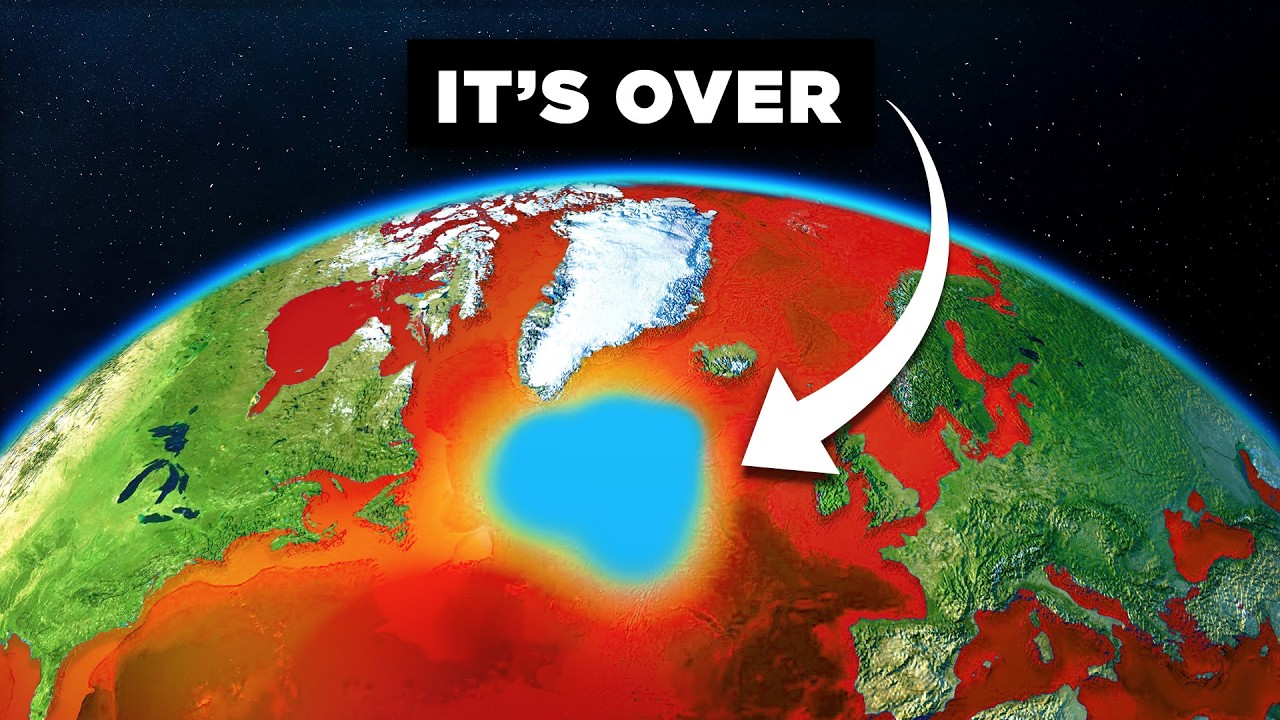
A European Ice Age is Coming Sooner Than We Thought...
RealLifeLore
Overview
This video explains the crucial role of the Atlantic Meridional Overturning Circulation (AMOC) in maintaining Europe's relatively mild climate. It details how the AMOC functions as a global conveyor belt, transporting warm water to Europe and cold water to Antarctica, driven by differences in water density. The video highlights the alarming possibility of the AMOC collapsing due to climate change, which could lead to a significant cooling of Europe, potentially triggering a modern ice age. It discusses the scientific evidence, ongoing research, and projected consequences of such a collapse, emphasizing the long-term implications for global climate patterns and human society.
Save this permanently with flashcards, quizzes, and AI chat
Chapters
- Europe's latitude is further north than commonly perceived, yet its climate is significantly milder than comparable regions in North America.
- This climatic anomaly is primarily due to the Atlantic Meridional Overturning Circulation (AMOC), a vast ocean current system.
- The AMOC acts like a conveyor belt, driven by differences in seawater temperature and salinity, moving water masses across the Atlantic.
- Warm surface waters from the tropics are transported northeast towards northwestern Europe, moderating its climate.
- The AMOC is fueled by the sinking of cold, salty, dense water in the North Atlantic near Greenland.
- As this dense water sinks and travels south, prevailing winds in the South Atlantic pull it back to the surface via upwelling.
- The water then travels north along the surface, merging with the Gulf Stream, which carries warm tropical waters towards Europe.
- This cyclical process transports heat to Europe and cold to Antarctica, influencing global climate patterns over centuries.
- Climate change is accelerating the melting of the Greenland ice sheet, releasing large amounts of freshwater into the North Atlantic.
- This influx of freshwater reduces the salinity and density of surface waters near Greenland, hindering the sinking process that drives the AMOC.
- Warmer atmospheric temperatures also reduce the ocean's ability to cool and transfer heat at the surface, further weakening the AMOC.
- These factors create a dangerous feedback loop, making the water less dense and less capable of sinking, potentially leading to a collapse.
- Scientific monitoring systems like the RAPID array have shown a measurable decline in the AMOC's strength since 2004.
- A significant weakening, potentially below 6 'sverdrups' (a measure of water flow), could trigger a shutdown phase.
- The 'cold blob' observed in the North Atlantic off Greenland, a region that has cooled despite global warming, is a key indicator of AMOC disruption.
- Historical evidence, like the Younger Dryas period 12,000 years ago, shows that AMOC collapses have occurred before, causing rapid cooling.
- There is ongoing scientific debate about the exact timing and likelihood of an AMOC collapse, with differing model predictions.
- Some models, like those used by the IPCC, suggest a weakening but not a full collapse before 2100, while others predict a collapse sooner.
- Challenges in modeling complex factors like ice melt and cloud cover contribute to the uncertainty.
- Leading experts now estimate a significant chance (up to 50% or more under high emissions scenarios) of collapse within centuries, with some projections indicating potential tipping points between 2037 and 2109.
- Governments, like Iceland, are beginning to recognize the risk as a national security threat.
- Northwestern Europe would experience significantly colder winters, with increased sea ice coverage and harsher conditions resembling Siberia.
- Agriculture in the UK and Ireland could collapse due to increased drought and inability to sustain rainfed farming.
- Southern Europe would likely become warmer and drier, increasing drought rates.
- Global impacts include accelerated Antarctic ice melt, rising sea levels along the US East Coast, altered rainfall patterns in the Amazon and Sahel, and weakened monsoons in Asia.
- Even a significant weakening, short of a full collapse, would lead to negative consequences.
Key takeaways
- Europe's mild climate is largely dependent on the AMOC, a complex ocean current system that transports heat.
- Climate change, particularly the melting of the Greenland ice sheet, is disrupting the AMOC by reducing water density.
- Scientific evidence indicates the AMOC is weakening, and there's a significant risk of it collapsing, potentially leading to a new ice age in Europe.
- While the exact timing is debated, the potential consequences of an AMOC collapse are severe and far-reaching, affecting global weather patterns and sea levels.
- Historical events like the Younger Dryas demonstrate that AMOC disruptions can cause rapid and drastic climate shifts.
- Even without a full collapse, a weakening AMOC will lead to significant negative climatic changes.
- The long-term, slow-moving nature of the AMOC means that once a tipping point is reached, recovery could take centuries.
Key terms
Test your understanding
- How does the AMOC contribute to Europe's relatively mild climate compared to other regions at similar latitudes?
- What specific effects of climate change are most directly impacting the stability of the AMOC?
- What are the primary indicators scientists use to monitor the strength and potential weakening of the AMOC?
- What are the projected consequences for northwestern Europe if the AMOC were to collapse?
- Why is it challenging for scientists to predict the exact timing of an AMOC collapse, and what are the implications of this uncertainty?