24:58
N-Gen Math Algebra II.Unit 12.Lesson 4.Conditional Probability
eMATHinstruction
Overview
This lesson introduces the concept of conditional probability, which is the probability of an event occurring given that another event has already occurred. It explains how conditional probability changes the sample space and demonstrates how to calculate it using both two-way frequency charts and probability formulas. The lesson emphasizes that conditional probability is about understanding how the occurrence of one event affects the likelihood of another, using examples involving student post-graduation plans and hair/eye color.
How was this?
Save this permanently with flashcards, quizzes, and AI chat
Chapters
- Conditional probability measures the likelihood of an event happening when another event is known to have already occurred.
- The occurrence of the first event changes the possible outcomes, thus altering the probability of the second event.
- Two-way frequency charts are a useful tool for visualizing and calculating conditional probabilities.
Understanding conditional probability is crucial because real-world events are often interconnected, and knowing that one event has happened can significantly change our predictions about another.
The probability of it raining given that it is cloudy outside is higher than the general probability of rain.
- When calculating the probability of event A given event B, the sample space is reduced to only the outcomes in event B.
- The numerator is the number of outcomes that are in both A and B (the intersection).
- The denominator is the total number of outcomes in event B.
This method provides a concrete way to understand how restricting the sample space based on a known condition directly impacts the probability calculation.
In a survey of 52 seniors, the probability of a student going to college given they are female is calculated by considering only the 22 female students and finding how many of them are going to college (13), resulting in a probability of 13/22.
- The conditional probability of event A given event B, denoted P(A|B), can be expressed using counts as n(A and B) / n(B).
- This formula can be rewritten in terms of probabilities by dividing both the numerator and denominator by the total number of outcomes in the sample space (n(S)).
- The resulting probability formula is P(A|B) = P(A and B) / P(B).
These formulas allow for the calculation of conditional probability even when direct counts are not available, using pre-existing probability values.
The probability of event A occurring given that event B has occurred is the probability that both A and B occur together, divided by the probability that B occurs.
- Conditional probability can be calculated using proportions (probabilities) directly from a data table, without needing to convert to counts.
- The key is to identify the relevant row or column that represents the condition (the given event) and use its total as the denominator.
- Comparing the conditional probability to the general probability of an event helps determine if there is a dependence between the events.
This demonstrates the practical application of conditional probability in analyzing relationships and dependencies within data, such as the link between hair color and eye color.
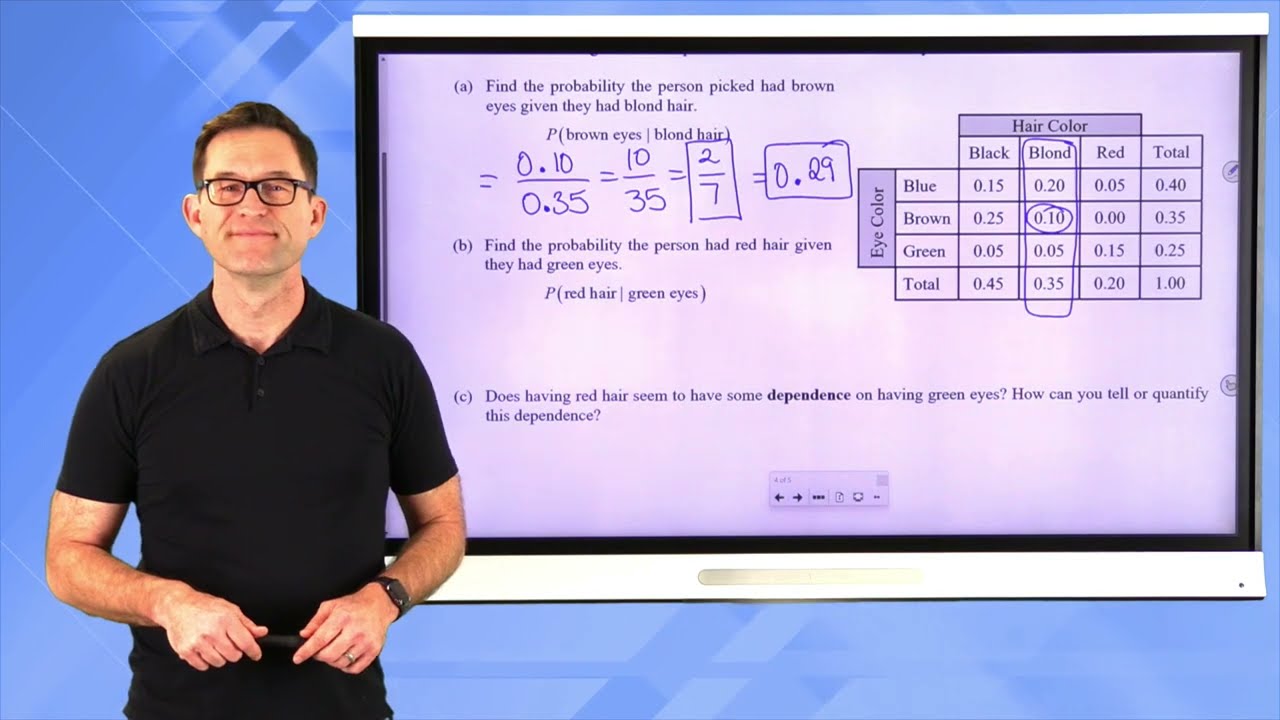
The probability of a person having brown eyes given they have blonde hair is calculated using the proportion of people with blonde hair as the denominator and the proportion of people with both blonde hair and brown eyes as the numerator (0.10 / 0.35).
- If the conditional probability P(A|B) is different from the general probability P(A), then events A and B are dependent.
- Dependence means that the occurrence of event B changes the likelihood of event A.
- The lesson previews the next topic: formally defining and calculating independence versus dependence between events.
Identifying dependence is crucial for making accurate predictions and understanding causal relationships, as opposed to assuming events are unrelated.
A person with green eyes is three times more likely to have red hair (60% probability) than a person selected randomly from the general population (20% probability), indicating a dependence between green eyes and red hair.
Key takeaways
- Conditional probability is about how knowing one event occurred changes the likelihood of another event.
- The core idea of conditional probability is reducing the sample space to only include outcomes relevant to the given condition.
- Calculations can be done using counts from frequency tables or using probability formulas like P(A|B) = P(A and B) / P(B).
- When dealing with probabilities, the denominator is the probability of the condition (the 'given' event).
- If P(A|B) is not equal to P(A), then events A and B are dependent.
- Understanding dependence helps reveal meaningful relationships within data.
Key terms
Conditional ProbabilityEventSample SpaceIntersection of EventsFrequency ChartProbability FormulaDependenceIndependence
Test your understanding
- What does it mean for an event to have a conditional probability?
- How does the sample space change when calculating conditional probability?
- What is the formula for conditional probability using probabilities, and what does each part represent?
- How can you determine if two events are dependent using conditional probability?
- Why is it important to distinguish between dependent and independent events?