38:48
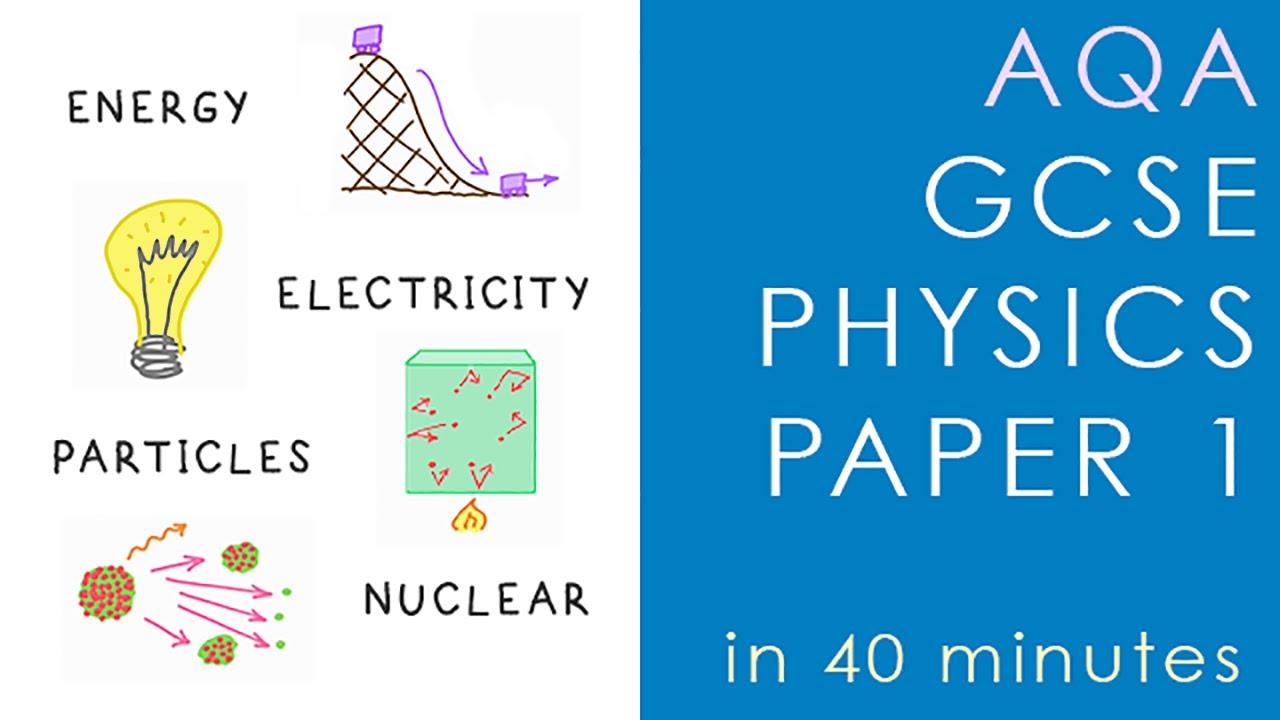
All of AQA PHYSICS Paper 1 in 40 minutes - GCSE Science Revision
Science Shorts
Overview
This video provides a comprehensive revision of AQA GCSE Physics Paper 1 topics, covering energy, electricity, density, states of matter, atomic structure, and radioactivity. It explains fundamental concepts like energy transfer, conservation, and stores, moving on to electrical circuits, Ohm's Law, and power. The summary also delves into density calculations, the properties of solids, liquids, and gases, atomic models, isotopes, and various types of radiation, including their properties and applications. Finally, it touches upon nuclear fission and fusion as energy sources, emphasizing practical applications and exam-relevant details.
How was this?
Save this permanently with flashcards, quizzes, and AI chat
Chapters
- Measurements require units (e.g., meters for distance, seconds for time).
- Prefixes (kilo, milli, micro) are used to represent very large or small numbers, often in powers of a thousand.
- Energy is a conserved quantity; it cannot be created or destroyed, only transferred or transformed.
- Energy exists in various 'stores' such as kinetic, gravitational potential, elastic potential, and chemical potential.
Understanding units and prefixes is crucial for accurate calculations in physics, while grasping the concept of energy conservation is fundamental to explaining how physical systems work.
Converting 5 micrometers to meters involves dividing by 1,000 twice (or by 1 million) because micrometers are very small units.
- Kinetic energy (KE) depends on mass and velocity squared (KE = 0.5mv²).
- Gravitational potential energy (GPE) depends on mass, gravitational field strength, and height (GPE = mgh).
- Elastic potential energy is stored in stretched or compressed objects like springs (E = 0.5k x²).
- Thermal energy changes are calculated using E = mcΔT, where c is specific heat capacity.
- In a closed system, energy is conserved; for example, GPE lost by a falling object is converted into KE.
These equations allow us to quantify energy changes and predict how objects will behave when energy is transferred between different stores.
A roller coaster at the top of a hill has GPE, which is converted into KE as it descends.
- Work is defined as energy transferred.
- Power is the rate at which energy is transferred (Power = Energy / Time, measured in Watts).
- Efficiency measures how much useful energy is transferred compared to the total energy input (Efficiency = Useful Output / Total Input).
- Wasted energy is often lost as heat due to friction or air resistance.
These concepts help us understand how efficiently devices use energy and how much energy they consume or produce over time.
A 200W laptop power supply uses 200 Joules of energy every second; if only 120W is useful power, its efficiency is 60%.
- Energy sources are where we get energy from; they can be finite (fossil fuels, nuclear) or renewable (wind, solar, hydro).
- Electricity is the flow of electric charge (current).
- Current (I) is measured in Amperes (A) and is the rate of charge flow (I = Q/T).
- Potential difference (V), or voltage, is the energy transferred per unit charge (V = E/Q), measured in Volts (V).
Understanding energy sources is key to sustainability, while the principles of electricity form the basis of most modern technology.
A 6V battery provides 6 Joules of energy for every Coulomb of charge that passes through it.
- Resistance (R) opposes the flow of current and is measured in Ohms (Ω).
- Ohm's Law states that for a resistor, Voltage = Current × Resistance (V = IR).
- For ohmic components (like resistors), V and I are directly proportional, resulting in a straight-line IV graph.
- For non-ohmic components (like filament bulbs), resistance changes with temperature, leading to a curved IV graph.
Ohm's Law is a fundamental relationship in electrical circuits, allowing us to calculate voltage, current, or resistance if two are known.
If a 10-ohm resistor has a 5V potential difference across it, the current flowing through it is 0.5A (I = V/R).
- In series circuits, current is the same everywhere, voltage is shared, and total resistance is the sum of individual resistances.
- In parallel circuits, voltage is the same across each branch, current is shared, and total resistance is lower than the smallest individual resistance.
- Components like thermistors and LDRs have resistance that changes with temperature and light, respectively, allowing them to be used in sensors.
Understanding how components behave in series and parallel arrangements is essential for designing and analyzing electrical circuits.
In a parallel circuit, if one bulb burns out, the others continue to function because the circuit is not broken.
- Direct Current (DC) flows in one direction (from batteries), while Alternating Current (AC) periodically reverses direction (from mains sockets).
- Mains electricity in the UK is typically 230V and 50Hz.
- Plugs have live (brown), neutral (blue), and earth (green/yellow) wires for safety.
- Fuses are safety devices that melt and break the circuit if the current becomes too high.
Knowledge of mains electricity and plug safety is vital for everyday life and understanding how our homes are powered.
A microwave drawing 800W on a 230V supply needs a fuse rated higher than its operating current (approx. 3.5A), so a 5A fuse is used.
- Electrical power can be calculated as P = VI, P = I²R, or P = V²/R.
- Electricity is transmitted at very high voltages (using step-up transformers) to minimize energy loss due to resistance in cables.
- Step-down transformers reduce the voltage to a safe level (230V) for domestic use.
Understanding power calculations and the principles of electricity transmission explains why power lines operate at high voltages and how energy reaches our homes efficiently.
Transmitting electricity at high voltage reduces the current, thereby significantly decreasing the energy lost as heat in the transmission cables.
- Rubbing insulating materials together can transfer electrons, creating static electric charges.
- Like charges repel, and opposite charges attract.
- A charged object creates an electric field around it.
- Electric field lines show the direction and strength of the field, always pointing from positive to negative.
Static electricity explains phenomena like shocks from touching metal after walking on carpet, and electric fields are fundamental to understanding forces between charges.
When you touch a Van de Graaff generator, electrons are removed, leaving your body positively charged, causing your hair to stand on end due to repulsion.
- Density (ρ) is mass per unit volume (ρ = m/V) and depends on particle type and packing.
- Regular objects' volumes can be calculated geometrically; irregular objects' volumes are found by water displacement.
- Matter exists as solid (particles vibrate in fixed positions), liquid (particles slide past each other), and gas (particles move randomly and are far apart).
- Changes of state (melting, boiling) require energy to overcome forces between particles, increasing potential energy without changing temperature.
Density is a key property for identifying substances, and understanding states of matter explains the physical behavior of materials.
To find the volume of a stone, you submerge it in water in a measuring cylinder and measure the volume of water displaced.
- Internal energy is the sum of the kinetic and potential energies of particles within a substance.
- During a change of state, temperature remains constant while potential energy changes.
- Specific Latent Heat (L) is the energy needed to change the state of 1 kg of a substance (E = mL).
- E = mcΔT applies when temperature changes (kinetic energy increases), while E = mL applies during a state change (potential energy changes).
These concepts differentiate between heat energy affecting temperature and heat energy causing a change in the physical state of a substance.
When ice melts at 0°C, it absorbs energy (latent heat of fusion) to break bonds, but its temperature doesn't rise until all the ice has turned into water.
- Increasing the temperature or decreasing the volume of a gas increases its pressure due to more frequent and forceful particle collisions with container walls.
- Pressure and volume are inversely proportional at constant temperature (P₁V₁ = P₂V₂).
- Atoms consist of a nucleus (protons and neutrons) and orbiting electrons.
- Isotopes are atoms of the same element with different numbers of neutrons (e.g., Carbon-12 and Carbon-14).
Understanding gas pressure is vital for many applications, and the structure of atoms is the foundation of chemistry and nuclear physics.
When you pump up a bicycle tire, you are forcing more air molecules into a fixed volume, increasing the pressure inside the tire.
- Radiation is energy emitted as particles or waves.
- Alpha (α) particles (2 protons, 2 neutrons) are highly ionizing but have low penetration (stopped by paper).
- Beta (β) particles (fast electrons) are less ionizing than alpha but more penetrating (stopped by aluminum).
- Gamma (γ) rays are high-energy electromagnetic waves, weakly ionizing but highly penetrating (stopped by lead/concrete).
Knowing the properties of different types of radiation is crucial for understanding their uses (e.g., medical imaging, sterilization) and their potential hazards.
A Geiger-Müller tube detects alpha radiation, and its count rate drops to zero when a piece of paper is placed between the source and the tube.
- Radioactivity is the rate of decay of unstable nuclei.
- Half-life is the time taken for the activity of a radioactive source to halve.
- Background radiation is always present from natural and artificial sources.
- Corrected count rate = (Count rate with source) - (Background count rate).
Half-life is a critical concept for determining the longevity and safety of radioactive materials, used in applications from carbon dating to nuclear waste management.
If a sample has an initial activity of 80 Bq and a half-life of 10 years, after 20 years its activity will be 20 Bq (halved twice).
- Nuclear fission is the splitting of a large, unstable nucleus (e.g., Uranium-235) into smaller nuclei, releasing energy and neutrons.
- This process can lead to a chain reaction, which is controlled in nuclear reactors for power generation and uncontrolled in atomic bombs.
- Nuclear fusion is the joining of light nuclei (e.g., hydrogen) to form a heavier nucleus, releasing vast amounts of energy (as seen in stars).
- Both fission and fusion convert a small amount of mass into a large amount of energy.
Fission and fusion are powerful nuclear processes that are fundamental to understanding nuclear power generation and the energy production of stars.
Nuclear reactors control the chain reaction from fission by using control rods to absorb excess neutrons, preventing an uncontrolled explosion.
Key takeaways
- Energy is conserved and can only be transferred or transformed between different stores.
- Understanding the relationships between voltage, current, and resistance (Ohm's Law) is fundamental to analyzing electrical circuits.
- The principles of series and parallel circuits dictate how voltage, current, and resistance behave.
- Mains electricity uses AC, and safety features like fuses and earth wires are crucial.
- Density is a key physical property calculated from mass and volume, with different methods for regular and irregular shapes.
- Changes of state involve energy transfer that affects particle potential energy, not kinetic energy (temperature).
- Different types of radiation (alpha, beta, gamma) have distinct properties regarding ionization and penetration, influencing their uses and hazards.
- Half-life is a constant measure of the decay rate for a radioactive isotope, regardless of the initial amount.
Key terms
Energy StoresConservation of EnergyPowerEfficiencyCurrentPotential Difference (Voltage)ResistanceOhm's LawSeries CircuitParallel CircuitAC/DCFuseDensityStates of MatterInternal EnergySpecific Latent HeatIsotopesAlpha RadiationBeta RadiationGamma RadiationHalf-lifeNuclear FissionNuclear Fusion
Test your understanding
- Explain the difference between energy stores and energy transfers, providing an example of each.
- How does Ohm's Law relate voltage, current, and resistance, and what is the key difference in behavior between ohmic and non-ohmic components?
- Describe the main differences in current and voltage behavior between series and parallel circuits.
- What are the primary safety features found in a standard UK plug, and how do they protect the user?
- How do you calculate the density of an object, and what methods would you use to find the volume of a regular versus an irregular solid?
- What is the significance of half-life in understanding radioactive decay, and how does it differ from activity?
- Compare and contrast nuclear fission and fusion, including their inputs, outputs, and energy release mechanisms.