49:12
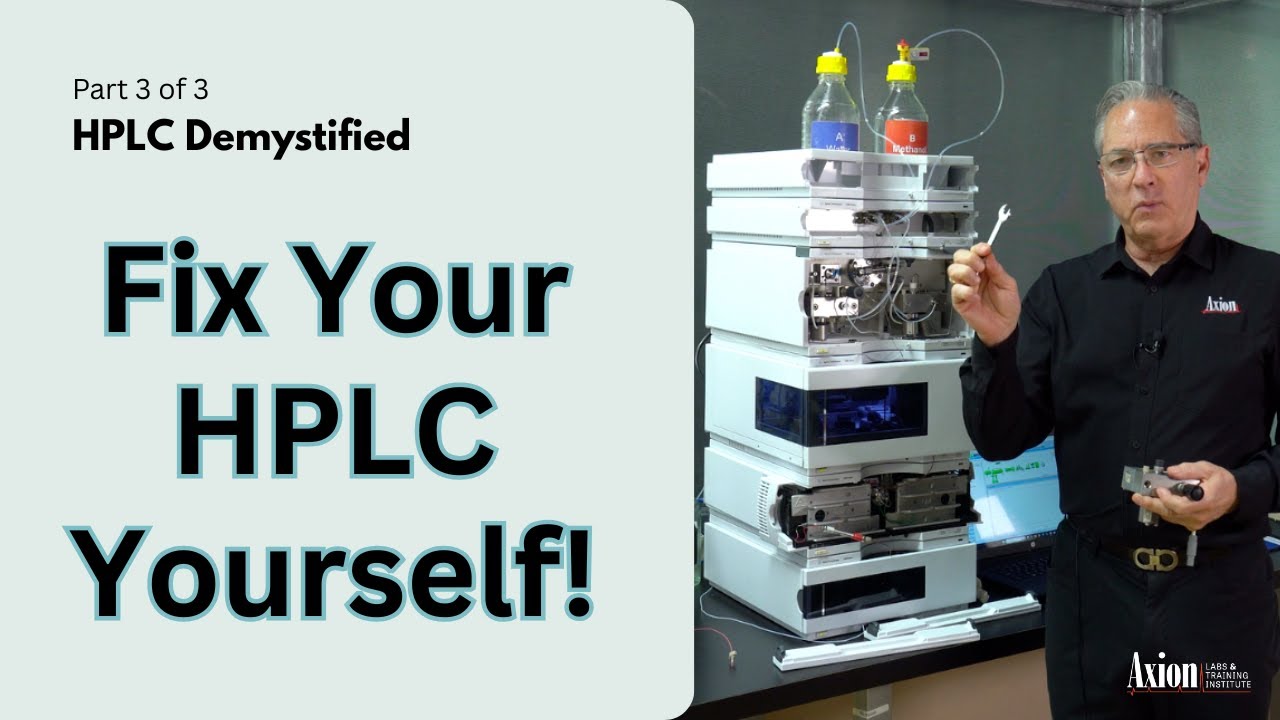
HPLC Demystified Part 3 | How to Maintain and Troubleshoot Your HPLC Like a Pro
Axion Labs & Training Institute
Overview
This video provides a practical guide to maintaining and troubleshooting High-Performance Liquid Chromatography (HPLC) systems, focusing on the hardware components. It covers essential maintenance for solvent bottles, degassers, pumps, autosamplers, and detectors. The presenter emphasizes preventative maintenance to ensure instrument longevity and reliable results, offering specific tips and techniques for common issues like microbial growth in solvent, pump pressure fluctuations, and autosampler reproducibility problems. The goal is to empower users to confidently manage their HPLC systems and avoid costly downtime.
How was this?
Save this permanently with flashcards, quizzes, and AI chat
Chapters
- Aqueous mobile phase bottles (e.g., water with buffers or acid) are prone to microbial growth, which can cause impurities and clog filters.
- Adding 5% methanol to the aqueous bottle acts as a preservative, preventing microbial growth for extended periods.
- Avoid using regular preservatives as they may contain UV-absorbing impurities that interfere with the baseline.
- Be vigilant about contamination from external sources like perfumes or hand sanitizers, and avoid using dirty funnels or filters.
- Regularly inspect the aqueous bottle for visible signs of growth ('floaties') and discard/clean if present.
Preventing microbial growth in solvent bottles is crucial because contamination can lead to significant analytical errors and instrument damage, impacting the reliability of your results.
Adding 5% methanol to the water bottle prevents the growth of algae and other microbes that would otherwise thrive in a buffered aqueous solution, which can clog filters and introduce impurities.
- Degassers remove dissolved gases from the mobile phase using a vacuum pump, which is essential for stable pump pressure.
- The most common way to damage a degasser is by precipitating buffer salts within its channels.
- Avoid running buffers in one channel and then switching to a strong organic solvent (like acetonitrile) in the same channel, as this can cause precipitation.
- If a degasser channel becomes clogged, it is often irreparable and requires replacing the entire unit, making prevention key.
Proper degasser function is vital for maintaining consistent backpressure in the HPLC system, and avoiding common mistakes prevents costly damage to this component.
If a phosphate buffer is run in channel A, and then acetonitrile is introduced into channel A, the buffer can precipitate and permanently block the tiny tubing within the degasser channel.
- The HPLC pump is the most critical component for maintenance, responsible for high-pressure solvent delivery.
- Pump problems are often indicated by pressure ripple (short-term pressure fluctuations), which should ideally be less than 2%.
- The most frequent cause of pump noise (high pressure ripple) is an air bubble in the pump inlet check valve.
- To remove air bubbles, open the purge valve and increase the flow rate significantly to flush the system.
- Preventative maintenance includes changing pump seals every 6 months to avoid unexpected failures during a run.
Regular pump maintenance, especially changing pump seals and addressing air bubbles, ensures consistent flow rates and pressures, which are fundamental for reproducible chromatographic results.
When a large pressure ripple is observed, opening the purge valve and running the pump at a high flow rate (e.g., 5 mL/min) can effectively flush out air bubbles trapped in the check valve.
- Pump seals are a primary wear item and should be replaced preventatively, ideally every six months.
- The pump head can be removed from the instrument for easier maintenance.
- When replacing seals, it's beneficial to soak the new seals in isopropanol to ensure a liquid layer is present upon reassembly, aiding the sealing process.
- Reassembly requires careful alignment of components, including piston guides and the pump head halves, and stepwise tightening of screws.
- Starting with wet seals (primed with isopropanol) eliminates the need for a separate 'seal wear-in' procedure.
Proactive replacement of pump seals prevents catastrophic pump failure during a run, which can lead to significant data loss and regulatory issues, especially in pharmaceutical settings.
Soaking new pump seals in isopropanol before installation ensures that a lubricating liquid layer is already present between the seal and the piston, facilitating immediate proper sealing upon pump startup.
- The primary function of an autosampler is to inject the exact same volume of sample repeatedly.
- Loss of reproducibility in peak area or height (e.g., >2-3% variation) often indicates a problem with the autosampler's rotor seal.
- The rotor seal is a plastic component within the injection valve that wears down over time due to friction against a ceramic surface.
- Replacing the rotor seal is the most common repair for autosampler reproducibility issues.
- The isolation seal, located behind the rotor seal, should also be replaced during this maintenance.
Maintaining the autosampler's rotor seal is essential for ensuring consistent sample injection volumes, which directly impacts the accuracy and reliability of quantitative analysis.
If injecting a standard 10 times results in peak areas varying by more than 2-3%, the first troubleshooting step is to replace the rotor seal in the injection valve.
- The most common maintenance for a UV detector is replacing the lamp, typically once a year.
- A failing lamp may not ignite immediately; trying to 're-fire' it a few times can often extend its life temporarily.
- Monitoring lamp energy via software can predict when replacement is needed.
- While detectors are generally low maintenance, ensuring the lamp is functioning correctly is vital for signal detection.
A properly functioning detector lamp is critical for detecting analytes, and understanding its lifespan and replacement process ensures uninterrupted data acquisition.
If the software indicates 'lamp failed to light,' attempting to reignite it a few times might allow it to function for a few more weeks, providing time to order a replacement.
Key takeaways
- Proactive maintenance, especially for the pump and autosampler, is more effective and less costly than reactive repairs.
- Microbial contamination in aqueous mobile phases is a significant issue that can be prevented with simple additives like methanol.
- Understanding pressure ripple is key to diagnosing pump problems, with air bubbles being a common culprit.
- Regular replacement of pump seals (e.g., every 6 months) is a critical preventative measure.
- Loss of peak area/height reproducibility in autosampler injections points directly to a worn rotor seal.
- While most HPLC components are robust, consistent attention to detail in solvent preparation and routine maintenance minimizes downtime.
- Many common HPLC maintenance tasks, like pump seal replacement, are manageable for the user with proper guidance.
Key terms
HPLCMobile PhaseAqueousBufferMethanolAcetonitrileMicrobial GrowthDegasserPressure RipplePump SealsAutosamplerRotor SealReproducibilityInjection ValveUV DetectorLamp
Test your understanding
- Why is it important to add a small percentage of methanol to aqueous mobile phase bottles, and what are the consequences of not doing so?
- What is the most common cause of pump noise or high pressure ripple in an HPLC system, and how can it be resolved?
- How does a worn rotor seal in an autosampler affect chromatographic results, and what is the recommended maintenance schedule for this component?
- Describe the preventative maintenance strategy for HPLC pump seals and explain why it is considered more beneficial than waiting for failure.
- What is the primary risk associated with the HPLC degasser, and how can users avoid causing damage to this component?