10:47
Binary Codes: Classification of Binary Codes Explained
ALL ABOUT ELECTRONICS
Overview
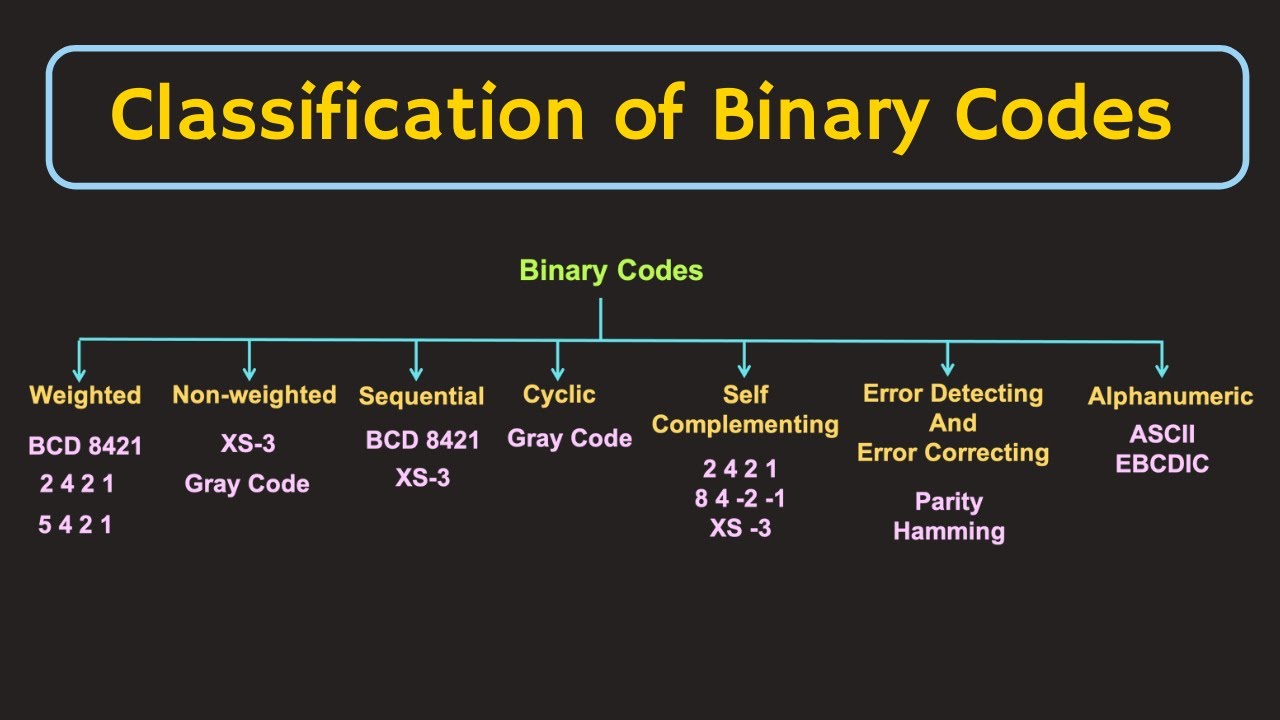
This video introduces the fundamental concept of binary codes, explaining how they represent data using ones and zeros. It categorizes binary codes into two main types: numeric and alphanumeric. Numeric codes are further classified based on properties like weighting (weighted vs. non-weighted), sequence (sequential), bit changes between successive codes (cyclic), and self-complementing characteristics. The video also briefly touches upon error detection and correction codes. This foundational understanding prepares viewers for more detailed explorations of specific binary codes in subsequent videos.
How was this?
Save this permanently with flashcards, quizzes, and AI chat
Chapters
- Binary codes represent numbers, letters, or characters using combinations of ones and zeros.
- Different binary codes have evolved over time to represent information efficiently.
- Binary codes are broadly classified into numeric and alphanumeric categories.
Understanding binary codes is crucial as they form the basis of all digital information processing and communication.
Representing letters like 'A' or numbers like '5' using sequences of 0s and 1s.
- Numeric binary codes represent numerical data (0-9).
- Alphanumeric binary codes represent letters, numbers, and special characters.
- ASCII is a popular alphanumeric code used for data transmission between computers and I/O devices.
This distinction helps in understanding the specific purpose and application of different coding schemes.
ASCII code being used to send a typed character from a keyboard to a computer.
- Numeric codes can be weighted or non-weighted.
- Weighted codes assign a specific positional weight to each bit (e.g., 8, 4, 2, 1 in BCD 8421).
- The sum of the weights where a bit is '1' determines the decimal equivalent.
- Non-weighted codes, like XS3 and Gray code, do not follow a positional weighting principle.
The weighting scheme determines how a binary sequence is converted to its decimal equivalent, impacting calculation and interpretation.
In BCD 8421, the code '0111' (4+2+1) represents the decimal number 7.
- Weighted codes can be positive (e.g., BCD 8421, 5421) or negative (e.g., 84(-2)(-1)).
- Positive weighted codes use only positive positional weights.
- Negative weighted codes incorporate negative weights for certain positions.
Understanding positive and negative weighted codes expands the possibilities for representing numbers and can lead to more efficient or specialized encoding schemes.
The negative weighted code 84(-2)(-1) representing decimal 1 as '0111' (4 - 2 - 1 = 1).
- Non-weighted codes do not adhere to positional weighting.
- Examples include XS3 (Excess-3) and Gray code.
- Sequential codes, like BCD 8421 and XS3, increment by one binary number for each successive decimal digit.
- Cyclic codes, like Gray code, change only one bit position between successive codes, useful for preventing errors in mechanical encoders.
These codes offer different advantages, such as simpler transitions (Gray code) or unique mathematical properties (XS3), making them suitable for specific applications.
Gray code's property where decimal 3 ('0010') and decimal 4 ('0110') differ by only one bit.
- Self-complementing codes have the property that their 9's complement can be obtained by inverting the bits of the original code.
- XS3 and 84(-2)(-1) are examples of self-complementing codes.
- Error detecting codes, like those using parity bits, help identify if data has been corrupted during transmission.
- Error correcting codes (e.g., Hamming codes) can not only detect but also fix errors.
Self-complementing codes simplify certain arithmetic operations, while error detection/correction mechanisms are vital for reliable digital communication.
In XS3 code, flipping the bits of the code for 0 ('0011') results in the code for 9 ('1100').
Key takeaways
- Binary codes are the foundation for representing all digital information.
- Codes are broadly categorized into numeric and alphanumeric, serving different data types.
- Weighted codes rely on positional values, while non-weighted codes have other defining characteristics.
- Sequential codes ensure smooth transitions between representations of consecutive numbers.
- Cyclic codes minimize bit changes between adjacent values, crucial for certain hardware.
- Self-complementing codes simplify the calculation of 9's complements.
- Error detection and correction codes are essential for ensuring data integrity in digital systems.
Key terms
Binary CodeNumeric Binary CodeAlphanumeric Binary CodeWeighted CodeNon-Weighted CodeBCD (Binary Coded Decimal)Sequential CodeCyclic CodeSelf-Complementing CodeError Detection CodeError Correction Code
Test your understanding
- What is the fundamental difference between numeric and alphanumeric binary codes?
- How does a weighted binary code like BCD 8421 represent a decimal number?
- Why are cyclic codes, such as the Gray code, useful in certain applications?
- What property defines a self-complementing code, and why is it significant?
- How do error detection codes differ from error correction codes?